
The “tried and true” method your neighbor used twenty years ago might actually be the fastest way to sink your property value today. Watching a sidewalk settle or seeing water pool near your foundation creates a specific kind of anxiety for any Arkansas homeowner. You want the tripping hazard gone and your curb appeal restored, but conflicting advice makes the choice between mudjacking vs poly leveling feel like a high-stakes gamble. It’s frustrating when you’re looking for a permanent fix but keep hearing about “quick patches” that often fail after a single rainy season in our heavy local soils.
You deserve a level, safe surface that stays put without the mess of a construction zone. This guide clarifies the critical differences between traditional mudjacking and modern polyurethane leveling so you can choose the most durable, cost-effective solution for your home in 2026. We will look at how these methods interact with Central Arkansas clay, compare the long-term value of each, and explain why the weight of your repair material determines if your concrete stays level for good. You’ll gain the technical clarity needed to transform that sinking feeling into the security of a stable, permanent home repair.
Concrete slabs don’t just sink on their own. In Central Arkansas, from the neighborhoods of Little Rock to the lakeside properties in Hot Springs, the culprit is almost always the soil beneath your feet. Our region’s high clay content and frequent heavy rains create a cycle of expansion and contraction. Over time, this movement leads to soil erosion and compaction, leaving empty pockets or “voids” under your driveway, pool deck, or sidewalk. Without support, the heavy concrete eventually gives way, creating the cracks and uneven surfaces you see today.
When you start researching repairs, you’ll quickly encounter the debate of mudjacking vs poly leveling. Mudjacking is the traditional approach, involving a mixture of water, soil, sand, and cement pumped under the slab. Poly leveling, also known as polyjacking, utilizes a high-density, expanding polyurethane foam to achieve the same lift. Choosing between them isn’t just about the immediate result; it’s about the long-term health of your property. Selecting a method that doesn’t account for Arkansas soil conditions often leads to repeat failures within 24 months, forcing you to pay for the same repair twice.
Mudjacking became the industry standard in the mid-20th century because it was a significant improvement over completely replacing concrete. It provided a functional way to fill large voids using readily available materials. However, as structural engineering advanced, professionals began looking for lighter alternatives that wouldn’t put extra stress on weak soil. Polyurethane was originally reserved for heavy industrial applications, such as stabilizing bridge approaches and highway sections. Today, this technology is the preferred residential choice because it addresses the root cause of sinking without the massive weight of traditional cement slurries.
The physical differences between these two methods are obvious the moment the work begins. Mudjacking requires heavy equipment to mix and pump a thick, liquid slurry. Because this material is so dense, contractors must drill large access holes, often up to 2 inches in diameter, to move the mixture under the slab. These large “scars” remain visible even after they’re patched.
Polyurethane concrete leveling is a minimally invasive structural solution that restores slab integrity without the bulk of traditional methods. The foam expands rapidly to fill every corner of the void, providing a precise lift while using holes no larger than a penny. This modern approach ensures your property remains safe and visually appealing without the mess of a construction site.
Understanding the mechanics of mudjacking vs poly leveling helps you visualize why one method outlasts the other in our humid Arkansas climate. While both processes aim to restore a level surface, the physics behind the lift couldn’t be more different. Mudjacking is a brute-force approach that uses heavy machinery to shove a thick mixture of sand and cement into the dark spaces under your home. Poly leveling, however, uses chemical expansion to gently and precisely fill every gap.
The process begins with drilling. For mudjacking, a contractor drills several large holes, usually two inches in diameter, across your slab. These large openings can actually create stress points in the concrete. We take a different approach with polyurethane, drilling tiny 5/8-inch holes that are easily hidden. Once the holes are ready, the material is injected. Mudjacking relies on high-pressure pumps to move the heavy slurry, while poly leveling involves a liquid injection that expands on its own. This expansion allows us to monitor the lift in real-time, making tiny, incremental adjustments until the slab is perfectly flush with the surrounding concrete. Finally, we patch the holes with a color-matched cement, leaving your driveway looking clean rather than like a patched-up construction zone.
Polyurethane foam is unique because it expands 7 to 14 times its original liquid volume within seconds of injection. This powerful expansion force allows the foam to travel into “hidden” voids and tight crevices that a thick mudjacking slurry simply can’t reach. While mudjacking only fills the areas directly in the path of the pump’s pressure, polyurethane flows like water before expanding into a rigid, structural foam. This ensures 100 percent coverage under the slab, which is vital for preventing future soil erosion. If you’re ready to see the difference for yourself, a complimentary initial assessment can identify exactly where those hidden voids are hiding under your concrete.
Downtime is a significant concern for busy families in Little Rock or commercial property owners in Hot Springs. Mudjacking requires patience, as the heavy slurry needs anywhere from 24 to 72 hours to fully harden and support weight. If you drive on it too soon, you risk shifting the material and ruining the repair. Poly leveling offers a massive advantage here. The high-density foam reaches 90 percent of its full strength in just 15 to 30 minutes. You can park your car on the driveway or open your storefront to customers before our technicians have even finished packing up their tools. This speed makes it the logical choice for high-traffic areas that can’t afford to be out of commission for days.
Arkansas homeowners face a unique structural challenge: red clay. This soil is notorious for its extreme volume changes. During our heavy spring rains, the clay absorbs moisture and expands, putting upward pressure on your concrete slabs. In the dry heat of July and August, it shrinks significantly, leaving large gaps or “voids” behind. This constant movement is the primary reason your driveway or pool deck started sinking in the first place. When you compare mudjacking vs poly leveling, you have to consider how each material interacts with this volatile environment.
The weight of the repair material is where these two methods diverge most sharply. Mudjacking adds a massive amount of weight to soil that has already proven it can’t support the concrete above it. A cubic foot of mudjacking slurry weighs over 100 pounds. In contrast, high-density polyurethane foam weighs only 2 to 4 pounds per cubic foot. By choosing a heavy cement-based filler, you risk “secondary sinking,” where the added weight of the repair actually causes the soil to compress and settle even further. If you’re looking for polyjacking near me, you’ll find that our local expertise focuses on using these lightweight materials to avoid this exact paradox. We understand that adding more weight to weak Arkansas soil is rarely the right answer.
Polyurethane isn’t just a filler; it’s a stabilizer. As the liquid foam expands, it permeates loose soil and binds particles together into a solid, waterproof “crust.” This creates a foundation that resists future erosion. Traditional mudjacking slurry is essentially a mixture of dirt and cement. During a typical Arkansas thunderstorm, water can seep under the slab and slowly wash that slurry away. This leaves you right back where you started with a sunken slab and a tripping hazard. Polyurethane is impervious to water, so it won’t wash out or degrade regardless of how much rain falls.
Our region experiences significant temperature swings that can wreak havoc on rigid repair materials. In communities like Malvern and Conway, the winter freeze-thaw cycles cause ground movement that can easily crack brittle mudjacking patches. Similarly, extreme summer heat can cause cement slurries to shrink and pull away from the concrete. Polyurethane remains slightly flexible even after it cures. This allow it to move naturally with the slab during thermal changes without losing its structural integrity. It’s a durable solution designed to handle the specific climate of Central Arkansas.
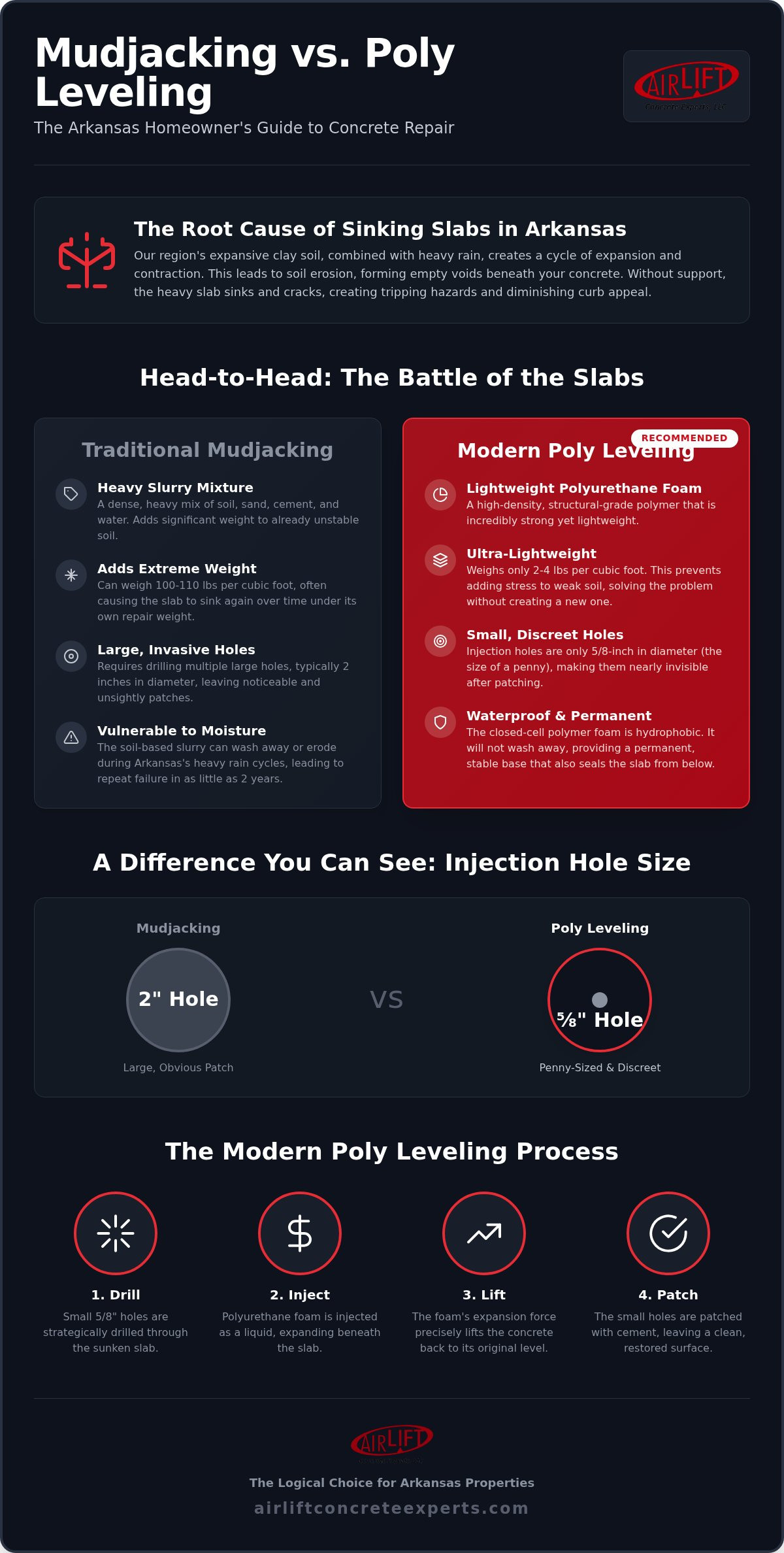
When comparing the initial quotes for mudjacking vs poly leveling, it’s easy to fall into the “Penny Wise, Pound Foolish” trap. Mudjacking often carries a lower upfront price tag, which appeals to homeowners facing unexpected repair costs. However, looking at the 10-year repair cycle reveals a different story. In the moisture-heavy environment of Central Arkansas, mudjacking repairs typically last only two to five years before the heavy slurry settles or washes away. You might find yourself paying for the exact same repair three times over a decade, whereas a single polyurethane application is a permanent fix.
Your property’s resale value also hinges on the quality of these repairs. If you’re preparing for a home inspection in Little Rock, the visual evidence of the work matters. Mudjacking leaves behind large, two-inch circular scars that signal a history of structural struggle to potential buyers. Poly leveling uses tiny injection points that are nearly invisible once color-matched. These small details suggest a high-end, professional maintenance approach, instilling confidence in buyers rather than raising red flags about future sinking. Beyond aesthetics, modern polyurethane foams are an eco-friendly choice, often formulated with recycled materials that won’t leach harmful chemicals into your soil or local groundwater.
The lifespan of your repair is determined by how the material handles the environment. Mudjacking relies on organic soil and cement that eventually breaks down or shifts. Because high-density foam is a synthetic, closed-cell material, it’s essentially permanent. It doesn’t rot, lose its shape, or compress over time. At Airlift Concrete Experts, we prioritize these “one and done” solutions because we know our neighbors value their time as much as their money. We aim to fix the problem once so you can stop worrying about your foundation for good.
Traditional concrete raising is a dirty process. It involves heavy hoses, spilled slurry, and significant amounts of drill dust that can coat your siding and windows. This “construction site” feel can be particularly hard on your landscaping and nearby flower beds. Poly leveling is a self-contained, clean process. The material is contained within the injection equipment until it’s under the slab, leaving virtually no surface residue. This ensures your manicured lawn remains undisturbed during the repair. If you’re ready to restore your concrete without the mess, you can schedule a complimentary initial assessment to get started today.
When you weigh the long-term health of your property, the decision between mudjacking vs poly leveling becomes a matter of logic rather than just upfront cost. Arkansas soil demands a solution that is as resilient as the people who live here. As a family-owned and operated business since 2017, we’ve seen how traditional repairs often buckle under the pressure of our regional red clay. The lightweight and waterproof nature of polyurethane foam simply outperforms the heavy, temporary nature of old-school slurry. We’ve dedicated our expertise to this modern technology because it protects your home’s equity and your family’s safety for the long haul.
Precision is paramount when you’re dealing with delicate areas like pool decks or interior floor leveling. A pool deck that’s off by even half an inch creates a major safety hazard, and the heavy weight of mudjacking can cause further stress on the pool shell. For our commercial partners in North Little Rock, the primary benefit is operational momentum. Business owners can’t afford to close their doors for days while a cement mixture cures. Our specialized concrete lifting services allow for immediate foot and vehicle traffic. This ensures your operations keep moving without a hitch, whether you’re managing a retail storefront or a busy warehouse.
We believe in transparency and straightforward communication. When you request a visit from Airlift Concrete Experts, you aren’t just getting a quote; you’re receiving a professional structural evaluation. Our technicians don’t just look at the surface cracks. We investigate the root cause of the sinking, whether it’s poor drainage, soil compaction, or erosion from seasonal rain cycles. This solution-oriented approach ensures that we aren’t just patching a symptom but providing a permanent fix that won’t require a revisit in two years. You’ll receive a clear explanation of the repair process and a detailed plan to stabilize your concrete for good.
We treat every property in Little Rock, Malvern, and Hot Springs like it’s our own. Our goal is to transform your structural anxiety into a sense of security. By choosing a partner who understands the specific environmental challenges of Central Arkansas, you’re investing in the long-term stability of your home. We’re proud to be the regional authority in polyurethane technology, and we’re ready to help you restore your property’s safety and curb appeal with a method that actually lasts.
Choosing between mudjacking vs poly leveling is a choice between a short-term patch and a permanent structural upgrade. We’ve seen how the heavy weight of traditional slurry often fails in our local red clay, while high-density polyurethane foam provides a lightweight, waterproof foundation that stays level. You don’t have to settle for tripping hazards or unsightly drill holes when a cleaner, more durable solution exists. Our specialized methods ensure your repairs survive the specific moisture cycles of Central Arkansas.
At Airlift Concrete Experts, we’re proud to be a family-owned team serving Little Rock, Malvern, and our surrounding communities. We use advanced high-density technology to ensure your driveway, pool deck, or sidewalk remains safe and stable for years to come. Our neighborly approach means we focus on finding the root cause of your sinking concrete before we ever start the repair. It’s time to stop worrying about property value and start enjoying a level, safe surface again.
Schedule Your Free Concrete Leveling Assessment Today and let our local experts provide the clarity you need to move forward with confidence. We’re ready to help you protect your investment.
When comparing mudjacking vs poly leveling, poly leveling typically has a higher upfront cost but offers better long-term value. While mudjacking might seem cheaper initially, its tendency to fail in Arkansas clay often results in repeat repairs. Polyurethane is a one and done investment that saves you money over a 10-year cycle by eliminating the need for recurring maintenance. We focus on providing the most durable solution for our neighbors in Little Rock and Malvern.
Yes, high-density polyurethane foam is specifically engineered to support heavy loads, including commercial vehicles and large RVs. Once the material cures, it provides a rigid, structural base that distributes weight evenly across the soil. This strength makes it an ideal choice for driveway leveling in residential areas like Bryant and Benton, where homeowners often park heavy equipment or recreational vehicles on their concrete surfaces.
Polyurethane concrete leveling is designed to be a permanent solution that lasts as long as the concrete itself. Unlike mudjacking slurry, which can decompose or wash away during heavy Arkansas rainstorms, high-density foam is a closed-cell material that does not rot or lose its shape. It remains stable beneath your slab indefinitely, providing consistent support through decades of seasonal temperature changes and shifting soil conditions.
The injection holes are remarkably discreet, measuring only 5/8 of an inch in diameter, which is about the size of a penny. After the leveling process is complete, our technicians fill these small openings with a color-matched cement grout. This makes the repair points nearly invisible to the naked eye. This aesthetic advantage is a key factor when comparing mudjacking vs poly leveling, as mudjacking requires much larger, more unsightly drill holes.
Yes, the specialized polyurethane foam we use is environmentally inert and safe for your property. Once cured, it does not leach chemicals into the surrounding soil or groundwater, making it a responsible choice for homes near the lakes in Hot Springs or delicate landscaping in Conway. The material is designed to stay exactly where it’s injected, providing structural stability without harming your local ecosystem or garden beds.
Mudjacking often struggles in Central Arkansas because the heavy cement slurry adds significant weight to our already unstable red clay. This extra mass can actually accelerate the sinking process, especially during wet seasons in North Little Rock or Sherwood. While mudjacking provides a temporary lift, it doesn’t stabilize the soil like polyurethane does. This often leads to the slab settling again within just a few years of the repair.
We address the root cause of sinking to prevent recurrence. In the rare event that a slab shifts due to extreme environmental changes, our team evaluates the site to determine if additional soil stabilization is necessary. Because our polyurethane foam binds with the soil, it usually prevents the erosion that causes secondary sinking. We stand by our work in communities from Cabot to Jacksonville to ensure your peace of mind.
Professional polyjacking requires specialized equipment and technical expertise that DIY kits simply cannot provide. Residential kits often lack the expansion force and high-density properties needed to lift heavy concrete slabs safely. Improper application can lead to cracked concrete or uneven surfaces that are much more expensive to fix later. Airlift Concrete Experts provides the professional precision required to ensure your driveway or sidewalk is restored correctly the first time.

 Call Now