
Arkansas red clay is more than just a local trademark; it’s a relentless force that can quietly undermine the very foundation of your home. When you notice a tripping hazard on your sidewalk or see water pooling toward your crawlspace, it’s natural to feel a sense of dread. You’ve likely worried that the only solution is to jackhammer the old concrete and start over. However, modern foundation slab jacking Arkansas homeowners trust has changed the game. We understand that your home is your most significant investment, and seeing cracks in your interior slab can be deeply unsettling.
The good news is that you don’t have to endure the noise, mess, or high cost of a full replacement. In this 2026 guide, you’ll discover how high-density polyurethane foam injection provides a surgical, long-lasting fix for sunken surfaces. We’ll walk you through the science of soil stabilization and explain how our specialized process restores your property’s safety with materials that cure to 90% strength in under 15 minutes. You’ll learn how to achieve a level, safe surface with minimal disruption to your landscaping or daily routine, ensuring your property remains stable for decades to come.
When you ask What is Foundation Slab Jacking, you’re looking for a way to restore your home’s stability without the chaos of a full demolition. In its simplest form, slab jacking is the process of raising sunken concrete by injecting specialized material beneath the surface. For homeowners dealing with foundation slab jacking Arkansas challenges, this method provides a precise solution to a problem that often feels overwhelming. It’s a surgical approach to repair that avoids the mess of traditional construction.
The primary culprit behind sunken driveways in Little Rock or uneven patios in Hot Springs is our state’s notorious red clay. This soil is highly plastic, meaning it’s incredibly sensitive to moisture levels. When it rains, the clay expands with immense force. When it dries out, it shrinks back, leaving the concrete above it unsupported. This constant movement is why traditional slabs across Central Arkansas are so prone to settlement and cracking over time.
It helps to distinguish between structural foundation lifting and cosmetic slab leveling. While both use similar principles, cosmetic leveling focuses on surfaces like sidewalks, driveways, and pool decks to remove tripping hazards. Structural lifting addresses the deeper supports of your home’s interior floor. Both are essential for maintaining property value, but they serve different roles in your home’s overall health and safety.
Our local weather plays a significant role in how your concrete behaves. Heavy spring rains often lead to soil washout, where water physically carries away the fine particles beneath your slab. Conversely, summer droughts cause the soil to shrink and pull away from the concrete, leading to a visible “drop.” In cities like Malvern and Conway, these localized geological features require an expert assessment to ensure the repair matches the specific soil conditions of your neighborhood.
Voids are air pockets that form beneath your garage or patio floor. While you can’t see them from the surface, they’re the primary reason a slab eventually cracks or collapses. Ignoring a small crack might seem harmless, but it often indicates a much larger void that could lead to a total slab failure if the concrete loses its support. Soil consolidation is the primary cause of Arkansas slab failure, occurring when the ground becomes more compact and loses its ability to support the weight of the concrete.
Modern concrete repair has moved far beyond the heavy, messy methods of the past. High-density polyurethane foam injection is a sophisticated two-part solution that combines at the tip of an injection gun. Once these components meet, they trigger a chemical reaction that creates a powerful hydraulic lift. This process is the gold standard for foundation slab jacking Arkansas homeowners rely on, as it addresses the root cause of settlement by filling the invisible voids beneath the surface before the lifting begins. It’s a clean, efficient way to restore stability without the need for heavy machinery.
The expansion process is the key to a successful repair. As the liquid foam enters the space beneath the concrete, it flows into every crevice and air pocket. Once it meets resistance, it begins to exert upward pressure. This allows technicians to achieve precision leveling within a tenth of an inch. Because the material is closed-cell and hydrophobic, it’s completely impervious to groundwater. When performing foundation slab jacking Arkansas experts prioritize this material because it remains stable regardless of soil moisture levels. Reviewing data on Arkansas Soil Properties confirms that our red clay is highly reactive, but polyurethane won’t wash away or degrade over time.
Traditional methods like mudjacking use a heavy slurry of sand, water, and cement. This adds significant weight to already struggling soil. Polyurethane is remarkably lightweight, adding only 3-5 lbs per cubic foot compared to the 100+ lbs associated with mud. By not overloading the soil, you reduce the risk of future settlement. Additionally, the cure time is incredibly fast. Most surfaces are ready for full weight-bearing traffic, including heavy vehicles, in under 15 minutes. This non-toxic, environmentally safe solution ensures your family and landscaping are never exposed to harmful chemicals.
The physical footprint of a foam repair is almost invisible. Technicians drill penny-sized entry points in the concrete, which are significantly smaller than the large ports required for older methods. During the injection, our team monitors the lift in real-time, using laser levels to ensure the slab returns to its original position without over-lifting. Once the work is complete, we patch the small holes with a concrete mixture that blends with your existing surface. If you’re ready to see how this technology can restore your property, you can schedule a free initial assessment with our local specialists.
Choosing the right repair method is a balance between long-term durability and immediate value. While many homeowners assume that a cracked driveway requires a full replacement, foundation slab jacking Arkansas experts often recommend a more targeted approach. Replacing a slab is a massive undertaking that usually costs 50-70% more than professional leveling. More importantly, simply pouring new concrete ignores the underlying soil instability that caused the original sink. If the soil remains unaddressed, your brand-new slab will likely begin to settle within a few years, leading to the same frustrating issues all over again.
Traditional mudjacking has been around for decades, but it’s increasingly viewed as an outdated solution for the unique challenges of Arkansas. While mudjacking uses a heavy slurry of sand and cement, modern “polyjacking” utilizes high-density foam. In our humid climate, foam offers a distinct advantage because it won’t wash away or erode when the water table rises. It provides a permanent, waterproof support system that remains stable regardless of the weather. By choosing foundation slab jacking Arkansas residents ensure their repair lasts for decades rather than just a few seasons.
Determining whether a slab can be saved depends on its overall health. If the concrete is mostly intact but has simply shifted or sunken, it’s an ideal candidate for leveling. This approach avoids the mess factor of heavy machinery that can destroy your landscaping and leave ruts in your lawn. Choosing to level rather than replace is also the more sustainable choice. It reduces your carbon footprint by keeping existing materials out of landfills and eliminating the need for the energy-intensive production of new concrete.
The weight of the repair material is a critical factor when dealing with soft Arkansas clay. Adding a heavy mud slurry can actually accelerate further sinking because the extra weight puts even more pressure on the unstable soil. Additionally, the organic materials often found in mudjacking mixtures can decay or shrink over time, leading to a much shorter lifespan for the repair. While mudjacking requires drilling holes the size of a soda can, polyurethane injection uses holes no larger than a penny to achieve superior results.
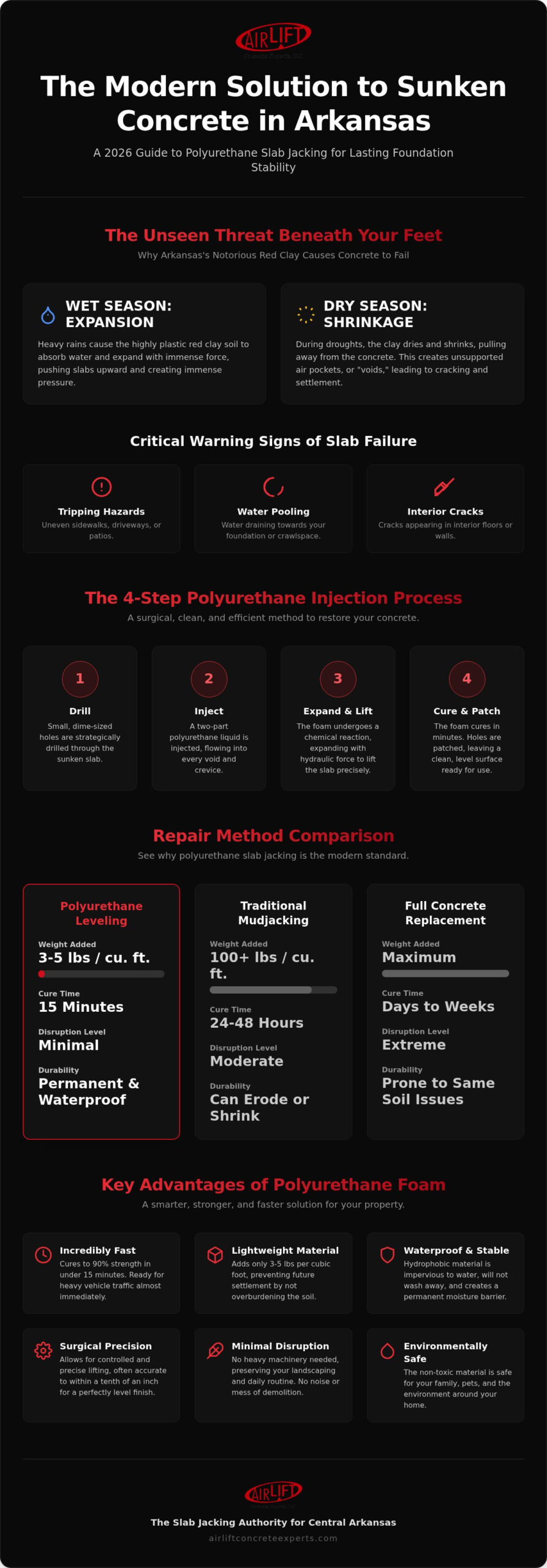
Identifying the early warning signs of slab failure can save you from the stress and expense of major structural damage. While some issues are obvious, others are subtle shifts that happen over months or years. For residents considering foundation slab jacking Arkansas, the most common red flag is the development of uneven joints between concrete sections. These offsets create dangerous tripping hazards on sidewalks and driveways, often becoming more pronounced after heavy rain or during the dry summer months. When one section of concrete sits higher than the neighbor, it’s a clear signal that the supporting soil has shifted.
Inside your home, you might notice cracks appearing in your interior slab floors. These are especially concerning when they occur under carpet, vinyl, or tile, as they often indicate the ground is no longer supporting the weight of the structure. Another clear sign is the formation of gaps between your floor and baseboards. If you can see light or feel a draft coming from the bottom of a wall, your slab has likely settled. Additionally, watch for water pooling in garage corners or against the exterior of your house. This redirected drainage often points to a slope change caused by sinking concrete, which can lead to further erosion if left unaddressed.
A sinking slab foundation doesn’t just affect the ground; it impacts the entire geometry of your home. When a portion of your floor drops, it pulls on the surrounding walls, often causing interior door frames to shift out of alignment. If you have a door that suddenly sticks or won’t latch properly, it’s frequently a symptom of floor settlement rather than a problem with the door itself. You may also notice small cracks in the drywall that seem to start at the floor level and work their way up. For a deeper look at how these issues relate to the broader health of your home, check out our guide on Foundation Repair Near Me to understand the structural context of Arkansas soil and safety.
On the outside of your property, look for separation between your porch or steps and the main house structure. A gap of even half an inch suggests that the soil beneath the porch slab has consolidated or washed away. Sloping driveways that pull away from the garage threshold are another major indicator that you need professional leveling. Finally, keep an eye out for visible voids appearing under the edges of your concrete. These air pockets are invitations for pests and further soil erosion. If you’ve noticed any of these red flags, we encourage you to request a complimentary initial assessment from our local team to protect your property’s value.
Airlift Concrete Experts represents a unique blend of family-owned values and cutting-edge patented technology. Since 2017, we’ve served our neighbors with a commitment to integrity that only a local specialist can provide. While national competitors might offer a one-size-fits-all approach, we understand that foundation slab jacking Arkansas projects require a deeper understanding of our regional soil. Our team is based in Malvern, but our reach extends across the heart of the state, ensuring that every homeowner receives the specialized care they deserve. We take pride in being a stable, reliable partner for property maintenance throughout the region.
The “Airlift Advantage” lies in our technical precision and the specialized materials we use. We don’t just inject generic foam; we utilize custom-engineered polyurethane designed to interact specifically with Arkansas’s volatile clay soils. This allows us to achieve a lift accuracy within a tenth of an inch, restoring your concrete to its original position without the guesswork. We prioritize transparency in every interaction, starting with a free initial assessment that provides a clear project scope and a predictable path to a permanent repair. Our goal is to transform your structural anxiety into a sense of long-term security.
Our capabilities extend far beyond residential driveways and sidewalks. We handle heavy-duty slab jacking for Arkansas industrial sites where structural stability is critical for daily operations and safety. One of our most specialized services is grain bin floor lifting, a technical process that requires extreme precision to ensure the structural integrity of agricultural storage. We also provide technical injection consulting for complex structural projects, helping commercial property owners navigate the challenges of soil consolidation and void filling under heavy loads. This level of expertise ensures that even the most demanding industrial floors are restored to their original specifications.
Our deep roots in the community mean we’re familiar with the specific environmental challenges faced by residents in Little Rock, Hot Springs, Benton, and Bryant. We also regularly serve customers in Cabot and Jacksonville, bringing our local knowledge of Arkansas weather patterns to every job site. We know how a rainy spring can impact the soil in one neighborhood differently than a dry summer in another. This regional expertise informs our repair strategy, ensuring that your concrete remains level and safe for the long haul. If you’re ready to restore your property’s stability, Schedule your free concrete assessment today and partner with a team that treats you like a neighbor.
Dealing with sunken concrete doesn’t have to be a source of constant stress for your family. We’ve explored how the volatile nature of our regional soil requires a specialized response, and how polyurethane foam provides a lightweight, durable alternative to heavy mudjacking or costly replacement. By choosing foundation slab jacking Arkansas homeowners can address the root cause of settlement with surgical precision. This modern approach ensures your sidewalks, driveways, and interior floors remain level for decades without the mess of traditional construction.
As a locally owned and operated team in Malvern, Airlift Concrete Experts is deeply invested in the safety of our community. We use a patented polyurethane leveling process that has been voted best in Arkansas for structural integrity. Our experts are ready to help you eliminate tripping hazards and protect your home’s value with minimal disruption to your daily life. Don’t let a sinking slab become a bigger structural issue. Request Your Free Concrete Lifting Estimate today and take the first step toward a safer, more stable property. We look forward to being your partner in maintaining a secure home.
Polyurethane foam injection is considered a permanent solution for concrete restoration because the material is hydrophobic. Unlike traditional mudjacking slurry, this high-density foam doesn’t wash away during heavy Arkansas rains or break down over time in the soil. It maintains its structural integrity and compressive strength for decades. While we can’t stop the earth from moving, the foam remains a stable, solid base that continues to support your slab long after the initial repair.
The cost of foundation slab jacking Arkansas homeowners encounter depends on the slab size and the volume of the underlying void. While we don’t provide flat-rate pricing without an inspection, this method is typically 50% to 70% more affordable than a full concrete replacement. Factors like the degree of the lift and the project location in Little Rock or Hot Springs influence the final estimate. We always provide a complimentary initial assessment to ensure transparency.
Slab jacking is designed to lift the concrete and close the gaps between separated sections, but it doesn’t physically heal the existing cracks. When we raise the sunken portion to its original height, the cracks often pull back together and become much less noticeable. However, the physical fracture in the concrete remains. We recommend that homeowners in Benton seal these cracks after the leveling process to prevent water from reaching the soil and causing future erosion.
You can typically drive on your leveled driveway in as little as 15 to 30 minutes after the injection is complete. Our high-density polyurethane foam cures to 90% of its full strength almost immediately upon expansion. This is a significant advantage over traditional concrete replacement, which often requires you to stay off the surface for several days. This rapid cure time ensures minimal disruption to your daily routine in busy areas like North Little Rock or Sherwood.
Modern polyurethane injection foams are environmentally safe and completely inert once they’ve cured beneath the slab. The material doesn’t leach harmful chemicals into the surrounding soil or groundwater, making it safe for use near your garden, lawn, or landscaping. This non-toxic nature is a primary reason why many homeowners in Bryant and Cabot choose foam over other chemical stabilizers. It provides a robust structural solution without compromising the health of your local ecosystem or property.
Slab jacking specifically addresses “slab-on-grade” concrete like driveways, patios, and garage floors by injecting material directly beneath them. House leveling, or foundation repair, often involves installing piers or beams to stabilize the deep structural footprint of a home. While foundation slab jacking Arkansas specialists focus on surface-level restoration, house leveling is a more intensive process used when the actual frame of the home has shifted due to deep soil movement or structural failure.
Most residential projects, such as a standard two-car driveway or a backyard patio, are completed in just a few hours. Our technicians arrive with a self-contained mobile unit, drill the necessary injection holes, and perform the lift with real-time monitoring. Because there’s no need for heavy excavation or long drying periods, your property is restored in a single morning or afternoon. This efficiency makes it a preferred choice for homeowners in Jacksonville and Hot Springs Village.
Yes, our polyurethane material is hydrophobic, which means it’s designed to work effectively even in the presence of water. It won’t mix with groundwater or lose its lifting power during a typical Arkansas rainstorm. While we monitor site conditions for extreme weather events, the injection process is robust enough to handle the damp soil conditions common in Conway and Malvern. This allows us to maintain a steady repair schedule throughout the year, regardless of seasonal humidity.

 Call Now