

That uneven crack in your driveway isn’t just an eyesore; it’s a clear signal that the infamous Arkansas Red Clay is shifting beneath your home. You probably feel a pang of anxiety every time you see water pooling near your foundation or notice a guest stumble on a jagged sidewalk edge. It’s frustrating to watch your property’s value and safety decline because of soil conditions you can’t control in 2026. Addressing these issues early with sunken slab foundation repair Jacksonville specialists is the best way to prevent minor settling from turning into a major structural headache.
You don’t have to settle for the mess and expense of tearing out and replacing your concrete. This guide will show you how to permanently level your surfaces and stabilize the underlying soil using advanced polyurethane technology. By choosing this modern approach, you’ll gain a level, safe concrete surface without the days of downtime required by traditional methods. We’ll explore why Jacksonville’s unique environment causes these shifts. You will also see how a non-invasive repair can restore your peace of mind in just a few hours.
A sunken slab is a concrete section that has lost its structural support and dropped below its original grade. This isn’t just a surface issue; it’s a physical failure caused by empty pockets or voids in the ground below. In Jacksonville, the primary culprit is Arkansas Red Clay. This specific soil is highly expansive, meaning it swells significantly when wet and shrinks drastically during our hot, dry summers. These constant volume changes create a volatile environment for any concrete structure, from your front sidewalk to your garage floor. While surface-level wear like flaking or staining is cosmetic, a sinking slab indicates a deep-seated structural problem that requires professional attention.
Basic Foundation engineering principles teach us that a slab is only as stable as the ground beneath it. When the soil shifts, the concrete must follow. In our region, hydrostatic pressure and poor drainage act as the primary catalysts for this movement. When water isn’t directed away from the home, it saturates the clay, causing it to push upward or wash away entirely, leaving the slab hanging in the air.
Central Arkansas weather is famous for its “Drought-to-Deluge” cycles, which are particularly hard on concrete. During heavy spring rain, water can quickly wash away the sub-grade soil that supports your driveway or patio. Once the rain stops and a drought begins, the remaining clay shrinks and pulls away from the concrete. In Jacksonville, soil failure occurs when the ground can no longer support the weight of the slab due to moisture-driven volume changes and a loss of compaction. This seasonal transition is when most homeowners first notice gaps appearing between their concrete and their home’s siding.
Soil voids are literal gaps of air where solid earth used to be. They form through erosion or when poorly compacted soil settles over time. A dangerous phenomenon called “bridging” occurs when your concrete slab hangs over one of these empty spaces without any support from below. It might look solid, but it’s essentially a bridge without pillars. Eventually, the weight of a vehicle or even a person causes the concrete to snap and sink into the void. Ignoring a small one inch drop is a common mistake; that minor shift indicates the underlying support system has already failed. Without timely sunken slab foundation repair Jacksonville properties often suffer from massive structural cracks as those hidden voids expand and the concrete finally gives way.
When you’re faced with a sinking driveway or uneven patio, you essentially have two repair paths: traditional mudjacking or modern polyurethane foam injection. While both aim to solve the same problem, they work very differently in the context of sunken slab foundation repair Jacksonville projects. Mudjacking has been around for decades, but it relies on a heavy slurry of sand, cement, and soil. In the soft, shifting ground typical of Central Arkansas, adding more weight is often the last thing your property needs. According to data from the Geological Survey of Arkansas, our regional soil composition requires solutions that don’t exacerbate existing settlement issues.
Polyjacking is the superior choice for sunken slab foundation repair Jacksonville homeowners because the high-density foam adds almost zero load to the soil. While mudjacking slurry weighs about 100 pounds per cubic foot, polyurethane foam weighs only 2 to 4 pounds. It’s strong enough to lift a concrete highway yet light enough to keep from sinking further into the clay. Plus, it’s an environmentally friendly option. The foam is inert and won’t leach chemicals into your Arkansas yard, making it safe for pets and gardens. You can even drive your car over a repaired slab just 15 minutes after the process is complete.
The science behind polyjacking lies in the foam’s expansion. Once injected, it travels through every hidden void, expanding to ensure 100% surface contact with the bottom of the slab. This creates a waterproof, durable barrier that won’t wash away during a typical Arkansas thunderstorm. The installation is also much cleaner than older methods. We drill holes the size of a penny, whereas mudjacking requires holes the size of a soda can. This preserves the structural integrity and look of your concrete while providing a permanent fix.
Choosing polyjacking near me is typically 50% cheaper than pouring new concrete. When you replace a slab, you’re paying for more than just the new material. You have to account for demolition, hauling away the old debris, and the inevitable damage to your landscaping. Repairing your existing slab preserves the color and texture of your Jacksonville masonry, ensuring a seamless look for your home’s exterior. It’s a faster, cleaner, and more affordable way to protect your property’s value. If you aren’t sure which method is right for your property, a complimentary initial assessment can provide the clarity you need.
Your home often provides subtle warnings before a structural failure occurs. Many homeowners notice a slight dip in a sidewalk or a small gap near the garage and assume it’s a natural part of a house aging. This leads to the number one misconception we see: the belief that “it’s just settling and will stop on its own.” In the reality of Central Arkansas soil, settlement is rarely a finished process. Because the clay beneath your home expands and contracts with every season, a small 1-inch drop is usually just the beginning of a larger downward trend. Ignoring these early signals won’t make them go away; it only gives the underlying voids more time to grow.
Identifying the need for sunken slab foundation repair Jacksonville starts with a simple walk around your property. You should look for visual symptoms like pooling water near your exterior walls, which indicates the concrete is no longer sloped away from the house. Tripping hazards on your walkways or driveway are more than just a safety risk; they’re clear evidence that the soil has failed to support the weight of the slab. When these exterior slabs sink, they can pull on the connected structure, leading to interior issues like sloping floors or “stair-step” crack patterns in your brickwork.
The most common sign of trouble is an uneven joint where your driveway meets the garage floor. If one side has dropped, it creates a jarring bump every time you pull your car in. Pool decks are also highly susceptible to settlement, often creating dangerous gaps between the concrete and the pool coping which can lead to water leaks and further erosion. Another classic red flag is the appearance of cracks in the brickwork or siding directly above your garage door. This often happens when the heavy garage slab sinks, pulling the surrounding framing and masonry down with it.
For houses built on a concrete slab, the symptoms often move inside. You might notice a growing gap between your baseboards and the floor, or find that your favorite rug suddenly feels like it’s on a hill. Doors that stick, rub against the frame, or refuse to latch properly are also major indicators that the frame is no longer square due to slab movement. If you’re seeing these signs, our guide on foundation repair near me offers a full symptom checklist to help you evaluate the severity. Catching these issues early through a professional sunken slab foundation repair Jacksonville assessment can save you from the stress of a full-scale structural overhaul later.
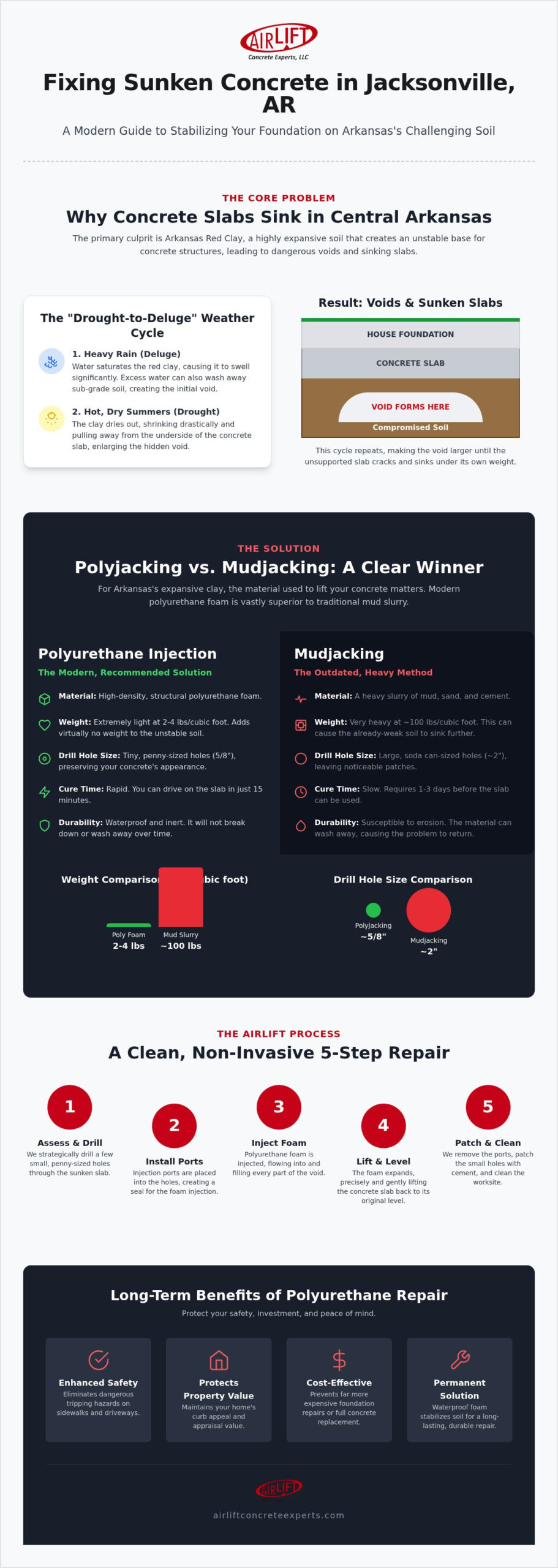
Restoring your home’s safety and curb appeal doesn’t have to be a long, invasive ordeal. We’ve refined a methodical five-step system designed specifically to handle the unique challenges of Arkansas soil. This process ensures that your sunken slab foundation repair Jacksonville project is handled with technical precision and neighborly care. By following a logical progression from diagnosis to cleanup, we transform unstable concrete into a reliable surface once again.
Our approach relies on the predictable behavior of high-density polyurethane. As the foam expands beneath the concrete, it doesn’t just lift the slab; it also compacts the loose, underlying soil to create a more stable base. This dual action addresses both the symptom of the sunken slab and the environmental cause. Once the material cures, the foam becomes a permanent, waterproof support structure that won’t wash away or degrade over time. This level of precision prevents the over-lifting or secondary cracking that often occurs with less controlled repair methods.
You won’t have to deal with the noise of jackhammers or the mess of a demolition crew. Most sunken slab foundation repair Jacksonville projects take less than half a day to complete. Because our equipment is self-contained and our process is quiet, we keep your neighbors and your landscaping happy. The best part is the immediate return on your investment. Since the foam cures in minutes, you can use your driveway or patio the very same afternoon. If you’re ready to see how this process can work for your home, you can schedule your complimentary assessment to get started.
Your home’s exterior is the first thing a potential buyer or appraiser sees. In the 2026 Jacksonville real estate market, curb appeal is a major factor in property valuation. A driveway with jagged edges or a sidewalk that has dropped several inches creates an immediate negative impression. Beyond aesthetics, these issues signal to a buyer that the underlying soil may be unstable. Investing in sunken slab foundation repair Jacksonville services restores that smooth, professional finish while proving that you’ve been a proactive steward of your property’s structural health.
Safety and liability are equally important considerations for any homeowner. A sunken slab isn’t just a nuisance; it’s a legal risk. Uneven concrete surfaces are primary causes of trip-and-fall accidents on residential properties. By leveling these surfaces, you eliminate hazardous edges and ensure a safe path for guests, delivery drivers, and your family. Perhaps most importantly, addressing these surface level issues early prevents the need for more expensive professional foundation repair in the future. When you stabilize the slabs around your home, you’re often preventing water from tracking down toward the main foundation and causing deeper structural shifts.
While our polyurethane foam provides a permanent support structure, maintaining the surrounding environment is key to long-term success. You should regularly inspect your gutter system to ensure runoff is directed at least five to ten feet away from your newly leveled slabs. Standing water is the enemy of Arkansas Red Clay. Additionally, sealing any remaining hairline cracks in the concrete surface prevents water from reaching the sub-grade soil again. Be mindful of your landscaping as well. Large trees or shrubs planted too close to a driveway can pull moisture from the soil during a drought, leading to localized shrinkage and new settlement issues.
Choosing a family-owned specialist like Airlift Concrete Experts offers a level of accountability you won’t find with a national franchise. We’ve been serving Central Arkansas since 2017, and our reputation is built on the stability of the homes we’ve repaired. We understand the specific geological challenges of Jacksonville because we live and work in this community. Our neighborly approach means we provide straightforward solutions without the high-pressure sales tactics of larger corporations. When you see the Airlift name in a real estate listing, it acts as a badge of quality for local buyers. If you’re ready to secure your home’s future, Schedule your free assessment with Airlift Concrete Experts today and let’s ensure your concrete stays level for years to come.
Jacksonville homeowners face a unique challenge with shifting Arkansas Red Clay, but you don’t have to let a sinking driveway or uneven patio diminish your home’s value. By choosing specialized high-density polyurethane technology, you can address the root cause of settlement without the mess and disruption of new construction. This modern approach provides a permanent, waterproof support system that stabilizes your concrete in just a few hours. When you’re ready for professional sunken slab foundation repair Jacksonville, choosing a family-owned authority that has served the region since 2017 ensures lasting results.
Our team at Airlift Concrete Experts provides a zero-mess process that delivers same-day results, allowing you to use your driveway or pool deck the very same afternoon. We’re proud to be a local partner in maintaining the safety and curb appeal of our Central Arkansas communities. You deserve the peace of mind that comes with a level, stable foundation. Take the first step toward a safer home today and Request Your Complimentary Slab Assessment in Jacksonville. We look forward to helping you restore your property with the honest, expert care you expect from a neighbor.
The total investment for sunken slab foundation repair Jacksonville depends on several local variables, including the square footage of the affected area and the volume of polyurethane foam required to fill the underlying voids. Every project is unique because the depth of the settlement varies significantly between properties. We provide a complimentary initial assessment to diagnose the specific needs of your driveway or patio, ensuring you receive a clear understanding of the project scope before any work begins.
Polyurethane foam injection is superior for our local environment because it is significantly lighter than traditional mudjacking slurry. Arkansas Red Clay is highly sensitive to weight; adding a heavy mixture of sand and cement can actually cause further sinking over time. High-density foam adds almost no load to the soil while providing a waterproof, permanent support structure. This modern method is cleaner, faster, and much more effective for the volatile soil conditions found across Central Arkansas.
We can typically lift slabs with multiple cracks as long as the concrete remains structurally sound and hasn’t completely crumbled. The polyurethane foam expands into all hidden voids, supporting each individual section from beneath. While the lift will level the sections and close the gaps, the existing cracks will still be visible and should be sealed afterward to prevent water from reaching the sub-grade. Our technicians can evaluate your specific slab to determine if leveling is the right solution.
Once injected, the high-density polyurethane foam is designed to be a permanent solution. It is a waterproof, inert material that won’t wash away or degrade over time, even during the heavy rainfall cycles we experience in Pulaski County. Unlike traditional mudjacking slurry, which can erode or shrink, the foam maintains its structural integrity and volume indefinitely. This durability ensures your driveway or sidewalk stays level and supported for the remaining life of the concrete.
Repair holes are very discreet and much smaller than those used in older leveling methods. We drill penny-sized access points that are approximately 5/8 of an inch in diameter. After the lifting process is complete, we patch these holes with a durable cementitious grout that blends with your existing concrete. Within a few weeks of weathering, these spots become nearly invisible, preserving the aesthetic appeal of your home’s exterior surfaces and landscaping without the need for total replacement.
Postponing your repair usually leads to more expensive structural issues and increased safety risks. As the soil voids beneath your concrete expand, the slab will continue to sink, eventually causing large structural cracks or a complete collapse. This movement can also put stress on your home’s main foundation, potentially requiring deep-piering solutions later. Addressing the problem now prevents trip-and-fall accidents and stops the cycle of erosion before it impacts your property’s overall structural integrity.
Professionally leveled concrete directly impacts your home’s appraisal and marketability. In the 2026 Jacksonville real estate market, buyers and inspectors look closely at driveways and sidewalks for signs of soil instability. A level, safe entrance enhances curb appeal and instills confidence in potential buyers. By resolving these issues, you protect your equity and ensure the home meets safety standards, which is essential for a smooth closing and a higher valuation in Pulaski County.
Concrete leveling can be performed successfully at any time of year in Arkansas. Our polyurethane technology is not dependent on specific temperatures for a successful cure. However, many homeowners prefer to schedule repairs during the drier summer months when the soil is more stable and less saturated. Regardless of the season, our team monitors local weather patterns to ensure the ground conditions are appropriate for a precise and lasting lift for your property.

 Call Now