

What if the most dangerous part of your home isn’t the steep stairs or the electrical box, but the front walkway you use every single day? In Arkansas, our shifting red clay soil often turns a once-perfect path into a series of hazardous ledges. You’ve likely felt that spike of anxiety when a neighbor walks a little too close to a raised edge, or perhaps you’ve worried that the only solution is an expensive, messy demolition. It’s a common concern for homeowners across Little Rock and Conway who want to maintain a safe, welcoming property without the headache of full concrete replacement.
This guide will show you how to restore safety and curb appeal using modern polyurethane leveling techniques specifically designed for our local environment. You’ll learn how to achieve a level, durable result that stands up to Arkansas weather cycles and meets current ADA standards. We’ll walk through the science of soil stabilization, the benefits of a non-invasive repair process, and why specialized uneven sidewalk repair Arkansas services are the most efficient way to secure your home’s value for years to come. By the end of this article, you’ll understand how to turn a liability back into an asset in just a single afternoon.
Arkansas homeowners often face a unique geological challenge: the infamous red clay. This soil is known for its high plasticity, which means it changes volume significantly based on its moisture content. When the clay gets wet during our heavy spring rains, it expands with immense force. Conversely, during a scorching July in Central Arkansas, the soil shrinks and pulls away from the concrete. This constant movement creates a “shrink-swell” cycle that eventually destabilizes the heavy slabs above, leading to the need for professional uneven sidewalk repair Arkansas services.
Hydrostatic pressure also plays a major role in property maintenance. As water saturates the ground, it exerts upward pressure on the concrete. This pressure can cause slabs to tilt or develop deep-seated structural settlement. It’s vital to distinguish these issues from minor surface-level cracks. While surface cracks might be aesthetic, structural settlement indicates that the ground beneath is no longer providing adequate support, which can lead to dangerous trip hazards if left unaddressed.
In cities like Little Rock and Conway, weather patterns are the primary driver of concrete failure. Heavy rains don’t just soak the soil; they often wash away the fine sub-base materials that keep a sidewalk level. When these materials disappear, they leave behind empty spaces or “voids.” Various Concrete leveling methods are designed to address these specific gaps without needing to tear up the entire walkway and start from scratch.
Freeze-thaw cycles further complicate the situation for local homeowners. When water trapped in those voids freezes, it expands and heaves the concrete upward. Once it thaws, the slab drops back down, often in a different position than before. Simply filling these gaps with traditional dirt or gravel isn’t a permanent fix because those materials will eventually wash away or settle just like the original soil did.
Detecting soil failure early can prevent a minor trip hazard from becoming a major liability, making uneven sidewalk repair Arkansas a priority for safety-conscious homeowners. One of the easiest ways to check is by listening. If you notice a “hollow” sound when walking or tapping on a slab, it usually indicates a void has formed underneath. You should also look for pooling water near the edges of your walkway. Standing water is a red flag that the soil is either oversaturated or has settled in a way that prevents proper drainage.
It’s also helpful to recognize the difference between a tree root heave and true soil settlement. A root heave typically pushes a single point of the concrete upward, while soil failure often causes the entire slab to tilt or sink uniformly. Identifying these signs early allows you to address the root cause before the damage spreads to your home’s foundation or becomes an unsightly eyesore.
When homeowners face a trip hazard, the immediate thought is often a full replacement. However, uneven sidewalk repair Arkansas has evolved significantly. Polyjacking, or polyurethane concrete leveling, offers a surgical approach to restoration that most traditional methods can’t match. Unlike pouring new slabs, this modern technique targets the root cause of the problem: the unstable soil beneath the concrete. It’s a solution that prioritizes long-term stability over a temporary aesthetic fix.
The primary difference lies in the weight of the materials used. Traditional mudjacking relies on a heavy slurry of sand, soil, and cement. This adds thousands of pounds to already failing Arkansas clay, which often causes the slab to sink again under its own weight. High-density polyurethane foam is incredibly lightweight, weighing only a few pounds per cubic foot. It expands to fill voids and compress the soil without adding a significant load. Additionally, the cure time is remarkably fast. You can walk on your sidewalk within 15 minutes of the repair, whereas new concrete requires days of drying time and restricted access.
Ensuring a level surface is not just about curb appeal; it’s about meeting specific safety standards. The Americans with Disabilities Act (ADA) sets strict guidelines for vertical displacements on public-facing walkways. Polyjacking allows for precise, incremental adjustments to meet these safety requirements, protecting you from potential liability and ensuring your property remains accessible to everyone.
Mudjacking was the industry standard for decades, but it has distinct drawbacks in our local environment. The process requires drilling large, unsightly holes, often up to two inches in diameter. These ports are difficult to patch invisibly and can weaken the structural integrity of the slab. Because the grout used in mudjacking is water-based, it remains susceptible to the same erosion and “shrink-swell” cycles that caused the initial sinking. Polyurethane is inherently waterproof. It creates a permanent seal that prevents future washouts, making it a far more durable choice for the Central Arkansas climate.
Tearing out old concrete is an invasive, expensive, and time-consuming ordeal. It involves heavy machinery, loud demolition, and a massive amount of waste sent to local landfills. More importantly, new concrete is often just a “band-aid” if the underlying soil issues aren’t addressed. If the red clay shifted once, it will likely shift again, potentially causing your brand-new sidewalk to crack or sink within a single season. Leveling is typically a fraction of the cost and preserves your existing materials while stabilizing the ground. If you’re unsure which path to take, a complimentary initial assessment can clarify whether your concrete is a candidate for restoration.
Leaving a sunken slab unaddressed is a gamble that few property owners can afford. In Arkansas, the responsibility for sidewalk maintenance often falls squarely on the property owner. If a guest or customer trips on your walkway, the legal and financial consequences can be staggering. A simple 1/4 inch offset is all it takes to be classified as a dangerous trip hazard under federal safety guidelines. This small ledge is enough to catch a shoe and cause a serious fall, especially for those with limited mobility or vision impairments.
Insurance companies are also paying closer attention to these structural defects than in years past. If an inspector identifies uneven concrete during a routine assessment, you could face increased premiums or a denied claim if an accident occurs. Beyond the legal risks, your sidewalk is the first thing people see. In competitive real estate markets like Benton and Bryant, a level walkway significantly boosts curb appeal and overall property value. Investing in uneven sidewalk repair Arkansas ensures your home remains attractive and, more importantly, safe for every visitor who walks up to your door.
For business owners in Little Rock, maintaining a safe entrance is a matter of professional survival. Retail and office spaces must adhere to strict accessibility standards to avoid costly injury lawsuits and ADA violations. Utilizing commercial concrete lifting allows you to fix these issues without closing your doors to the public. Because polyurethane foam cures in minutes, your entrance remains open to customers throughout the repair process. This zero-downtime approach is essential for high-traffic areas where even a few hours of closure can impact your bottom line.
At home, the stakes are even more personal. Uneven walkways are particularly dangerous for children playing and elderly residents who may not notice a slight elevation change. When one section of your sidewalk sinks, it often creates a chain reaction that affects the functionality of your porch and driveway access. If you notice that your sidewalk is pulling away from your home’s exterior, it might be time to search for foundation repair near me. Often, the same soil instability causing your sidewalk to sink is also threatening the structural integrity of your home. Repairing the concrete now prevents a cascading series of structural failures later.
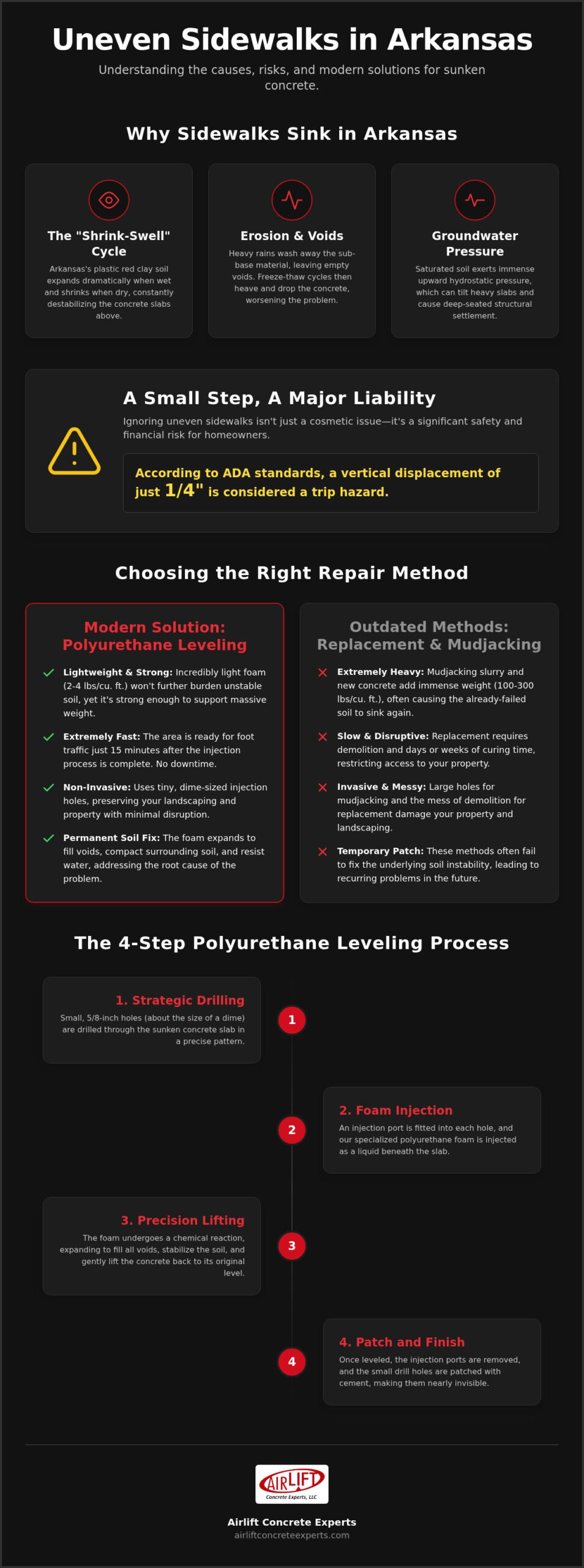
Understanding the mechanics of a repair can transform a stressful property issue into a manageable maintenance task. The process begins with a meticulous initial assessment. Our technicians evaluate the degree of settlement and use specialized tools to locate the voids beneath your slabs. This allows us to determine a precise injection pattern that ensures the concrete is lifted evenly, providing a reliable foundation for uneven sidewalk repair Arkansas.
Unlike traditional methods that require large, damaging holes, we utilize the “small port” advantage. We drill tiny holes, no larger than a penny, through the sunken concrete. This is a critical part of uneven sidewalk repair Arkansas because it preserves the structural integrity of your original walkway while preparing it for restoration. These ports are strategically placed to ensure the foam reaches the areas where the soil has failed most significantly.
Once the ports are ready, we begin the injection phase. We pump high-density polyurethane foam through the ports and into the underlying soil. As the foam expands, it fills every gap and exerts a controlled upward force, lifting the concrete with 0.01-inch precision. Finally, we patch the holes with color-matched grout. This creates a near-invisible repair that restores the look and safety of your path without the mess of a full construction site.
The science of high-density polyurethane is particularly effective for our local environment. As the foam expands, it compacts the loose Arkansas soil, creating a solid, stable base that prevents future sinking. This material is completely waterproof and will never wash away, even during the heaviest spring rains. This durability is why so many homeowners search for polyjacking near me when they want a permanent fix for their residential property.
We respect your time and your property, which is why our setup is designed for minimal disruption. We typically arrive with just one specialized truck that houses all our equipment. The noise level is much lower than traditional methods; you won’t have to deal with the roar of jackhammers or concrete mixers. Perhaps the biggest benefit is the immediate use. You can walk or even drive on the surface within 15 to 30 minutes of us finishing the job. If you’re ready to see how this process can work for your home, you can request a complimentary initial assessment today to get started.
Choosing the right partner for your home’s maintenance is about more than just finding a service provider; it’s about finding a local authority you can trust. Family-owned and operated since 2017, Airlift Concrete Experts has built a reputation as the definitive specialist for uneven sidewalk repair Arkansas. We aren’t a national chain with a one-size-fits-all approach. We’re a team of hardworking regional specialists based in Malvern who understand the unique structural challenges of our community. We treat every customer like a neighbor because, in Central Arkansas, that’s exactly what you are.
Our approach centers on using advanced polyurethane technology specifically tailored to handle the volatile nature of Arkansas red clay. While other companies might suggest outdated methods or expensive new construction, we focus on precision restoration. During a complimentary initial assessment, our technicians don’t just look at the cracks on the surface. They evaluate the underlying soil conditions and the structural integrity of your slabs. You’ll receive a clear, honest explanation of the repair process, giving you the information you need to make a confident decision about your property.
Our roots run deep in this region. We proudly serve homeowners and business owners in Little Rock, Hot Springs, Conway, Cabot, and Benton. Because we live and work in the same environment as our clients, we’ve mastered the specific techniques required to stabilize concrete against our state’s unique weather cycles. We believe that polyurethane concrete leveling is the cornerstone of modern restoration. It provides a lightweight, durable solution that respects the existing landscape while offering a level of stability that traditional dirt or gravel fill simply can’t provide.
It’s easy to put off sidewalk repairs, but waiting often leads to wider cracks and more significant soil erosion. Taking action now prevents a minor trip hazard from turning into a major liability or an expensive foundation issue. We’ve designed our evaluation process to be entirely stress-free and low-pressure. Scheduling your free assessment is the first step toward reclaiming your home’s curb appeal and ensuring the safety of everyone who visits. Our goal is to transform your anxiety into security, providing you with a stable, level sidewalk that’s ready for use the same day we finish our work.
Arkansas red clay doesn’t have to be a permanent threat to your property’s safety. By choosing polyurethane leveling instead of traditional replacement, you address the root cause of sinking without the mess or long wait times. This precision technology stabilizes the volatile soil and eliminates dangerous trip hazards in a single afternoon. Finding a reliable partner for uneven sidewalk repair Arkansas is the most important step in protecting your home’s value and your family’s safety.
Since 2017, Airlift Concrete Experts has served Little Rock, Malvern, and all of Central Arkansas as a family-owned and operated specialist. We use precision polyurethane foam technology to deliver results that last through every weather cycle. Our team understands the local landscape better than anyone else, and we’re committed to treating your property with the care it deserves. Schedule Your Free Sidewalk Assessment Today and let our local experts restore your peace of mind. You deserve a property that is as safe as it is beautiful; we’re here to help you achieve that goal.
Polyurethane concrete leveling is significantly more effective for Arkansas’s expansive red clay soil than traditional mudjacking. Mudjacking relies on a heavy slurry that adds thousands of pounds to unstable ground, often causing the sidewalk to sink again. High-density polyurethane is lightweight and waterproof; it expands to fill voids and stabilize the base without adding stress. This modern approach ensures a more permanent fix for homeowners in Little Rock and Conway who want to avoid recurring settlement issues.
Polyurethane foam is a permanent solution for uneven sidewalk repair Arkansas because the material does not degrade or wash away over time. Unlike dirt or cement-based fills, high-density foam is hydrophobic, meaning it resists water and remains stable through Central Arkansas’s intense wet and dry cycles. Once the foam cures and stabilizes the soil beneath your slab, it provides a durable foundation that maintains its shape and lifting power for the life of the concrete.
The injection ports are very discreet and typically no larger than the size of a penny. After the lifting process is complete, our technicians fill these small holes with a specialized, color-matched grout to blend in with your existing concrete. While the patches might be slightly visible immediately after the job, they weather naturally over time. This non-invasive method is much cleaner than the large, unsightly holes required for older mudjacking techniques used in Malvern and Benton.
We can often level sidewalks with multiple cracks, provided the concrete remains structurally sound. The polyurethane foam expands to fill the voids beneath each individual section, lifting them back into a uniform position. However, if the concrete is crumbling or has shattered into tiny fragments, leveling may not be effective. During a complimentary initial assessment, we evaluate the condition of your slabs to determine if restoration is the right choice for your property’s safety.
The cost of sidewalk repair varies based on the size of the slabs and the volume of the voids beneath them. Generally, polyurethane leveling is a fraction of the cost of tearing out and pouring new concrete. Since every property in the Little Rock area has different soil conditions, we offer a complimentary assessment to provide an accurate estimate. Choosing repair over replacement saves you money while avoiding the disruption of a major construction project.
Standard homeowners insurance policies in Arkansas typically don’t cover sidewalk leveling caused by normal soil settlement or red clay expansion. Most insurance providers view concrete maintenance as the owner’s responsibility. However, it’s wise to check your specific policy for coverage related to sudden events. Regardless of coverage, addressing uneven sidewalk repair Arkansas is a proactive way to prevent denied claims or premium hikes that often follow a trip-and-fall accident on your property.
Ignoring a sunken sidewalk leads to increased liability risks and more expensive repairs in the future. As water continues to pool in the sunken areas, it further erodes the sub-base, causing the slabs to tilt or crack even more severely. In cities like Bryant and Sherwood, an unmaintained walkway also lowers your home’s curb appeal and market value. Small vertical offsets can quickly become major trip hazards that put your neighbors and guests at risk.
High-density polyurethane foam is hydrophobic, which means it can be safely and effectively injected even if the soil is damp. The material reacts and expands regardless of moisture, making it an excellent choice for the humid and rainy climate often found in Central Arkansas. While we avoid working during extreme torrential downpours for safety reasons, typical wet weather doesn’t stop the foam from stabilizing your slabs and providing a level, secure surface for your home.

 Call Now