
Why would you spend thousands of dollars tearing out and replacing a driveway when the concrete itself is still perfectly solid? In Central Arkansas, the real culprit behind those ugly cracks and uneven walkways is often the “shrink-swell” nature of our local clay soil. It’s a common sight across Little Rock and Conway; one day your patio is level, and the next, you’re dealing with dangerous trip hazards and water pooling near your foundation. While many assume a total replacement is the only fix, polyurethane slab jacking offers a modern, efficient way to restore your property without the mess of a construction site.
You likely want a permanent solution that doesn’t involve heavy machinery tearing up your lawn. We agree that structural repairs shouldn’t be a source of more stress. This article explains how high-density foam provides a fast and non-invasive way to level your sunken slabs. You’ll discover how this process stabilizes the underlying soil and creates a safe surface that’s ready for use in minutes. We’ll walk through the technical benefits of this specialized method and show you how to protect your home’s value with a clean, professional repair.
Concrete settlement isn’t just an eyesore. It’s a physical symptom of what’s happening beneath your property. When you ask What is Polyurethane Slab Jacking?, you’re looking at a precision-engineered answer to unstable soil. This method involves injecting a specialized, high-density polymer through small, penny-sized holes in the concrete. As the liquid components mix, they react and expand, creating a powerful force that lifts the slab back to its original position while simultaneously stabilizing the ground below.
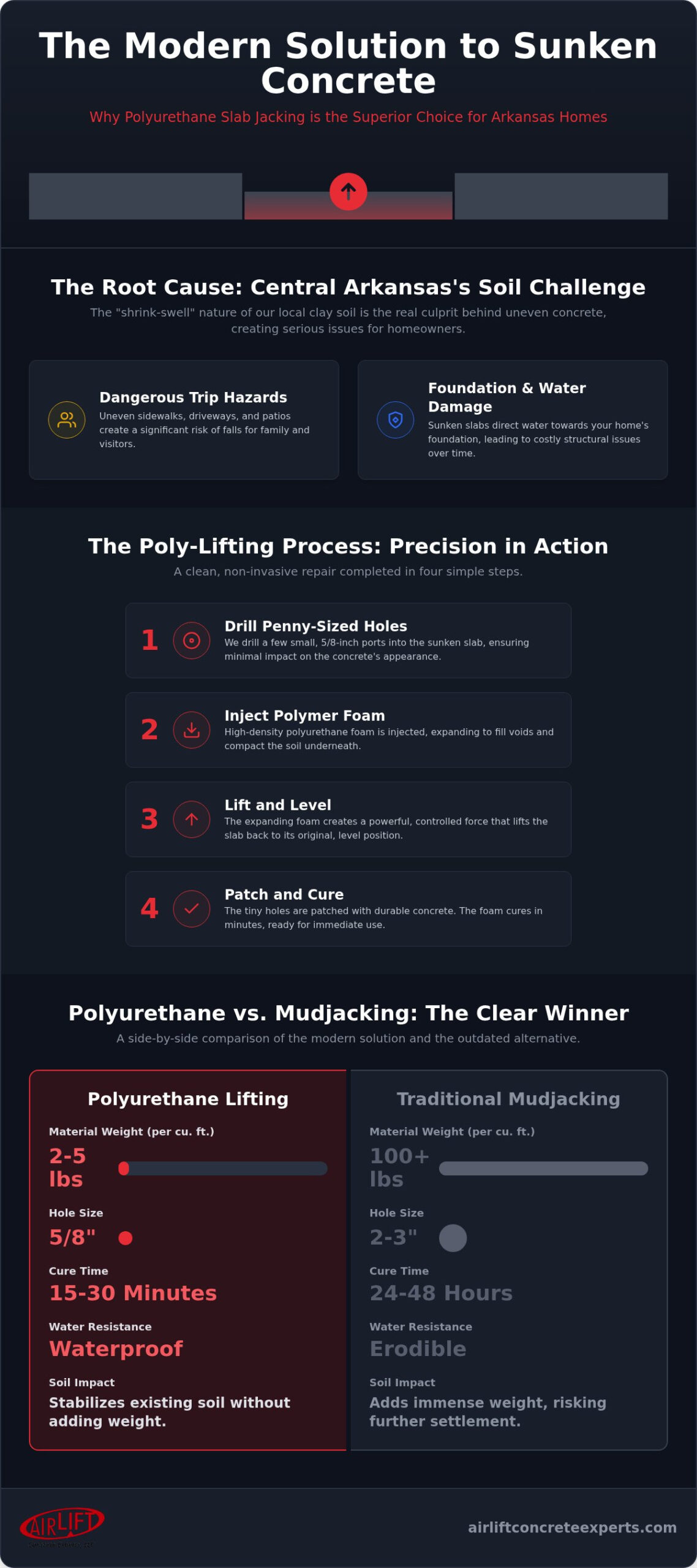
Historically, contractors relied on “mudjacking,” which pumped a heavy mixture of sand, water, and cement under the slab. The industry is moving away from these heavy fillers because they often weigh over 100 pounds per cubic foot. In the “shrink-swell” clay soils of Central Arkansas, adding that much weight can actually cause the concrete to sink again. Polyurethane slab jacking solves this by using a material that weighs only 2 to 5 pounds per cubic foot while providing incredible support. This lightweight nature prevents further soil compression, addressing the root cause of the settlement rather than just masking the problem.
The process relies on a two-part liquid polymer reaction. When these parts meet, they begin to expand almost instantly, filling every hidden void and crevice in the soil. This foam can expand to 20 or 30 times its original liquid volume. This expansion doesn’t just fill space; it compacts the loose soil around it to create a stable base. Despite being lightweight, the cured foam is remarkably strong. Commercial-grade polyurethane can support between 7,200 and over 14,000 pounds per square foot, ensuring your driveway or patio stays put for decades. It’s an inert material, which means it won’t leach chemicals into your yard or break down over time.
Walk through any neighborhood in Malvern or Little Rock and you’ll likely see the signs of settlement. Uneven sidewalks create dangerous trip hazards for families and guests. Beyond the immediate risk of a fall, sunken slabs often tilt toward your home, directing rainwater toward the foundation rather than away from it. This moisture buildup can lead to much more expensive structural foundation issues if left unaddressed. Restoring these surfaces isn’t just about curb appeal; it’s about protecting the long-term integrity and value of your home. A level surface ensures proper drainage and a safe environment for your neighbors and loved ones.
Precision engineering doesn’t have to mean a massive construction site in your front yard. One of the most significant advantages of polyurethane slab jacking is the specialized, non-invasive equipment used to perform the repair. Unlike traditional methods that require large excavation teams, our technicians use a compact delivery system that can reach almost any area of your property without damaging your landscaping. This streamlined approach allows us to work efficiently while maintaining the aesthetic integrity of your home.
The visual impact of the repair is nearly invisible once the job is finished. We drill tiny injection ports that are only 5/8-inch in diameter, roughly the size of a penny. This is a major departure from older techniques that required holes several inches wide. Because these ports are so small, they’re easily patched and blended into your existing concrete. The speed of the process is equally impressive. High-density foam cures to 90% of its full strength in just 15 to 30 minutes. This means you can drive your car over a repaired driveway or walk across a leveled sidewalk almost immediately after we finish.
Our process begins with the strategic drilling of 5/8-inch injection ports across the sunken section of the slab. Technicians then inject the specialized polyurethane resin through these ports. As the two-part liquid polymer mixes beneath the surface, it expands to fill every hidden void. We monitor the lift in real-time, using precise measurements to ensure the slab returns to its exact original grade. Once the surface is perfectly level, we remove the injection equipment and patch the small ports with a durable concrete material that matches the surrounding surface. This methodical approach ensures a stable, long-lasting result without the mess of a full replacement.
The lightweight nature of the foam makes it the ideal choice for delicate pool deck repair. Because pool environments often have complex plumbing and drainage systems, the non-invasive nature of poly-lifting protects those underground assets from damage. On driveways and sidewalks, we focus on eliminating water pooling and trip hazards by restoring the proper pitch for drainage. We also specialize in interior floor leveling for Arkansas homes, where sub-millimeter precision is required to ensure your flooring remains stable and flat. If you’re noticing uneven surfaces around your property, a complimentary initial assessment can help determine the best path forward for your specific structural needs.
Homeowners often face a choice between traditional methods and modern technology when addressing sunken concrete. For decades, mudjacking was the standard approach. This process involves pumping a heavy slurry of sand, soil, and cement under the slab. While it was once the only option, polyurethane slab jacking has largely replaced it because it addresses the physical limitations of the older method. Choosing between the two isn’t just about the price; it’s about understanding how the weight and durability of the material will affect your property in the long run.
The most immediate difference is how quickly you can get back to your normal routine. Traditional mudjacking requires a drying period of 24 to 72 hours before the concrete can support any weight. In contrast, high-density polyurethane cures to 90% of its full strength in about 15 to 30 minutes. Whether it’s a driveway that needs to hold a vehicle or a sidewalk that needs to be safe for foot traffic, the modern foam method allows for nearly immediate use. This efficiency is paired with an environmentally stable profile; the foam is inert and non-toxic, meaning it won’t leach chemicals into the surrounding soil or groundwater.
Weight is the most critical factor when dealing with the unique soil conditions in Central Arkansas. Mudjacking slurries are incredibly heavy, often weighing between 100 and 150 pounds per cubic foot. When you add tons of this material to soil that is already struggling to support a concrete slab, you run a high risk of causing further settlement. You’re essentially trying to fix a sinking problem by adding more weight to the problem area. Polyurethane slab jacking uses a material that weighs only 2 to 5 pounds per cubic foot. This lightweight foam provides the same lifting power without putting unnecessary pressure on the underlying soil, which is essential for preventing future sinking in our regional clay.
Durability is where the two methods diverge most sharply over time. Because mudjacking relies on a cement-based slurry, it’s susceptible to the same forces that caused the original settlement. These slurries can shrink as they dry, or worse, they can wash away during the heavy rain cycles common in Little Rock and Malvern. Once the material erodes, new voids form, and the slab sinks again. High-density polyurethane is completely waterproof and does not shrink. It acts as a permanent, stable filler that maintains its volume regardless of moisture levels. While the upfront cost of foam might be slightly higher than mudjacking, the fact that it doesn’t require repeated repairs makes it the more cost-effective choice for long-term property maintenance.
Homeowners in Central Arkansas face a unique structural challenge that many national contractors don’t fully appreciate. The ground beneath our feet is largely composed of Arkansas red clay, a soil type notorious for its “shrink-swell” behavior. During our humid subtropical summers in Little Rock and Malvern, the clay loses moisture and shrinks, pulling away from the bottom of your concrete slabs. When the heavy rains return, the soil expands rapidly. This constant movement creates empty pockets, or voids, that leave your driveway or patio without the support it needs to stay level.
We see the results of these soil cycles every day in residential neighborhoods across Benton and Conway. It often begins as a small crack in the garage floor or a slight dip where the driveway meets the street. If left unaddressed, these minor shifts turn into significant hazards. Polyurethane slab jacking is specifically designed to handle these regional soil conditions. The high-density foam doesn’t just lift the concrete; it fills those troublesome voids and compacts the surrounding clay to create a more stable, waterproof base that resists the effects of our local weather cycles.
Our local climate plays a massive role in slab stability. Thermal expansion during hot Arkansas afternoons followed by cooler nights can cause concrete to shift and settle. Even more dangerous are the heavy spring rains that can wash out the loose soil from under your driveway, leaving the heavy slab suspended over nothing but air. This is why understanding the specific foundation repair near me needs is so important. A local specialist knows that a repair must account for both the weight of the concrete and the volatility of the soil beneath it. Polyurethane slab jacking provides a lightweight solution that won’t contribute to further soil compression during these intense moisture cycles.
Whether you live in Jacksonville, North Little Rock, or Cabot, your home’s curb appeal is a point of pride and a major factor in your property value. Sunken, cracked concrete isn’t just an eyesore; it’s a signal to potential buyers that the property may have underlying structural issues. By leveling your concrete, you protect the rest of your home’s structural integrity by ensuring water flows away from your foundation rather than toward it. As a family-owned Arkansas business, we treat every job like we’re working on a neighbor’s home. We recommend starting with a complimentary initial assessment to identify exactly how the local soil is affecting your property and to find a permanent, professional solution.
Airlift Concrete Experts was founded in 2017 with a simple mission: to provide Arkansas homeowners with a reliable, long-term solution for structural instability. As a family-owned and operated business, we don’t treat your property like just another job site. We treat it like it belongs to a neighbor. While some companies split their focus between new construction and repair, we’ve chosen to specialize exclusively in structural restoration. This focus means our team brings a high level of technical expertise to every project, ensuring that your polyurethane slab jacking repair is performed with the precision required for lasting stability.
Whether you’re a homeowner in Malvern or a business owner in Little Rock, we tailor our approach to meet your specific needs. Residential projects often focus on safety and curb appeal, while our commercial concrete lifting services are designed for high-traffic areas that require maximum durability. We understand that downtime is costly for a business. Because our foam cures so quickly, we work to ensure your surfaces are ready for use in minutes. Regardless of the job size, we’re dedicated to leaving your property cleaner than we found it. Our non-invasive equipment doesn’t leave ruts in your lawn or heavy dust on your siding.
Booking your assessment is a straightforward, low-pressure process. We serve communities across the region, including Bryant, Benton, and Hot Springs. When you search for polyjacking near me, you’ll find that our commitment to transparency sets us apart. We begin every project with a complimentary initial assessment. During this visit, we’ll evaluate the state of your concrete, identify the underlying soil issues, and provide a clear plan for restoration. We don’t sell DIY kits because we believe structural work requires professional-grade materials and specialized training to be truly effective.
A professionally leveled surface is an investment that pays off for decades. By choosing polyurethane slab jacking, you’re opting for a permanent fix that protects your home’s foundation and restores your peace of mind. We’re here to help you navigate these structural challenges with confidence, providing the stable ground your family deserves. Our team is ready to transform your uneven surfaces into safe, level walkways that enhance your property’s value and safety.
Settling concrete doesn’t have to be a permanent headache for your household. By choosing polyurethane slab jacking, you’re investing in a solution that works with the unique soil conditions of Central Arkansas rather than against them. This modern method provides a waterproof, lightweight, and durable fix that stabilizes your property without the invasive mess of a full replacement. Whether you’re dealing with a sinking pool deck in Malvern or a trip hazard on your Little Rock driveway, we have the specialized expertise to restore safety and curb appeal to your home.
Airlift Concrete Experts has been a family-owned and operated partner to our neighbors since 2017. We focus exclusively on professional repair and lifting because we believe in preserving what you’ve already built. Our team is ready to help you navigate these structural challenges with transparency and care. Contact Airlift Concrete Experts for a Free Assessment today to see how our high-density foam can stabilize your concrete for decades to come. We look forward to helping you create a safer, more stable environment for your family.
A professional repair using high-density foam typically lasts for decades. Because the material is waterproof and inert, it won’t break down or wash away when exposed to moisture. This durability makes it a superior long-term choice compared to traditional methods that rely on organic materials. Once the foam expands and cures, it provides a stable foundation that remains intact regardless of the environmental shifts common in Central Arkansas.
In almost every category, polyurethane slab jacking outperforms mudjacking. The foam is significantly lighter, weighing about 2 to 5 pounds per cubic foot compared to the 100 or 150 pounds of cement slurry. This prevents the repair from causing further soil compression. Additionally, the cure time is minutes rather than days. It also offers a waterproof barrier that protects against the erosion that often causes mudjacking repairs to fail over time.
You can typically use your concrete surface within 15 to 30 minutes of the injection process. The specialized foam reaches about 90% of its full compressive strength in this short window. This is a major benefit for homeowners in Little Rock who need to use their driveways or sidewalks without waiting days for new concrete to dry. Our technicians ensure the surface is stable and ready for traffic before they leave your property.
The high-density polyurethane slab jacking foam we use is an environmentally responsible choice for your property. Once the material has cured, it becomes inert and non-toxic. It doesn’t leach chemicals into the surrounding soil or groundwater, making it safe for use near gardens, lawns, and local water systems. Its durability also reduces the need for future repairs, which minimizes the overall environmental impact of maintaining your home’s structural integrity over many years.
The total cost for a repair depends on several factors, including the size of the slab and the volume of the voids beneath it. While we don’t provide flat rates, this method is often much more affordable than the cost of tearing out and replacing the entire concrete surface. We provide a complimentary initial assessment to give you an accurate evaluation of your specific project needs in communities like Conway and Malvern.
This process is designed to level the slab and close the gaps caused by sinking. While the lifting process often brings cracked sections back together, it doesn’t physically remove the crack itself. Once the slab is stabilized and level, we recommend sealing the remaining cracks to prevent water from reaching the soil again. This combination of leveling and sealing creates a safe, durable surface that prevents the problem from returning.
Yes, this method is highly effective for interior floor leveling. Because the injection ports are so small and the equipment is compact, we can work inside homes with minimal disruption. The foam’s expansion is incredibly precise, allowing our technicians to lift interior slabs to within a fraction of an inch. This ensures your floors are perfectly level for new tile, hardwood, or carpet installation without the need for heavy demolition.
Our process focuses on compacting and stabilizing the existing soil to prevent future movement. The foam fills the voids that lead to settlement, creating a solid base. However, if your property has significant drainage issues that cause massive soil erosion, further shifts could occur. This is why we evaluate the entire area during our initial assessment to ensure we’re addressing the root cause and providing a repair that lasts.

 Call Now