
Tearing out and replacing a sunken warehouse slab in 2026 is often an unnecessary drain on your facility’s budget and schedule. You’ve likely noticed that even a minor shift in your loading dock or shop floor isn’t just an eyesore. It’s a liability that damages expensive forklifts and invites OSHA scrutiny for trip hazards. We understand that in busy industrial hubs like Little Rock, Conway, or Hot Springs, you can’t afford to close off a section of your floor for days while new concrete cures.
This guide explains how high-density polyurethane foam injection has become the gold standard for commercial concrete leveling in Arkansas. You’ll discover how this specialized process restores structural integrity and provides a level, safe surface in a matter of hours, not days. We’ll walk through the specific challenges of our state’s “shrink-swell” clay soils and why this modern injection method offers a more durable, waterproof solution than traditional mudjacking or total replacement. This approach ensures your facility remains operational while addressing the root cause of the settlement.
Identifying concrete failure in a professional setting often starts with subtle cues before escalating into a major operational bottleneck. For many facility managers, the first sign isn’t a collapsed slab, but a series of small, persistent issues that disrupt daily workflows. Recognizing these symptoms early allows for proactive What is concrete leveling? interventions before the damage requires total demolition. In high-traffic areas, these defects aren’t just cosmetic; they’re direct threats to your bottom line.
Keep a close eye on these specific indicators across your property:
The primary driver behind the need for commercial concrete leveling Arkansas businesses face is our local soil. Much of the state sits on highly expansive “red clay.” This soil undergoes a dramatic shrink-swell cycle. During our hot, dry summers, the clay loses moisture and shrinks, leaving massive underground voids beneath heavy commercial slabs. When the rains return, the soil expands, but it rarely pushes the concrete back to its original position. Large-scale slabs are particularly vulnerable because their sheer weight accelerates sinking into these empty spaces. While Little Rock facility managers deal with deep clay deposits, those in Hot Springs Village often face issues where thin soil layers over rock wash away, creating similar instability.
Safety is a non-negotiable priority for any Arkansas facility in 2026. OSHA standards generally identify any vertical change of 1/4 inch or more in a walkway as a trip hazard. Relying on “Watch Your Step” signs or yellow paint is a temporary fix that actually documents your awareness of a hazard without resolving it. This can lead to increased liability in the event of a slip-and-fall accident. Permanent repair through high-density foam injection eliminates the physical hazard entirely, protecting both your employees in industrial zones and your customers in retail spaces. Addressing these hazards immediately ensures you remain compliant and keeps your insurance premiums from spiking due to preventable accidents.
Polyurethane concrete leveling, often called polyjacking, is a high-tech alternative to traditional repair methods. It involves injecting a two-part polymer resin beneath a settled slab through small, non-invasive ports. As these liquids mix, a chemical reaction occurs, causing the material to expand into a rigid, high-density foam. This expansion force is powerful enough to lift multi-ton commercial slabs while simultaneously compacting the loose soil underneath. Facility managers looking for reliable commercial concrete leveling in Arkansas often prefer this method because it addresses both the surface levelness and the underlying soil stability in a single application.
The resins used in 2026 are engineered for extreme load-bearing capacity. High-density foams used in industrial applications provide support ranging from 7,200 to over 14,000 pounds per square foot. This ensures that heavy machinery pads and warehouse floors can withstand constant traffic without re-settling. Modern resins are also environmentally inert and non-toxic. They won’t leach chemicals into the Arkansas water table or local soil, making them a safe choice for food-grade facilities and schools alike.
Efficiency is the hallmark of the polyjacking process. Our crews drill small, penny-sized holes in a strategic grid across the affected area. We then inject the resin using specialized equipment that allows for real-time monitoring. This precision is vital; we can lift a slab to within a fraction of an inch to ensure perfect alignment with adjacent surfaces. Because the foam cures almost instantly, your floors are ready for foot traffic or heavy machinery in just 15 to 30 minutes. This speed is a game-changer for busy hubs in Little Rock or Benton that can’t afford operational delays.
Many older facilities were originally repaired using mudjacking, which involves pumping a heavy slurry of sand and cement under the concrete. However, this method has significant drawbacks in the Arkansas climate. Mudjacking material is incredibly heavy, often adding hundreds of pounds of weight to already stressed soil. This extra load can actually trigger secondary sinking. In contrast, polyurethane foam is lightweight and hydrophobic. It acts as a waterproof barrier that resists Arkansas groundwater and won’t wash away during heavy rain cycles. While mudjacking grout can erode or break down over time, polyurethane is a permanent solution that maintains its structural integrity for the life of the slab.
When you’re managing a facility in 2026, the decision between repairing a slab and replacing it entirely comes down to more than just the initial bid. Total cost of ownership includes the price of demolition, debris disposal, and the acquisition of permits under current Arkansas building codes. Choosing commercial concrete leveling Arkansas professionals allows you to bypass these logistical hurdles. While a new concrete pour requires heavy equipment that can damage your surrounding landscape, polyurethane injection uses a small footprint that preserves your existing infrastructure.
Replacement often fails to address the root cause of the problem: the soil. Pouring a heavy new slab over the same unstable Arkansas clay that caused the first one to sink is a temporary fix. Polyurethane foam injection compacts the loose soil and fills the voids that led to the settlement in the first place. This provides a long-term structural foundation that a simple replacement can’t match. By choosing to lift rather than demolish, you’re investing in the stability of the ground itself, not just the surface you walk on.
The most significant hidden cost of concrete replacement is the operational shutdown. Standard new concrete requires a 28-day cure period to reach full strength. For a 24/7 industrial facility or a high-volume distribution hub in Little Rock, losing a loading dock for a month is financially devastating. Polyjacking offers a 15-minute cure time. We’ve seen retail parking lots in Benton restored during off-hours, where the surface was ready for a full morning rush of traffic before the store even opened. You don’t have to choose between a safe floor and a productive workday.
Sustainability is a growing priority for Arkansas businesses aiming to meet modern environmental standards. Preserving your existing slabs keeps tons of concrete out of local landfills and reduces the demand for new cement production. Green Leveling is a method to reduce carbon footprints in Arkansas construction by minimizing material waste and energy consumption. This approach allows your facility to maintain high safety standards while supporting broader corporate social responsibility goals. Because the equipment used for foam injection is compact, site disturbance is kept to an absolute minimum, protecting your property’s aesthetics and local ecosystem.
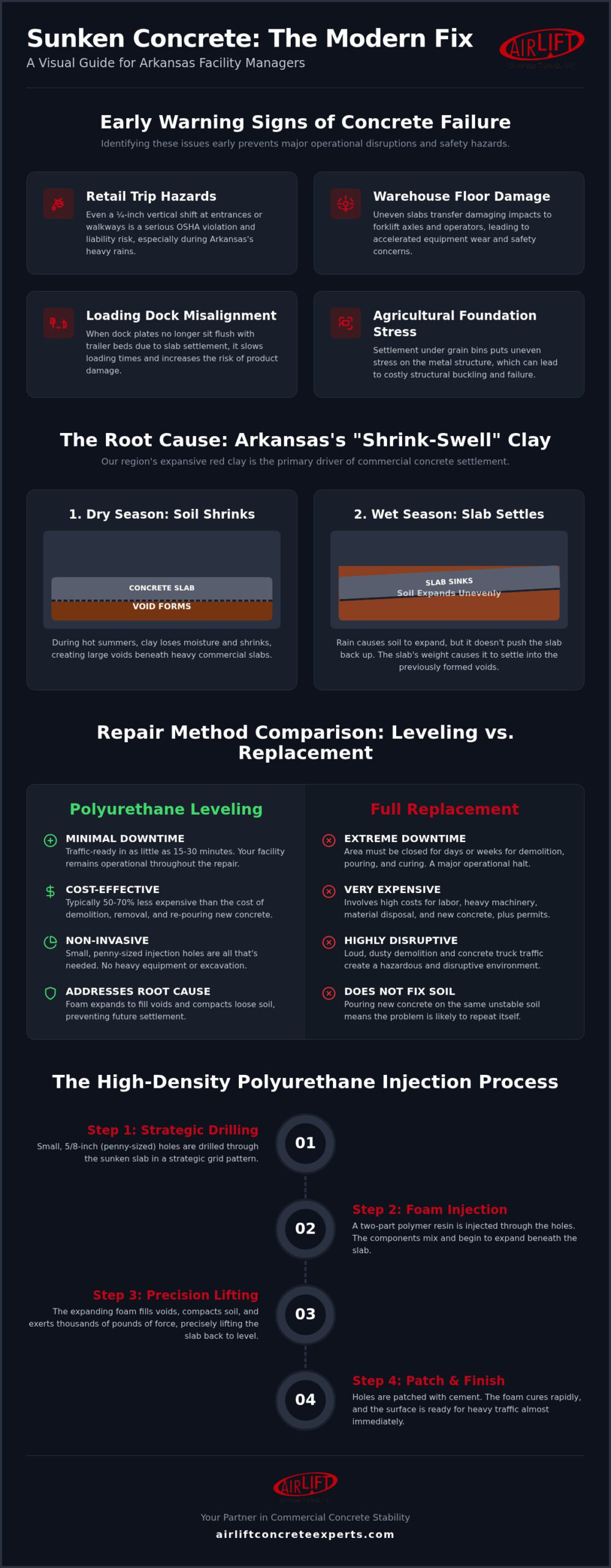
Executing a successful repair on a busy facility requires a methodical approach that balances technical requirements with your operational realities. A structured commercial concrete leveling Arkansas project follows a four-step process designed to ensure long-term stability without disrupting your revenue stream. By planning ahead, you can transform a stressful structural issue into a routine maintenance task that protects your property value.
In industrial settings, the stakes are much higher than in residential projects. Slabs beneath heavy machinery, high-density storage racks, and loading docks must withstand immense point loads. We test for subsurface voids specifically in these high-stress zones to prevent catastrophic slab cracking. This technical process shares some similarities with the polyurethane concrete leveling techniques used for residential foundations, but commercial applications require higher-density resins engineered for industrial weight. We also evaluate the condition of existing expansion joints to ensure the entire floor system moves as intended under thermal stress.
Choosing the right partner is vital for a seamless project. You need a contractor who understands the specific geological challenges of Little Rock and Conway. Ask potential partners about their insurance and bonding specifically for commercial job sites, as these requirements are more stringent than residential work. Finally, confirm their flexibility. A reliable specialist should offer after-hours or weekend availability to ensure your production line never stops moving. If you’re ready to secure your facility’s foundation, schedule a professional assessment with our regional experts today.
Choosing a partner for commercial concrete leveling Arkansas involves finding a team that understands our local geology as well as they understand structural engineering. Since 2017, our family-owned business has operated with a simple philosophy: treat every commercial property like it belongs to a neighbor. We aren’t a distant national franchise using a one-size-fits-all approach. Instead, we bring deep regional expertise that spans from the rocky terrain of the Ouachita Mountains to the soft alluvial soils of the Arkansas River Valley. This local knowledge allows us to predict how specific soil profiles will react to high-density foam injection, ensuring a repair that lasts.
We’ve invested in specialized, high-capacity lifting equipment specifically designed for the rigors of industrial job sites. Whether we’re stabilizing a massive warehouse floor in Little Rock or leveling a heavy machinery pad at a Malvern industrial site, our equipment provides the precision and power required for multi-ton lifts. Our approach goes beyond simple surface leveling. We focus on comprehensive soil stabilization, filling the subsurface voids that lead to settlement. This methodical process ensures your facility doesn’t just look better; it’s structurally sound for the long haul.
Maintaining a safe and efficient facility is a priority for property managers across the state. To meet this demand, we’ve deployed mobile units that provide rapid response times throughout the Central Arkansas business corridor. Our dedicated teams support the economic engines of our community, including:
We believe transparency is the foundation of any successful commercial partnership. That’s why we offer a complimentary initial assessment for local property managers. During this visit, we conduct a thorough site evaluation to identify void locations and calculate the specific industrial load requirements for your repair. You’ll receive a customized plan that outlines the exact steps needed to restore your concrete with zero operational downtime. It’s time to stop worrying about trip hazards and forklift damage. Contact Airlift Concrete Experts for a Free Commercial Quote and see why we’re the definitive local authority in structural stability for 2026.
Managing a commercial property in 2026 requires balancing safety compliance with strict operational budgets. You’ve seen how ignoring sinking slabs leads to costly forklift repairs and liability risks. High-density polyurethane foam injection offers a sophisticated way to stabilize your floors without the logistical nightmare of demolition. By choosing commercial concrete leveling Arkansas experts, you’re addressing the root cause of settlement while keeping your facility running at full capacity.
Our family-owned team brings a deep understanding of regional soil conditions to every job site. We use specialized industrial-grade resins that provide long-term stability for the heaviest loads. With our zero-downtime guarantee, your operations can continue uninterrupted while we restore your property’s safety and value. Don’t let uneven concrete slow your business down. Request a Free Commercial Concrete Assessment Today and partner with a local authority you can trust. We’re ready to help you build a more stable foundation for your business.
Polyurethane concrete leveling cures almost instantly. Most commercial surfaces are ready for full foot traffic or heavy machinery in as little as 15 to 30 minutes after the injection is complete. This rapid turnaround is a significant advantage over traditional concrete replacement, which often requires a 28-day cure period. Your facility can maintain its normal production schedule without the long delays associated with demolition and new pours.
Yes, the high-density foam used for commercial concrete leveling Arkansas facilities is specifically engineered for industrial loads. These specialized resins provide support ranging from 7,200 to over 14,000 pounds per square foot. This capacity is more than enough to sustain the weight of heavy forklifts, high-density storage racks, and stationary manufacturing machinery. The foam compacts the underlying soil, creating a stable foundation that prevents future settlement under heavy use.
We certainly can. Grain bin floor settlement is a unique challenge in Arkansas’s agricultural sectors. When the concrete foundation beneath a bin shifts, it places uneven pressure on the metal structure, which can lead to structural buckling. Our high-density foam injection fills the voids beneath the bin floor to restore a level surface. This process stabilizes the bin and protects your investment without the need for expensive structural teardowns.
The primary differences are weight and durability. Mudjacking uses a heavy sand and cement slurry that can actually trigger more sinking because of its sheer weight. Polyjacking uses a lightweight foam that adds minimal load to the soil. Additionally, polyjacking requires only penny-sized injection holes, while mudjacking needs much larger ones. Polyurethane is also waterproof and won’t wash away, making it a much more durable choice for the Arkansas climate.
Your business won’t need to shut down. We specialize in zero-downtime repairs by coordinating with your facility’s operational schedule. Our equipment has a very small footprint, allowing us to work in one area while your team continues production in another. We also provide after-hours and weekend service for hubs in Little Rock and Conway to ensure that your workflow remains completely uninterrupted throughout the entire leveling process.
Polyurethane repairs are designed to be permanent. Unlike traditional grout or mudjacking material, the high-density foam used in commercial concrete leveling Arkansas projects is hydrophobic. It doesn’t erode or break down when exposed to groundwater. It remains stable in the soil indefinitely, resisting the shrink-swell cycles of Arkansas clay. By filling the voids and compacting the subgrade, the foam provides a long-term foundation that prevents the concrete from sinking again in the future.
Leveling addresses the root cause of the cracks by stabilizing the sinking slab. As we inject the foam and lift the concrete, the cracks often close up as the sections return to their original position. While the foam doesn’t technically glue the concrete back together, it removes the stress that caused the break. We typically recommend sealing the remaining cracks after the lift to prevent moisture from reaching the newly stabilized soil.
Yes, the modern injection resins used in 2026 are environmentally inert and non-toxic. Once the chemical reaction is complete and the foam has cured, it doesn’t leach any harmful substances into the soil or the Arkansas groundwater. This safety profile is essential for facility managers overseeing food-grade warehouses, schools, or agricultural properties. You can rest assured that the structural repair won’t have any negative impact on the local ecosystem or water table.

 Call Now