
If you choose the cheapest quote to fix your sinking driveway, you might end up paying for the same repair three times before the decade is over. It is a common cycle for Central Arkansas homeowners who struggle with trip hazards and uneven slabs that just won’t stay put. When you are looking at the polyjacking vs mudjacking cost Arkansas contractors provide, the lowest initial bid often ignores the heavy reality of our local soil conditions.
We understand how stressful it is to see your property value dip because of shifting ground and cracked concrete. You want a solution that works the first time without turning your yard into a construction zone. This guide compares the true ROI of modern leveling methods against traditional slurry, specifically tailored for the unique expansion and contraction of Arkansas red clay. You will learn why the weight of your repair material matters more than the price tag, how to achieve a level surface that lasts for years, and why a 15 minute cure time is a game changer for your home’s curb appeal and safety.
Choosing the right repair method for a sunken driveway or patio requires looking beneath the surface. In Central Arkansas, the ground is rarely static. Most homeowners are forced to choose between two primary options: mudjacking and polyjacking. Mudjacking is an older process that involves pumping a thick slurry of sand, cement, and soil under the slab. Polyjacking is a modern alternative that uses high density polyurethane foam to achieve the same lift. While both fall under the umbrella of concrete leveling techniques, their performance in our local environment is vastly different. When you analyze the polyjacking vs mudjacking cost Arkansas contractors present, you have to consider whether the material can withstand the pressure of our native soils.
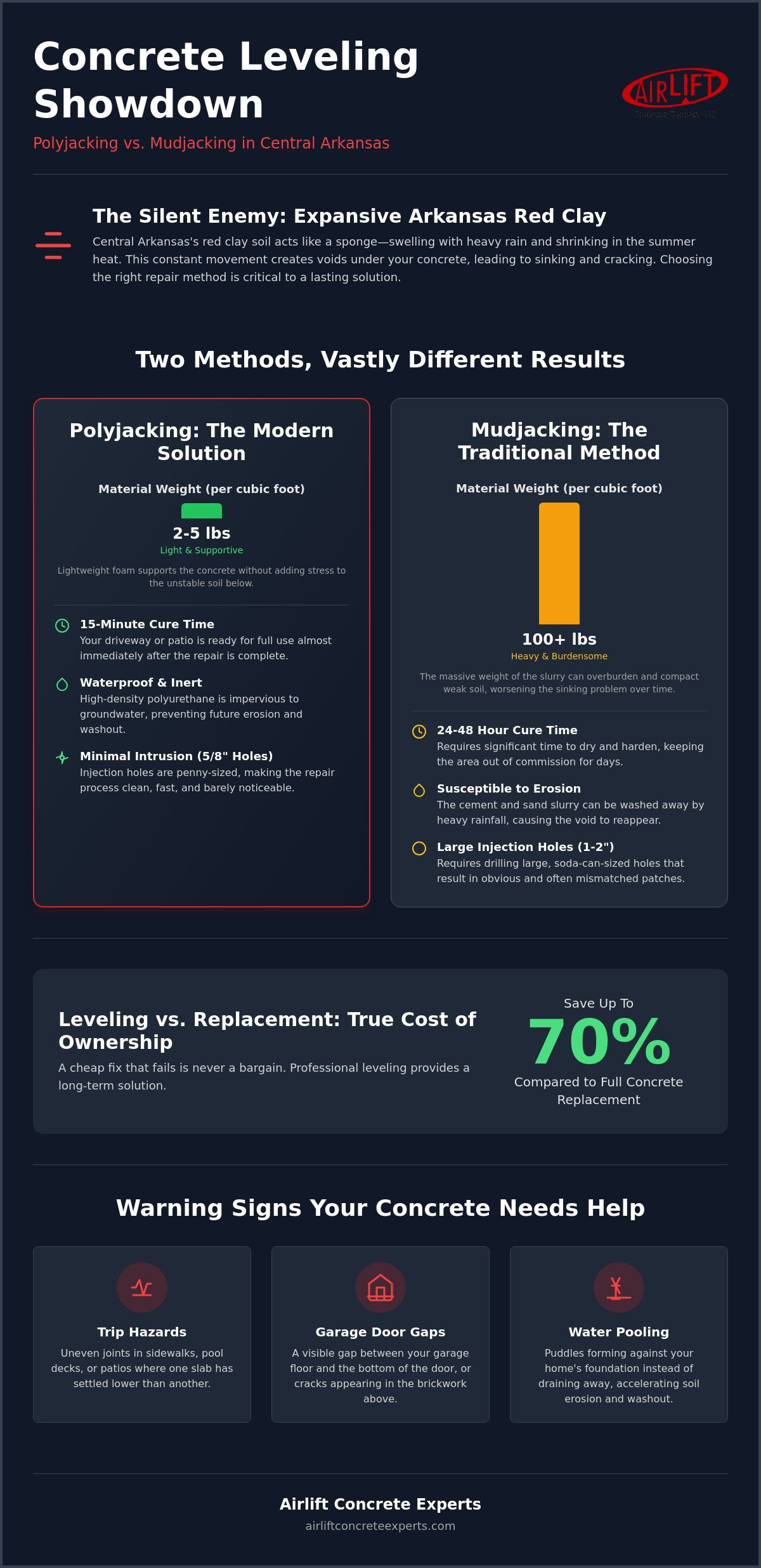
The biggest factor in any repair is the weight of the material itself. Traditional mudjacking slurry is incredibly heavy, often weighing up to 100 pounds per cubic foot. In contrast, the specialized foam used in polyjacking weighs only 2 to 5 pounds per cubic foot. This weight difference is the deciding factor in whether a repair lasts for a decade or fails within a few seasons. If you add thousands of pounds of heavy mud to already unstable ground, you are essentially creating a sinking anchor that pulls the concrete down even further.
Central Arkansas is famous for its thick, expansive red clay. This soil acts like a sponge; it swells significantly during our humid, rainy springs and shrinks during the brutal heat of a Malvern or Little Rock summer. This constant movement creates large voids under your concrete slabs. If you fill those voids with heavy mudjacking slurry, the clay eventually collapses under the added stress. The relationship between Arkansas soil and your home’s foundation is delicate. Using a lightweight, waterproof foam ensures that you aren’t overtaxing the ground that is already struggling to support your concrete.
Structural issues rarely stay small. If you notice a 1-inch drop in your sidewalk today, it can easily become a 5-inch structural failure after another season of heavy rainfall and soil erosion. Homeowners in Benton and Hot Springs should look for these specific warning signs:
Taking a “Total Cost of Repair” approach in 2026 means looking past the first invoice. A cheap fix that requires a second or third visit is never actually a bargain. Understanding the polyjacking vs mudjacking cost Arkansas residents face involves calculating the long term value of a material that won’t wash away or sink into the clay.
When evaluating the polyjacking vs mudjacking cost Arkansas residents often focus on the upfront fee, but the technical performance of polyurethane foam offers a level of value that slurry cannot match. Polyjacking relies on a two-part chemical reaction. When these liquids mix, they expand rapidly into a high-density foam that hunts for hidden voids beneath your concrete. This expansion doesn’t just fill empty spaces; it creates a structural support system that is both lightweight and incredibly strong. Because the material is inert, it won’t react with the soil or leach chemicals into your yard, making it a safe choice for families and pets.
The most significant technical difference lies in the density of the materials. Mudjacking slurry is a heavy mixture of sand and cement that weighs between 100 and 150 pounds per cubic foot. In the reactive red clay of Central Arkansas, this massive weight often leads to “overburdening” the subgrade. When you search for polyjacking near me, you are looking for a solution that solves the problem without adding more stress to the ground. Polyurethane foam weighs only 2 to 5 pounds per cubic foot. As it expands, it actually compacts the surrounding soil, creating a denser and more stable base for your concrete slabs to rest upon.
We use advanced laser levels to monitor the lifting process in real time. This allows us to achieve a level of precision within 1/10th of an inch. Mudjacking is often a “brute force” method where the pressure of the heavy slurry can be difficult to control, sometimes leading to over-lifting or cracking the slab. Our process is more surgical. By controlling the injection rate, we ensure a perfect transition between slabs, which is vital for proper drainage. Keeping water moving away from your foundation is the best way to prevent future settlement issues. If you are concerned about your home’s structural integrity, you can request a professional assessment to see if your slabs are candidates for this precision lifting.
The long-term durability of polyurethane is also supported by a technical report on polyurethane injection, which highlights its effectiveness in stabilizing infrastructure. This durability is especially important in Little Rock and surrounding areas where heavy rainfall can wash away the organic materials used in mudjacking slurry. Furthermore, the aesthetic impact is minimal. We only need to drill holes about 5/8 of an inch in diameter, roughly the size of a penny. Compare this to the 2-inch holes required for mudjacking, which look like soda cans and leave a permanent “polka dot” pattern on your driveway. Finally, the cure time for polyjacking is just 15 minutes. You can drive your car over the repaired area almost immediately, whereas mudjacking requires you to wait 24 to 72 hours before the surface is usable.
When you receive quotes to repair your sunken driveway or patio, the bottom line is usually the first thing you look at. However, the polyjacking vs mudjacking cost Arkansas homeowners see on paper doesn’t tell the whole story. While mudjacking often carries a lower initial price tag, it is frequently a temporary fix that results in a “failure tax” within 24 to 36 months. We encourage our neighbors to view concrete leveling techniques as a long term investment in their property’s structural health rather than a one-time expense. Choosing a method that fails to address the underlying soil issues in Central Arkansas only leads to more spending down the road.
The total value of a repair is measured by how long it lasts. Polyjacking generally costs about 15% to 25% more than traditional mudjacking upfront. This difference accounts for the specialized equipment and the high performance polyurethane foam that is impervious to groundwater. When you consider that professional leveling can represent a 50% to 70% cost saving compared to full concrete replacement, the initial investment in a permanent solution becomes much more attractive. In the reactive red clay of our region, a permanent fix is always cheaper than a recurring repair.
Several factors influence the final quote for polyurethane concrete leveling in Arkansas. The size of the project is the primary driver, but the complexity of the “void” beneath the slab also dictates the volume of material required. Large driveways in Little Rock or sprawling pool decks in Hot Springs require more foam to stabilize the subgrade. Mobilization fees also play a role; as a local specialist based in Malvern, we can often provide more efficient service to our neighbors in Benton and surrounding areas without the high overhead costs of national franchises.
Traditional mudjacking comes with secondary costs that don’t appear on the initial invoice. Because mudjacking requires heavy machinery and large amounts of wet slurry, it often leaves deep ruts in Central Arkansas yards, necessitating expensive landscaping repairs. There is also the “loss of use” factor to consider. Mudjacking slurry can take up to 72 hours to cure, while our poly-lifting process allows you to use your driveway in as little as 15 minutes. A “cheap” quote often ignores the root cause of soil instability, leaving you with a heavy material that is destined to sink into the clay again. In 2026, the ROI of professional leveling is clear: a precision-leveled surface increases property resale value and provides peace of mind that your home is structurally sound.
Seeing a repair crew arrive at your home shouldn’t be a source of stress. We prioritize a clean, non-invasive experience that respects your property and your schedule. Unlike traditional methods that require heavy excavators or large mixing trucks, our equipment is contained within a single box truck. This small footprint is especially beneficial for Central Arkansas yards where we want to avoid damaging the turf or leaving ruts in the soft clay. When you compare the polyjacking vs mudjacking cost Arkansas contractors quote, remember to factor in the convenience of a project that finishes in hours rather than days.
Preparation for our visit is simple. We ask that you clear the work area of vehicles, patio furniture, or potted plants. Once our team arrives, we perform a final site assessment to confirm the injection points. This local, expert evaluation ensures we are addressing the specific settlement patterns of your slab. If you are ready to restore your home’s safety, you can schedule your initial assessment today to get started.
Our patented process is methodical and precise. We follow four distinct steps to ensure your concrete is stabilized for the long term:
Every neighborhood in our region presents different challenges. For example, navigating the specific groundwater levels in Hot Springs Village requires a deep understanding of how moisture moves through the subgrade. A national franchise might use a one-size-fits-all approach, but a family-owned team understands local permit requirements and soil behavior. This regional authority is essential for high-quality professional foundation repair. We live in the communities we serve, which means we treat every project like we are working on a neighbor’s home. The final walkthrough is our favorite part of the job. We verify the lift with you, ensuring the drainage is correct and the trip hazards are gone before we pack up our gear.
When you weigh the polyjacking vs mudjacking cost Arkansas homeowners typically encounter, the conversation often shifts to whether it is better to just start over with new concrete. In 2026, the financial gap between repair and replacement has widened significantly. Full demolition and replacement can cost three to four times more than professional leveling. Between the labor for jackhammering, the fees for hauling debris to a landfill, and the rising price of new concrete delivery, “ripping and replacing” is often an unnecessary drain on your home improvement budget.
Choosing concrete lifting is also the more environmentally responsible choice. It keeps perfectly good concrete out of Arkansas landfills and requires far less energy than manufacturing and transporting new cement. However, there are times when a slab is truly “too far gone.” If your concrete is crumbling into small chunks or has “spiderweb” cracks throughout the entire surface, the structural integrity may be compromised beyond what foam can support. In those rare cases, we will be honest with you about the need for a new pour. For most settlement issues, however, our patented polyurethane process is the gold standard for restoring safety and value.
Full replacement is a major disruption for families in quiet neighborhoods like Cabot or Sherwood. The process involves days of noise, dust, and heavy trucks that can damage your driveway’s edges or your neighbors’ curb space. One often overlooked downside is the “color mismatch” problem. New concrete is bright white and rarely blends with the seasoned slabs around it, which can actually hurt your home’s curb appeal. Perhaps most importantly, pouring new concrete on top of the same unstable red clay doesn’t solve the root problem. Without the soil stabilization provided by expanding foam, your brand new driveway is just as prone to sinking as the old one was.
Our goal is to provide a permanent fix that protects your home’s resale value. By using our specialized polyurethane injection process, we address the voids and soil compaction issues that cause slabs to fail in the first place. This approach offers several long term benefits for Arkansas homeowners:
The peace of mind that comes with a stable foundation is priceless. You don’t have to live with the anxiety of a sinking walkway or a cracked garage floor. By choosing a solution that works with the unique environment of Central Arkansas, you ensure your property remains safe and beautiful for years to come. We are proud to be your local partner in maintaining the structural health of your home.
Your concrete surfaces are more than just functional; they are essential to your home’s safety and curb appeal. We have explored why the polyjacking vs mudjacking cost Arkansas homeowners evaluate must include the long-term stability of the repair material. Traditional mudjacking often fails because its heavy slurry eventually sinks into our native red clay, leading to recurring settlement. Polyjacking solves this cycle by using a lightweight, waterproof foam that stabilizes the soil and stays in place regardless of the shifting weather or groundwater levels.
Since 2017, our family-owned team has helped neighbors in Malvern, Little Rock, and throughout Central Arkansas reclaim their properties. Our patented polyurethane leveling process provides precision lifting to within 1/10th of an inch. This level of accuracy ensures your surfaces are perfectly aligned without the mess or disruption of heavy machinery. You are investing in a repair that protects your property value and your family’s safety.
You don’t have to navigate structural repairs alone. We are here to provide the technical expertise and reliable service you deserve. Get your free, no-obligation concrete leveling quote from Airlift Concrete Experts today! We look forward to helping you restore your home’s stability with a solution built to last.
Polyjacking typically costs about 15% to 25% more upfront than traditional mudjacking. However, when you evaluate the polyjacking vs mudjacking cost Arkansas homeowners see on their initial quotes, the long term value is much higher because it doesn’t require repeat repairs. The lightweight nature of the foam prevents secondary sinking, which saves you from paying for the same fix twice when the heavy slurry fails.
Polyurethane foam is a permanent solution designed to last for the life of the concrete. Unlike the organic materials found in mudjacking slurry, high density foam is inert and waterproof. It won’t decompose or lose its structural integrity when exposed to the moisture cycles of our local red clay. This ensures your slabs stay level for decades regardless of how much the soil expands or contracts.
Yes, mudjacking slurry can erode and wash away over time, especially during the heavy rainfall common in Little Rock and Malvern. Because the slurry is a mixture of soil, sand, and cement, it remains susceptible to water infiltration and erosion. Once the material washes out from beneath the slab, the concrete will inevitably sink again, often leading to more expensive structural failures.
You can drive your vehicle on the driveway in as little as 15 minutes after the injection process is complete. The chemical reaction that creates the foam happens quickly, and the material reaches its full structural strength almost immediately. This is a major advantage over mudjacking, which typically requires a waiting period of 24 to 72 hours before the surface can safely support the weight of a car.
We provide a complimentary initial assessment for homeowners throughout Little Rock, Benton, and the surrounding Central Arkansas areas. Our team visits your property to evaluate the soil conditions and the extent of the slab settlement. This allows us to provide a transparent, low pressure quote that addresses the specific needs of your project without any hidden fees or obligations to move forward.
The high density polyurethane foam we use is environmentally inert and safe for use around your family, pets, and landscaping. Once the foam has cured, it does not leach chemicals into the surrounding soil or groundwater. Choosing repair over replacement also reduces the amount of concrete waste sent to local landfills, making it the most eco friendly option for property maintenance in our community.
Polyjacking is highly effective at leveling and stabilizing cracked slabs, provided the concrete isn’t crumbling or structurally compromised. The expanding foam fills the voids beneath the cracks and lifts the sections back into their original position to within 1/10th of an inch. While the foam doesn’t “heal” the crack itself, we seal the injection ports and joints to prevent water from entering and causing further damage.
Many homeowners in our region report that mudjacking fails within two to five years due to the weight of the slurry. The heavy material often causes the reactive red clay to compress further, leading to secondary sinking. When you factor this into the polyjacking vs mudjacking cost Arkansas homeowners pay over a decade, the “cheaper” method often ends up being more expensive because of the high frequency of re-repair.

 Call Now