
Over 10,000 ADA Title III lawsuits are filed across the country every year, and here in Arkansas, a single quarter-inch of vertical displacement is all it takes to turn a walkway into a legal liability. If you’ve noticed your walkway dipping or cracking, you’re likely frustrated by the declining curb appeal and worried about the safety of neighbors or delivery drivers. It’s stressful to imagine that the only solution involves tearing out your yard for a costly, weeks-long construction project.
The good news is that you don’t have to replace your concrete to make it safe again. You can achieve a level, durable surface in a single afternoon without the mess of traditional demolition. This 2026 guide explains how specialized polyurethane leveling offers a permanent solution for sunken sidewalk slab repair in Little Rock. We’ll show you how this modern technology stabilizes the shifting Arkansas red clay beneath your property, ensuring your walkways remain compliant and beautiful for years to come.
In its simplest terms, sunken sidewalk slab repair in Little Rock is the specialized process of stabilizing and lifting concrete sections that have shifted due to soil failure. While it sounds like a straightforward mechanical fix, the real challenge lies beneath the surface in our unique Arkansas environment. Most homeowners assume their concrete is failing because it was poured poorly, but the culprit is almost always the ground itself.
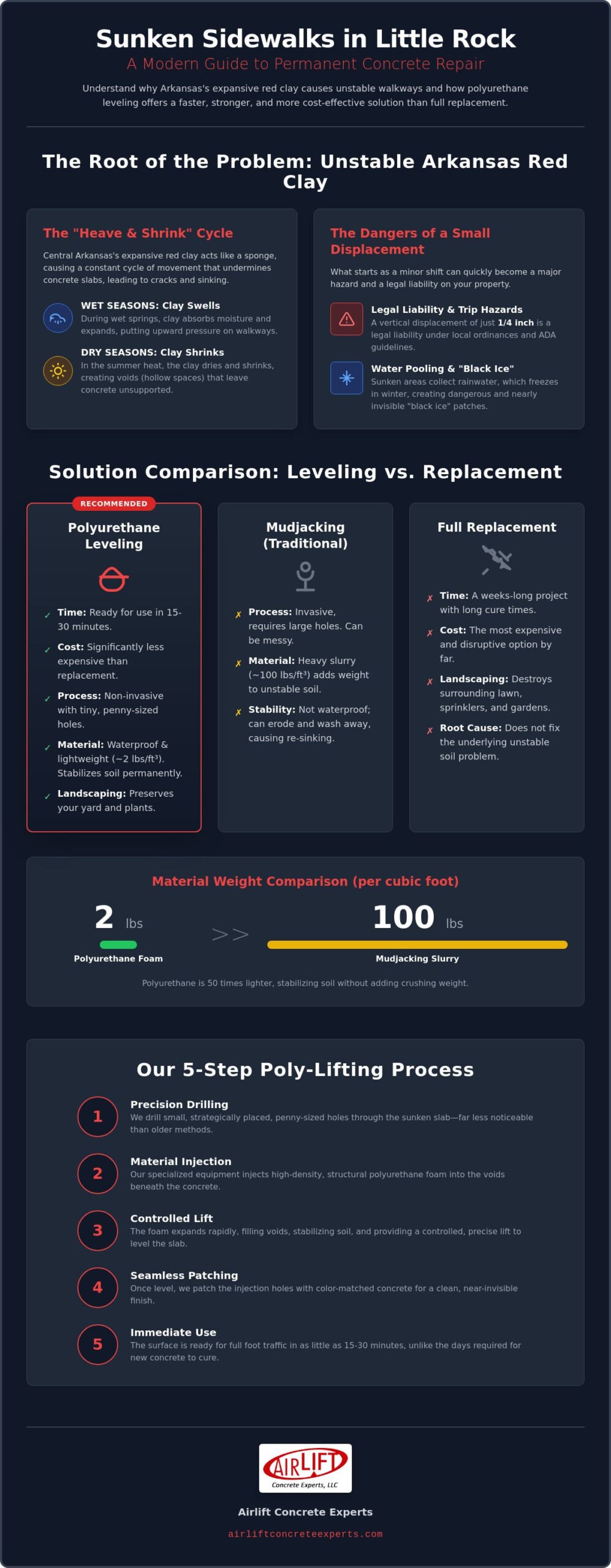
The Central Arkansas region is defined by its heavy red clay. This soil is highly expansive, meaning it acts like a sponge. During our humid, wet springs, the clay absorbs moisture and swells, putting upward pressure on your walkways. When the heat of a typical Little Rock July arrives, that same soil loses moisture and shrinks significantly. This constant cycle of “heave and shrink” eventually leaves hollow spaces, or voids, under your sidewalk. Without solid ground to rest on, the heavy concrete slabs inevitably crack and sink under their own weight.
Beyond the natural movement of clay, Central Arkansas neighborhoods often face “washout” issues. Heavy spring rains can carve out channels beneath concrete if your property’s drainage isn’t perfect. We often see slabs fail because gutter downspouts dump water directly at the edge of a walkway, rapidly accelerating soil erosion. Unlike sandy soils that might settle evenly, our red clay requires a specific approach to Concrete leveling that prioritizes long-term soil stabilization rather than just a temporary lift. If you ignore a minor one-inch drop now, the lack of support can lead to a total slab failure within a single season as the unsupported concrete snaps under pressure.
Identifying a problem early is the best way to protect your investment. Professionals look for the “trip hazard zone,” which is any vertical displacement greater than 1/4 inch. While it might look small, these edges are enough to catch a toe and cause a fall. Sunken slabs also create a secondary problem: they trap standing water. In the winter, this water freezes into “black ice,” creating a hidden danger for anyone walking on your property. Beyond safety, the aesthetic decline of uneven concrete can significantly hurt your home’s curb appeal, making the entire property look neglected even if the rest of your landscaping is pristine.
Understanding why your concrete is sinking is the first step toward a stable property; fixing it with the right technology is the second. While traditional methods have existed for decades, modern sunken sidewalk slab repair in Little Rock relies on high-density polyurethane foam. This material provides a surgical level of precision that older techniques simply can’t match. The process is non-invasive and respects your landscaping, focusing on the root cause of the shift without the need for heavy machinery.
Our repair process follows a methodical, five-step progression designed for efficiency and durability:
Traditional mudjacking uses a heavy slurry of sand and cement to push concrete upward. In our region, adding more weight to already unstable soil is often a recipe for further sinking. Polyurethane foam is incredibly lightweight, weighing about two pounds per cubic foot compared to the 100 pounds per cubic foot of mudjacking slurry. It’s a clean process that eliminates the “slurry mess” often left behind by older methods. Because the foam is waterproof, it acts as a permanent soil stabilizer that won’t wash away during a wet Arkansas spring.
The foam works by filling every microscopic void beneath the slab, creating a solid foundation that prevents future settlement. This is particularly important when dealing with the unique properties of Arkansas “buckshot clays”, which are known for their high expansion and contraction rates. Modern lifting foams are environmentally safe, non-toxic, and eco-friendly, ensuring no harmful chemicals leach into your soil. Despite being lightweight, this material maintains an impressive load-bearing capacity, easily supporting commercial-grade traffic once it has fully expanded. If you’re ready to secure your property, scheduling a professional assessment for polyurethane concrete leveling is the first step toward a permanent fix.
Deciding whether to repair or replace your concrete is a significant financial choice. For most property owners, the goal is to find a solution that is both effective and economical. When you choose professional leveling, you’re opting for a method that typically costs 50% to 70% less than a full tear-out and pour. This price difference exists because leveling eliminates the need for expensive demolition crews, heavy machinery, and high disposal fees at the landfill.
Time is another critical factor. A full replacement is a multi-day ordeal. You have to wait for the demolition, the form setting, the pour, and then several days for the concrete to cure before anyone can walk on it. In contrast, sunken sidewalk slab repair in Little Rock using polyurethane takes only a few hours. Your walkway is ready for use almost immediately, meaning you don’t have to block off your front entrance or redirect customers for a week.
Established Little Rock yards also benefit from the “no-dig” nature of poly-lifting. Traditional replacement requires heavy equipment that can rut your lawn and damage flower beds. Poly-lifting equipment is much smaller and less invasive. Additionally, keeping your original slabs avoids the “patchwork” look. New concrete is bright white and rarely matches the weathered, seasoned appearance of your existing driveway or porch. Using the modern approach ensures your property maintains a cohesive, uniform appearance.
Leveling is a smart long-term investment. By filling the voids beneath the slab, you’re restoring the structural integrity of the walkway and preventing the cracks from spreading. You also avoid hidden replacement costs like city permits or the environmental fees associated with concrete debris. Many homeowners find that polyurethane concrete leveling provides the best balance of safety and property value preservation. It addresses the root cause of the sinking without the unnecessary waste of a total replacement.
There are times when we’ll tell you that repair isn’t the right choice. If a slab has extensive “spiderweb” cracking, it may lack the structural strength to be lifted in one piece. Similarly, massive tree root intrusion can physically break the concrete or prevent it from returning to its level position. We pride ourselves on an honesty policy; we only recommend lifting what can be saved. If your sidewalk is too far gone, we’ll give you a straightforward assessment so you don’t waste money on a temporary fix. Our goal is to ensure your property is safe and stable for the long haul.
The legal definition of a trip hazard is stricter than most people realize. Federal standards under the Americans with Disabilities Act (ADA) state that any vertical displacement between adjacent sidewalk sections exceeding 1/4 inch is a violation. This small edge is enough to catch a shoe or impede a wheelchair, potentially leading to high-cost trip-and-fall litigation. If an accident occurs on a non-compliant path, your liability insurance may not fully protect you if the defect was a known, unaddressed issue.
The financial impact of a personal injury claim in Central Arkansas can be devastating for a small business or homeowner. Some people try to save money by grinding down the high edge of a concrete slab. This “quick fix” is often a mistake because it removes the protective top layer of the concrete, making it porous and prone to rapid crumbling. It also leaves an unsightly, scarred finish that hurts property value. A professional repair provides a level surface without compromising the slab’s strength, and having a record of professional maintenance can serve as a vital defense in demonstrating your commitment to property safety.
Staying compliant requires an understanding of specific measurements beyond just the 1/4 inch rule. For instance, the City of Little Rock’s development guidelines specify a maximum sidewalk cross slope of 2% to ensure proper drainage and accessibility. If your slabs have tilted significantly, they likely violate these standards and could cause water to pool, creating slip hazards during our icy winter mornings. Consulting with concrete lifting experts ensures that your repairs meet these precise federal and local requirements. We focus on restoring the correct pitch and elevation to keep your property accessible for everyone. Schedule your professional sidewalk assessment today to identify potential liability risks before they become legal problems.
Choosing a contractor for your property is about more than just finding the lowest bid; it’s about finding a partner who understands the local environment. At Airlift Concrete Experts, we are a locally owned and operated business that lives and works in the same communities we serve. We’ve spent years studying the specific behaviors of Arkansas soil, which allows us to provide a level of precision in sunken sidewalk slab repair in Little Rock that national competitors simply can’t match. We don’t just lift concrete; we provide a stable foundation that respects the unique geological challenges of our region.
Our service area extends across Central Arkansas, including Little Rock, North Little Rock, Benton, Bryant, and the surrounding areas. We’ve built our reputation on a commitment to transparency, which is why we offer complimentary on-site inspections for every neighbor. You’ll receive a straightforward, no-pressure estimate for your sunken sidewalk slab repair in Little Rock. You will know exactly what’s happening beneath your concrete and how we intend to fix it before any work begins.
We founded this company in 2017 with a singular focus on specialized concrete restoration. While general contractors might offer concrete work as a side service, we’ve dedicated our entire business to the science of leveling and stabilization. This specialization is why we never use retail DIY kits. Those consumer-grade products often lack the structural integrity needed to withstand the pressure of heavy slabs or the shifting nature of our clay. Instead, we use commercial-grade, high-density polyurethane foam that provides the necessary lift while acting as a permanent barrier against moisture. Over the years, we’ve saved local homeowners thousands of dollars by restoring their existing walkways rather than forcing them into unnecessary and expensive replacements.
When you schedule your complimentary inspection, one of our technicians will evaluate your sidewalk’s pitch, the extent of the voids, and the health of the surrounding soil. We take the time to answer your questions so you feel confident in the solution. Our residential projects come with a “no-mess” guarantee. Because our equipment is self-contained and our injection holes are so small, we leave your landscaping and property exactly as we found it, except with level, safe concrete. If you’re ready to eliminate trip hazards and restore your home’s curb appeal, Schedule your free Little Rock sidewalk inspection today!
Maintaining safe, compliant walkways doesn’t have to be a disruptive or expensive ordeal. You now understand that shifting Arkansas red clay is the primary culprit behind uneven concrete, and you know that modern technology offers a way to stabilize that soil permanently. By choosing specialized high-density polyurethane technology, you can restore your property’s safety and curb appeal in a single afternoon without the mess of a full demolition. This approach saves you significant time and money compared to traditional replacement.
Proactive maintenance is the most effective way to protect yourself from liability and ensure your home or business remains accessible. We can help. As a family-owned and operated company since 2017, we take pride in serving Little Rock, Benton, and all of Central Arkansas with honest, expert solutions. Get a Free Sidewalk Repair Estimate in Little Rock for your sunken sidewalk slab repair Little Rock today. We are ready to help you stabilize your foundation and provide the lasting security your property deserves.
The total cost for repair depends on the size of the sidewalk slabs and the depth of the voids beneath them. While we don’t provide flat rates without an inspection, professional leveling is consistently more affordable than a full tear-out and replacement. We offer free on-site assessments to provide an accurate estimate based on your specific property needs.
High-density polyurethane foam is designed to last as long as the concrete itself. It’s a chemically inert material that won’t rot, degrade, or wash away when exposed to moisture. Because it’s waterproof, it remains stable even during the heavy rain cycles common in Central Arkansas, providing a permanent foundation for your walkways.
No, the poly-lifting process is remarkably clean and non-invasive. We don’t need to bring heavy machinery or large trucks onto your grass. Our technicians use small, portable hoses to reach the sidewalk, and the injection holes are only about the size of a penny. This ensures your flower beds and turf remain undisturbed throughout the project.
We generally cannot lift slabs that have “spiderweb” cracking or have crumbled into small fragments. Successful sunken sidewalk slab repair in Little Rock requires the concrete to have enough structural integrity to be lifted as a single unit. If your sidewalk is too far gone for a reliable repair, we’ll give you an honest assessment during your inspection.
You can use your sidewalk for full foot traffic almost immediately after we finish. The polyurethane foam reaches its full load-bearing capacity in about 15 to 30 minutes. This is a major advantage over new concrete pours, which often require you to block off sections of your property for several days while the material cures.
Yes, the specialized foams we use are non-toxic and environmentally safe. Once the material has expanded and cured, it becomes inert and won’t leach chemicals into the surrounding soil or groundwater. It’s a safe solution for residential neighborhoods and won’t harm your plants or the local ecosystem.
We believe in the quality of our work and provide specific service protections for our structural repairs. Because soil conditions can vary across the region, we’ll discuss the details of our service coverage and what you can expect for your specific project during your initial consultation. We’re committed to ensuring you feel secure in your investment.
The primary difference is the weight of the material and the size of the equipment. Mudjacking uses a heavy slurry of sand and cement that can add thousands of pounds to already unstable soil. Polyjacking, or sunken sidewalk slab repair in Little Rock using foam, is much lighter and requires significantly smaller injection holes. This modern method is cleaner and provides a more durable result in our local clay soils.

 Call Now