
You step out to grab the mail and notice a jagged concrete ledge where your walkway used to be smooth. It’s a common sight throughout Central Arkansas, yet it often leaves homeowners asking the same frustrating question: why is my sidewalk sinking Little Rock? Beyond the obvious tripping hazard for your neighbors and family, these uneven slabs quickly diminish your home’s curb appeal. You might even worry that a loud, messy, and expensive total replacement is the only way to make your property safe again.
We understand that watching your property shift can feel like a losing battle against the elements. The good news is that a sunken sidewalk doesn’t have to be a permanent headache. This guide will help you discover the specific environmental causes behind Little Rock’s shifting concrete and the most effective, long-term solutions for Arkansas homeowners. We’ll explore the science of our local expansive clay soils and explain how polyurethane concrete leveling offers a surgical fix that restores your walkway without ruining your yard.
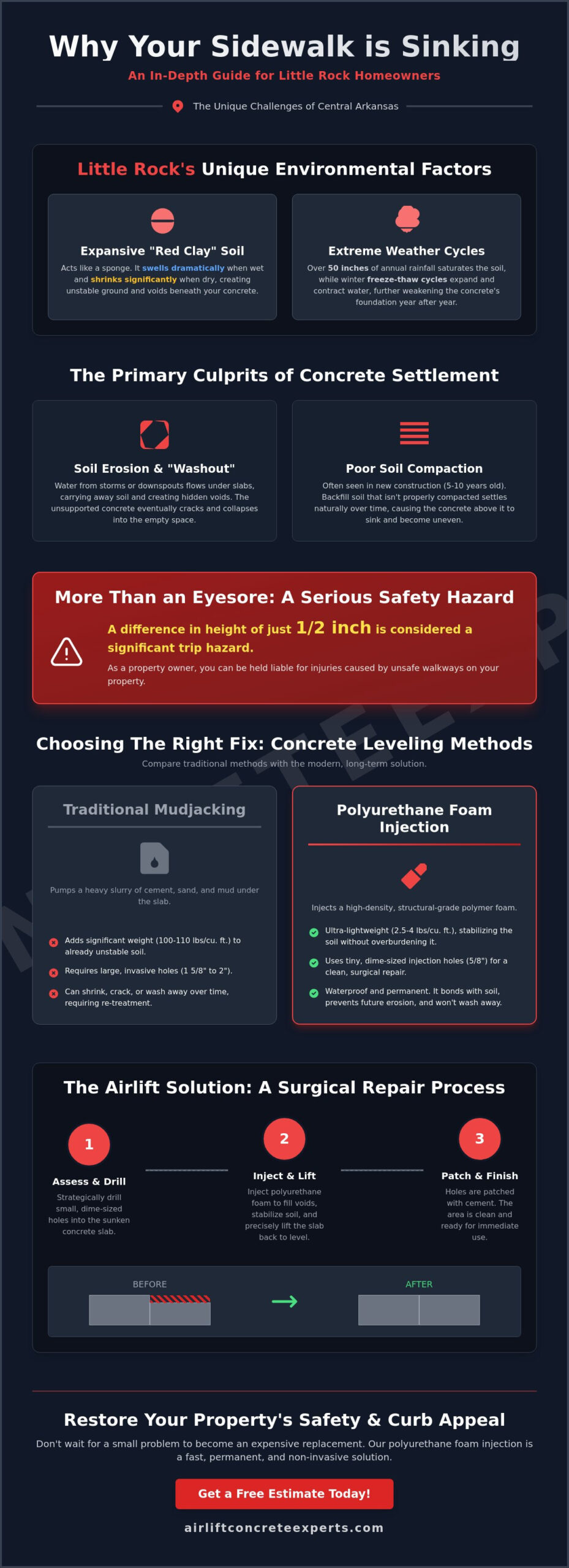
Sidewalk settlement occurs when the soil beneath a concrete slab can no longer support its weight, leading to downward movement. In Little Rock, this isn’t just a random occurrence; it’s a byproduct of our unique position in the Arkansas River Valley. The geological makeup of our region creates a challenging foundation for residential infrastructure. If you’ve spent your weekend inspecting a new ledge in your walkway and wondering why is my sidewalk sinking Little Rock homeowners often find the answer lies in the ground rather than the concrete itself. Our regional soil composition is uniquely prone to failure.
Central Arkansas is famous for its heavy, dense red clay. Expansive clay soils are particularly troublesome because they act like a sponge. During a wet Little Rock spring, this clay absorbs massive amounts of water and swells with incredible force. This upward pressure can actually heave concrete slabs. However, the real trouble starts during our hot, dry summers. As the moisture evaporates, the clay shrinks and pulls away from the concrete, leaving empty spaces or “voids” behind. Without the soil there to provide a solid base, the heavy sidewalk eventually drops into the hole. Expansive clay is a soil that changes volume significantly based on moisture content.
Our local weather patterns accelerate this process. Little Rock typically receives over 50 inches of annual rainfall, which keeps the soil in a constant state of flux. In historic neighborhoods like Hillcrest and the Heights, where mature trees and established landscapes compete for ground moisture, this “shrink-swell” cycle is even more pronounced. The roots of large oaks can pull moisture from the clay during a drought, causing localized sinking that makes one slab drop while the next stays put.
Winter brings its own set of challenges through freeze-thaw cycles. When water trapped beneath the concrete freezes, it expands and puts pressure on the slab. When it thaws, it often carries away loose sediment, further weakening the foundation. This repetitive stress makes sidewalk and driveway settlement a predictable part of homeownership in Central Arkansas. Understanding these environmental triggers is the first step toward finding a repair that actually lasts.
While the expansive clay we discussed previously provides the geological foundation for the problem, active environmental forces often trigger the actual movement. If you’re currently asking why is my sidewalk sinking Little Rock homes frequently suffer from subsurface erosion, often called “washout.” This process occurs when water from heavy storms or poorly directed gutter downspouts finds a path beneath your concrete. As the water moves, it carries away the soil’s structural support, leaving your walkway vulnerable to gravity.
Little Rock’s hilly terrain, particularly in areas like West Little Rock and Cammack Village, naturally accelerates water runoff. When water flows quickly across a sloping yard, it can seep under the edge of a sidewalk and wash away the “fines,” which are the small particles of sand and silt that keep soil stable. This creates a hidden hollow space. Your sidewalk might appear solid on the surface, but it’s actually “bridging” a dangerous empty void. Eventually, the weight of the concrete or the pressure of a pedestrian’s footstep causes the slab to snap and drop into the hole. To better understand the specific soil characteristics of your neighborhood, you can reference the Web Soil Survey resources provided by the University of Arkansas.
It’s a common frustration for owners of newer homes: the house is less than a decade old, yet the walkway is already uneven. This typically happens because of poorly compacted backfill. When developers clear land and dig foundations in newer Little Rock subdivisions, they move massive amounts of earth. If that soil isn’t mechanically compacted in specific, thin layers, it will naturally settle and compress over the first 5 to 10 years. Waiting for this process to “finish” on its own often leads to more severe cracking and higher repair costs. Opting for professional concrete lifting early in the process can stabilize the area before the damage requires a full, messy replacement.
Invasive tree roots from common Arkansas hardwoods like water oaks and maples also play a significant role. These roots grow toward moisture, often traveling directly under your sidewalk. As the root thickens, it exerts upward pressure that can tilt a slab, while the surrounding soil might be eroding, causing a double-sided problem. Additionally, hydrostatic pressure from poor drainage can build up during our rainy seasons. When water remains trapped under the concrete, it exerts force that weakens the bond between the slab and the ground. If you’ve noticed these symptoms on your property, a complimentary assessment from a local specialist can help you identify the root cause before the next heavy rain arrives.
When homeowners discover uneven concrete, they often look for the most cost-effective fix. If you’ve been researching why is my sidewalk sinking Little Rock, you’ve likely encountered two main options: traditional mudjacking and modern polyurethane injection. While mudjacking was the industry standard for decades, it often struggles to provide a lasting solution in our specific regional environment. Understanding the physical differences between these methods is key to ensuring your repair doesn’t become a recurring expense.
Mudjacking involves pumping a heavy “slurry” made of water, dirt, and cement under the concrete slab. This mixture is incredibly dense, often weighing over 100 pounds per cubic foot. In Central Arkansas, where our topsoil is already prone to compression, adding this massive weight can actually backfire. The heavy slurry often further compresses the weak soil beneath, causing the sidewalk to sink again within just a few years. Additionally, mudjacking requires large injection holes, roughly the size of a soda can, which can be unsightly on a residential walkway. Because the slurry is water-based, it remains vulnerable to the same “washout” issues that caused the original settlement, especially during our heavy seasonal rains.
Modern polyurethane concrete leveling offers a more refined, durable alternative. Instead of heavy mud, we use a specialized foam that weighs only 2 to 4 pounds per cubic foot. This lightweight material provides the necessary lift without overburdening the fragile soil beneath your home. The process is almost surgical; we drill tiny holes, about the size of a penny, and inject the liquid foam directly where it’s needed. As the foam expands, it travels into every hidden void and compacts the loose soil to create a stable foundation.
The benefits of this modern approach extend beyond just weight and aesthetics. Polyurethane offers several practical advantages for the busy Little Rock homeowner:
Choosing a repair method that addresses the root cause of the problem ensures a permanent fix. By using a material that actually strengthens the soil rather than just adding weight, you protect your property’s value and safety for the long term.
A small lip at the edge of a concrete slab might seem like a minor nuisance, but it quickly becomes a significant liability. In Little Rock, property owners are legally responsible for the maintenance and repair of sidewalks adjacent to their homes. If a mail carrier or neighbor trips on an uneven joint, you could be held responsible for any resulting injuries. Standard safety guidelines generally classify any vertical displacement over 1/4 to 1/2 inch as a dangerous trip hazard. If you’ve been asking why is my sidewalk sinking Little Rock, the answer often involves a combination of the environmental factors we’ve discussed and the immediate safety risks these shifts create.
Beyond the risk of injury, sunken concrete often indicates a drainage problem that could threaten your entire property. When a sidewalk tilts toward your home, it acts as a funnel. During our heavy Arkansas rainstorms, this directs water directly toward your home’s base. This concentrated moisture saturates the ground, which can lead to more serious foundation repair near me needs if the water causes the soil around your foundation walls to shift or erode.
Ignoring these early warning signs rarely saves money. When one side of a slab loses its support, the weight of the concrete creates intense stress along the center. This often results in “hinge cracks,” where the slab snaps in two. Once a slab is severely cracked or crumbled, simple leveling is no longer an option. Professional concrete leveling is a fraction of the cost of a full replacement, which typically ranges from $15 to $25 per square foot. Acting while the slab is still intact allows for a non-invasive lift that preserves your original concrete and your budget.
Identifying the problem early allows for a faster, cleaner fix. You should walk your property and look for these specific signs:
While some homeowners consider DIY foam kits found at big-box stores, these retail products often lack the specialized pressure and volume required for true structural lifting. They might fill a small hole, but they won’t provide the long-term stability needed to support heavy concrete slabs. If you’re noticing these hazards, it’s time to act before a small trip hazard becomes a major replacement project. You can request a complimentary initial assessment to determine the best path forward for your home.
When you discover the answer to why is my sidewalk sinking Little Rock, the next logical step is finding a partner who can restore your property without the stress of a major construction project. We believe that structural repairs should be as non-invasive as possible. Unlike traditional replacement methods that require heavy machinery to tear up your lawn and weeks of curing time, our approach focuses on surgical precision. We use specialized equipment that stays on the street or in the driveway, ensuring your landscaping and flower beds remain untouched during the process.
Our team has refined a steady, methodical approach to concrete raising that addresses the root cause of settlement. We follow three primary steps to ensure a stable and attractive result:
Since our founding in 2017, we have focused on building deep roots in the Central Arkansas community. We aren’t a national franchise; we’re a locally owned and operated business that treats every customer like a neighbor. Because we understand the unique challenges of the Arkansas River Valley’s soil, we can provide a solution that is specifically engineered to withstand our local climate. Our polyurethane foam is designed for longevity, providing a stable base that resists the “shrink-swell” cycles of our regional clay.
Our primary goal is always to offer a repair that saves you money and time. By choosing repair over replacement, we help homeowners avoid the high costs and logistical headaches of pouring new concrete. Whether you have a small residential walkway or a series of commercial paths, our expertise in polyjacking near me ensures your property remains safe and beautiful. We take pride in being the regional authority that transforms your property anxiety into a sense of lasting security. If you’re ready to fix your uneven sidewalk for good, we invite you to reach out for a professional assessment today.
Understanding why is my sidewalk sinking Little Rock is the first step toward a safer home. The combination of expansive clay and our local climate requires a specialized approach that traditional methods often fail to provide. By choosing polyurethane injection, you address the root cause of settlement with a lightweight, durable material that won’t wash away or further compress the soil. This surgical repair preserves your original concrete and your landscaping while eliminating dangerous trip hazards for your family and neighbors.
Since 2017, Airlift Concrete Experts has served the Central Arkansas community as a locally owned and operated specialist. We focus on providing long-term value by repairing rather than replacing, which saves you both time and money. Don’t wait for a small crack to become a costly replacement project. We invite you to Request Your Free Little Rock Concrete Inspection today. Our no-pressure structural assessments provide the technical clarity you need to protect your home’s value. We look forward to helping you stabilize your property and regain your peace of mind.
Professional concrete leveling is significantly more cost-effective than a total replacement. In most cases, leveling costs up to 70% less than the price of tearing out old slabs and pouring new ones. This approach saves you from the labor-intensive costs of demolition and debris removal while providing a stable surface in a fraction of the time.
Polyurethane injection is considered a permanent repair because the material is hydrophobic and does not degrade over time. Unlike the natural silt and clay in our local soil, the foam won’t wash away during heavy rain or shrink during a drought. It effectively fills the subsurface voids that answer the common question of why is my sidewalk sinking Little Rock homes for the long term.
We can typically lift cracked sidewalks as long as the concrete remains in large, manageable sections. While the injection process won’t make the physical cracks disappear, it aligns the slabs to eliminate the trip hazard. We patch the injection holes and can help you seal existing cracks to prevent water from reaching the soil beneath, which helps stop future settlement.
The polyurethane foam used for concrete raising is environmentally inert and will not leach chemicals into your soil or the local water table. The process is remarkably clean; we don’t require heavy trucks or excavators to drive across your grass. Our specialized equipment uses long hoses to reach your walkway from the street, ensuring your flower beds and turf remain undisturbed.
You can walk on your sidewalk within 15 to 30 minutes of the injection process. The high-density foam reaches the majority of its structural strength almost immediately. This rapid cure time is a primary advantage over traditional concrete replacement, which often requires you to block off the area for several days while the new pour sets.
Yes, property owners in Little Rock are legally responsible for the maintenance and repair of sidewalks adjacent to their property. The city has the authority to compel owners to make repairs if a walkway becomes a safety hazard. Proactively leveling your sidewalk also protects you from potential liability claims if a mail carrier or pedestrian trips on your property.
Concrete repair can be performed effectively during any season in Arkansas as long as the ground isn’t frozen. Many homeowners choose to schedule repairs during the dry summer months when the expansive clay has shrunk to its minimum volume. This allows us to fill the largest possible voids and provide the most stable foundation before the heavy spring rains return.
Polyjacking is an ideal solution for sinking porches, pool decks, and even interior floor leveling. The same lightweight foam technology that levels a sidewalk can support any heavy concrete slab on your property. Because the material is waterproof, it is especially effective for pool decks where constant water exposure often leads to soil erosion and settlement.

 Call Now