

You’re pulling into your driveway after a long day, but instead of a smooth transition, you hear the gut-wrenching scrape of your car’s undercarriage against the concrete. If you’ve noticed your driveway sinking near garage Malvern, you’re likely dealing with more than just an eyesore. It’s a daily frustration that creates trip hazards for your family and raises valid concerns about water pooling against your home’s foundation. In Malvern, our local soil conditions often turn a once-level entrance into a structural headache that feels impossible to ignore.
It’s completely normal to feel anxious about the cost and chaos of a full concrete replacement, but you don’t have to tear out your entire slab to fix the problem. This guide explains why our unique Arkansas red clay causes these shifts and how modern polyurethane injection provides a permanent, cost-effective solution. You’ll learn how to achieve a level transition to your garage and protect your home’s resale value without a week of construction downtime. We will walk through the 2026 repair standards that get you back on your driveway in hours, not days.
Many Malvern homeowners wake up to find a growing lip between their driveway and garage door. This isn’t just bad luck; it’s a result of how your home was built. A driveway sinking near garage Malvern often starts as a hairline crack at the expansion joint. This specific transition point is the most vulnerable area of your entire concrete surface because it represents a meeting of two completely different structural systems. While your garage is supported by deep footings designed to stay put, your driveway is a “floating” slab that relies entirely on the soil directly beneath it.
The “Malvern Bump” is a term locals use to describe that jarring jolt you feel when pulling into the garage. It’s more than a nuisance. It puts unnecessary stress on your vehicle’s suspension and creates a dangerous trip hazard for your family. Central Arkansas 2026 weather patterns have been particularly harsh on soil stability. We’ve seen an increase in heavy, concentrated rainfall followed by periods of high humidity, which causes the ground to shift more aggressively than in previous years. This cycle accelerates the settlement process, making a once-level driveway look like it’s pulling away from the house.
To understand the fix, you have to understand the physics of the problem. Your garage sits on a rigid footer that extends deep into the ground, well below the frost line. This keeps the garage floor stable. In contrast, your driveway slab is poured over topsoil or a thin layer of gravel. Because these two structures aren’t tied together, they move independently. The joint between them is the primary entry point for water. When water gets into that gap, it softens the soil or washes it away entirely, leaving a void. This is where concrete leveling becomes necessary to restore the balance. Every time you drive a heavy SUV or truck over that hollow spot, the weight compresses the remaining soil even further, deepening the sinkhole.
Catching the problem before it requires a major intervention can save you significant stress. Look for these specific physical symptoms around your garage entrance:
If you notice these signs, the subgrade beneath your concrete is likely failing. Addressing the issue now prevents water from reaching your garage’s foundation, which is a much more expensive repair.
Living in Malvern means dealing with specific environmental factors that don’t exist in other parts of the country. The proximity to the Ouachita River and our local geology play a massive role in why you’re seeing your driveway sinking near garage Malvern. It isn’t just about the weight of your vehicle; it’s about the ground moving beneath the slab. When the soil loses its ability to support the weight of the concrete, gravity inevitably takes over.
Much of our region is defined by Arkansas Red Clay, a soil type notorious for its expansive properties. Think of this clay as a giant subterranean sponge. During our wet Arkansas springs, the clay absorbs water and swells with incredible force. This creates hydrostatic pressure, which is the pressure exerted by a fluid at rest due to the force of gravity. In this context, it’s the water-saturated soil pushing upward against your concrete with enough power to shift heavy slabs. When the hot, dry summer hits, that same soil loses moisture and shrinks. This constant back and forth movement creates empty pockets, or voids, directly under your slab. Without a solid foundation to rest on, the heavy concrete eventually settles into these gaps.
While soil chemistry is a major factor, poor water management is often the primary catalyst for settlement. We frequently see downspouts that discharge water right at the corner where the driveway meets the garage. This concentration of runoff leads to the “Washout Effect.” High volumes of water move through the expansion joints and erode the sub-base, carrying away the sand and gravel meant to support the slab. Improper yard grading can also direct rainwater toward the house rather than away from it, leading to significant under-slab erosion. You might not see the damage until the concrete actually cracks, but a hollow sound when you walk over the area is a clear indicator of trouble.
Many homeowners try to bridge the gap with a DIY surface patch or a bag of quick-set concrete. These are temporary fixes at best. They add unnecessary weight to a failing sub-base without addressing the empty space underneath. A professional assessment of your soil stability can identify these voids before they lead to a complete structural failure. Understanding the source of the washout is the first step toward a permanent repair that protects your home’s value.
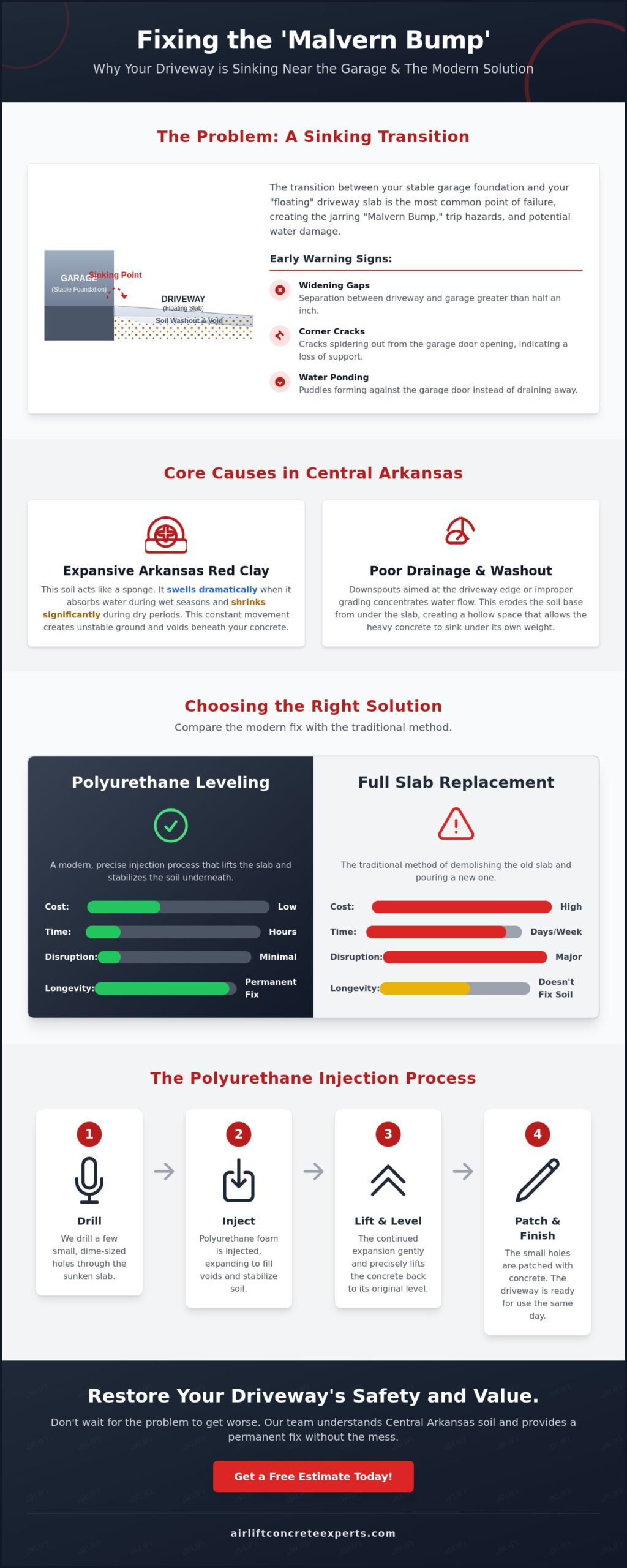
When you realize you have a driveway sinking near garage Malvern, your first instinct might be to call for a full replacement. However, tearing out and re-pouring concrete is often an unnecessary expense that causes more disruption than benefit. A full replacement involves days of noise, dust, and heavy machinery, followed by at least a week of waiting for the new slab to cure. In contrast, polyurethane injection addresses the root cause of the settlement without the need for a construction zone. It is a faster, cleaner, and more affordable way to restore your property’s safety.
How do you know if your driveway is truly “too far gone”? We generally recommend replacement only when the concrete has reached the end of its structural life. This includes slabs that are crumbling into gravel, showing “alligator” cracking across the entire surface, or where the internal rebar has rusted through and caused the slab to shatter into dozens of small, unliftable pieces. If the concrete is still solid but simply tilted or sunken, leveling is almost always the superior choice. It’s also a “green” solution because it keeps old concrete out of our local landfills and requires significantly less energy than manufacturing and transporting new cement.
Traditional mudjacking was once the standard repair method, but it’s often a poor fit for the expansive properties of Arkansas red clay. Mudjacking uses a heavy slurry of cement, sand, and soil that can weigh up to 150 pounds per cubic foot. In Malvern’s unstable soil, adding that much weight can actually cause the slab to sink again. Polyjacking uses a high-density, closed-cell foam that weighs only a few pounds per cubic foot. It’s strong enough to lift a driveway but light enough to avoid stressing the subgrade. Plus, the injection ports are only the size of a penny, whereas mudjacking requires holes the size of a soda can.
Beyond the immediate fix, leveling offers a strong return on investment. A sunken driveway can significantly lower a Malvern home appraisal, as it suggests underlying drainage or foundation issues to potential buyers. By addressing the gap early, you prevent water from reaching your garage’s footer, protecting the rest of your home from secondary structural damage. If you are searching for polyjacking near me, choosing a method that allows you to park your car back in the garage within 15 minutes of the repair is a clear advantage for any busy household. It’s a permanent fix that stabilizes the soil and your home’s value simultaneously.
We approach every driveway sinking near garage Malvern with a methodical, four-step process designed for surgical accuracy and long-term durability. First, our technicians drill tiny injection ports, roughly the size of a penny, into the sunken slab at strategic locations. Next, we inject high-density, closed-cell polyurethane foam beneath the surface. This material expands rapidly, filling the subterranean voids and compacting the loose soil we identified in previous sections. During the injection, we monitor the slab’s movement with high-precision laser levels to ensure the transition is perfectly flush with your garage floor. Finally, we seal the injection ports with a color-matched cement grout and secure the expansion joint to prevent future water infiltration.
Don’t be fooled by DIY foam kits found at big-box stores. These consumer products lack the density and compressive strength required to support a multi-ton concrete slab or a heavy vehicle. Our pro-grade structural polymers are engineered specifically to withstand the unique pressures of Arkansas soil. Once the material is injected, the foam becomes completely waterproof and chemically inert; it will not leach into the ground or break down over time. This creates a stable, lightweight foundation that won’t contribute to further settlement the way heavier materials might.
Most driveway-garage transition repairs are completed in just one to three hours. You won’t have to deal with the deafening noise of jackhammers or the dust and mess associated with tearing out old concrete. Polyjacking is remarkably clean and minimally invasive. The best part of the process is the immediate turnaround. Unlike new concrete construction that requires a 28-day cure time, polyurethane reaches 90 percent of its full strength within minutes. You can park your car back in the garage just 15 minutes after our crew finishes the job.
If you’re ready to eliminate that jarring “Malvern Bump” and restore your home’s curb appeal, schedule an assessment with our local specialists to see if polyjacking is the right fit for your property.
Airlift Concrete Experts has served Malvern and the surrounding Central Arkansas communities since 2017. We’ve built our reputation on a foundation of honesty and technical proficiency. When you’re dealing with a driveway sinking near garage Malvern, you need more than just a contractor; you need a partner who understands how our local environment affects your home’s stability. Our team doesn’t just look at the concrete surface. We look at the soil dynamics and drainage patterns that caused the issue in the first place. This neighborly approach ensures you receive a solution tailored to your specific property. By combining industrial-grade technology with a deep commitment to our community, we transform a stressful structural problem into a simple, permanent fix.
Our commitment to excellence means staying at the forefront of 2026 industry standards. We use specialized equipment that allows for precision lifting within fractions of an inch. This level of detail is essential when you’re trying to achieve a perfectly flush transition between your driveway and garage. We treat every home as if it were our own, ensuring the workspace stays clean and your daily routine remains uninterrupted. Our goal is to provide a sense of security and stability that lasts for years to come.
Our reach extends throughout the region, providing expert care to homeowners in Hot Springs, Benton, and Bryant. We specialize in concrete lifting and stabilization. Unlike some contractors who might push for a costly and unnecessary new driveway, our goal is always to preserve your existing concrete whenever possible. We believe in providing the most effective repair without the waste of a full replacement. By focusing on the structural integrity of the subgrade, we deliver results that stand up to the test of time and Arkansas weather. This focus on repair over replacement saves you money and reduces the environmental footprint of your home maintenance.
Taking the first step toward a safer home is straightforward. You can call our office or fill out our online form to request a professional site evaluation. During this assessment, our technicians will examine the extent of the settlement, identify any active drainage issues, and determine the precise amount of polyurethane needed to restore your slab. We provide clear, straightforward explanations so you can make an informed decision about your property maintenance. We don’t use high-pressure sales tactics. Instead, we offer the technical data and local expertise you need to protect your home’s resale value. It’s time to stop worrying about vehicle damage and trip hazards. Get your free driveway leveling quote in Malvern today!
A driveway sinking near garage Malvern doesn’t have to be a source of constant stress or a threat to your home’s resale value. By choosing specialized high-density polyurethane technology over the disruption of a full replacement, you’re investing in a solution that addresses the specific challenges of our local Arkansas soil. This modern approach stabilizes the ground beneath your slab and restores a flush, safe transition to your garage in just a few hours. It’s a permanent fix that allows you to focus on enjoying your home rather than worrying about the next rainy season or vehicle repair bill.
Since 2017, Airlift Concrete Experts has operated as a family-owned Arkansas business dedicated to providing honest, technical solutions for our neighbors. We believe in transparency and durability, which is why we offer complimentary initial structural assessments to help you understand the exact needs of your property. Don’t let a settling slab create unnecessary hazards for your family. Schedule Your Free Malvern Concrete Assessment Now and take the first step toward a level, stable driveway. We’re here to help you protect your investment with the local expertise you deserve.
A sinking driveway slab is usually a separate issue from your home’s foundation, but it often acts as an early warning sign. While the driveway “floats” on the surface soil, the gap created by settlement can direct rainwater straight toward your garage’s structural footer. If you don’t address this, the moisture can soften the soil supporting your home and potentially lead to foundation settlement over time.
The cost to repair a driveway sinking near garage Malvern depends on the size of the void and the volume of polyurethane material required to stabilize the slab. While this method is significantly more cost-effective than demolition and replacement, every property has unique subgrade conditions. A professional site evaluation is the only way to determine the specific requirements for a lasting repair on your property.
You should never use consumer-grade spray foam for structural concrete lifting. Hardware store foam is designed for insulation and lacks the compressive strength to support the weight of a concrete slab and a vehicle. Professional-grade structural polymers are engineered to be high-density and waterproof, providing a stable foundation that DIY kits cannot replicate.
Polyurethane concrete leveling is a permanent solution designed to withstand Arkansas’s intense humidity and temperature swings. Unlike traditional mudjacking slurry, which can erode or shrink over time, closed-cell foam is chemically inert and waterproof. It will not wash away during heavy rainstorms or break down due to the expansive nature of local red clay.
Your driveway’s appearance remains largely unchanged because the process preserves your existing slab. The only visible signs of the repair are tiny injection holes, which are roughly the size of a penny. We fill these holes with a cement grout designed to blend with your weathered concrete, and these small patches become even less noticeable as they age.
Ignoring the gap increases the risk of vehicle suspension damage and creates a serious trip hazard for your family. Additionally, the opening serves as a funnel for runoff to seep beneath your garage floor. This leads to deeper soil erosion and can eventually cause the interior garage slab to crack, resulting in much more expensive structural repairs.
No, polyjacking is specifically designed for rigid concrete slabs and is not an effective solution for asphalt. Asphalt is a flexible material that lacks the structural integrity to be lifted by foam injection. If your asphalt driveway is sinking or crumbling, you should check with a local paving specialist about resurfacing or patching options instead.
You can typically drive your vehicle over the leveled concrete within 15 to 30 minutes of the completed repair. Polyurethane reaches its full structural strength almost instantly, which is a major advantage over new concrete. This quick turnaround means you don’t have to park on the street or wait days for a new slab to cure.

 Call Now