
What if you could fix your sunken warehouse floors or tripping hazards on your sidewalks without shutting down your operations for a single day? You already know the stress of managing a commercial property in Central Arkansas, where our shifting alluvial soils can turn a perfectly level slab into a liability overnight. The constant worry about trip-and-fall accidents or damage to your expensive machinery is enough to keep any business owner up at night, especially when traditional repairs mean closing your doors for days. This is why commercial concrete raising in North Little Rock has become the preferred choice for local facility managers who need professional results without the frustration of downtime.
In this 2026 guide, you’ll learn how to restore safety and structural integrity to your property using high-density polyurethane injection. This method provides a level, OSHA-compliant surface that can support up to 14,000 pounds per square foot while allowing your team to get back to work in as little as 15 minutes. We’ll walk through the technical process of stabilizing Central Arkansas soils and explain how modern polyurethane concrete leveling offers a long-term solution that protects both your equipment and your bottom line.
When you manage a warehouse or a storefront in North Little Rock, your foundation is only as stable as the ground beneath it. Commercial concrete raising North Little Rock involves a specialized process where high-density polymers are injected through small holes in a sunken slab. Once beneath the surface, these polymers expand to fill voids and lift the concrete back to its original position. While there are several concrete leveling techniques available to property owners, the use of high-density polyurethane has become the regional standard because it addresses the root cause of the problem: unstable soil.
If you notice a drum-like, hollow sound when walking across your warehouse floor or driving a forklift over a joint, it’s a clear sign that a sub-base void has formed. These gaps occur when the supporting soil has either washed away or compacted unevenly. Ignoring these early symptoms often leads to severe structural damage. What starts as a minor trip hazard can quickly evolve into a full slab failure, potentially compromising the structural health of your entire facility and leading to costly, long-term repairs that go far beyond the surface of the concrete.
North Little Rock’s unique geography plays a significant role in how concrete behaves over time. Because much of our industrial zone sits in close proximity to the Arkansas River, many facilities are built on alluvial soils. These sandy, silty sub-bases are prone to shifting and erosion, especially during periods of heavy river flow or localized flooding. This movement creates the very voids that cause slabs to sink.
Additionally, Central Arkansas is known for its dense red clay. This soil type is notorious for a “shrink-swell” cycle. During our seasonal droughts, the clay loses moisture and shrinks, leaving the concrete without support. When the heavy rains return, hydrostatic pressure builds up, and the clay expands rapidly. This constant tug-of-war between the soil and the slab eventually causes the concrete to crack and settle, making commercial concrete raising North Little Rock a necessity for maintaining a level surface.
In many North Little Rock industrial parks, the first sign of trouble isn’t a crack, but “rocking” slabs. You might notice that when heavy machinery or a loaded forklift passes over an expansion joint, the slab visibly moves or deflects. This movement is a red flag that the sub-base is no longer providing uniform support. Another common symptom is the appearance of wall-to-floor gaps, particularly in office-to-warehouse transitions. These gaps suggest that the heavier industrial floor is pulling away from the building’s structural walls. Searching for polyjacking near me is often the most effective way to stabilize these areas before the damage requires a total tear-out and replacement.
High-density polyjacking is a sophisticated engineering solution designed specifically for the rigorous demands of industrial environments. When we perform commercial concrete raising North Little Rock, we use a specialized two-component polymer that reacts and expands beneath the slab. This material starts as a liquid, flowing into every micro-void and crack before expanding into a rigid, structural foam. Because this foam is hydrophobic, it doesn’t react with or become weakened by the high groundwater levels often found near the Arkansas River. It remains impervious to moisture, ensuring the repair stays stable regardless of the season.
The application process is remarkably clean and efficient. We drill penny-sized holes through the concrete and inject the resin. Unlike traditional methods that require large, unsightly patches, these small injection points are easily sealed and become nearly invisible. This allows for a surgical level of repair that maintains the aesthetic and structural integrity of your facility. If you’re concerned about the stability of your warehouse floor, you can reach out to a regional specialist to see if polyjacking is the right fit for your property.
Industrial floors must withstand immense pressure from high-reach forklifts and heavy warehouse racking. In these environments, compressive strength is the measure of a material’s ability to resist being crushed under a heavy load. Our commercial-grade foam offers a compressive strength of 100 to 200+ PSI, which is capable of supporting loads up to 14,000 pounds per square foot. By expanding to fill every gap, the foam creates 100% contact with the sub-base. This eliminates “point loading,” where a heavy weight is concentrated on a single unsupported spot; this is the leading cause of slab cracking in industrial zones.
Restoring a level surface requires more than just power; it requires extreme precision. We use advanced laser monitoring systems to achieve accuracy within 1/32 of an inch during the lifting process. This level of detail is vital for maintaining ADA compliance for ground surfaces, ensuring that transitions are smooth and safe for all users. Unlike traditional mudjacking, which uses a heavy slurry that can wash away over time, high-density foam actually consolidates loose soil. It binds the sub-base together, creating a permanent, lightweight foundation that won’t contribute to further settlement.
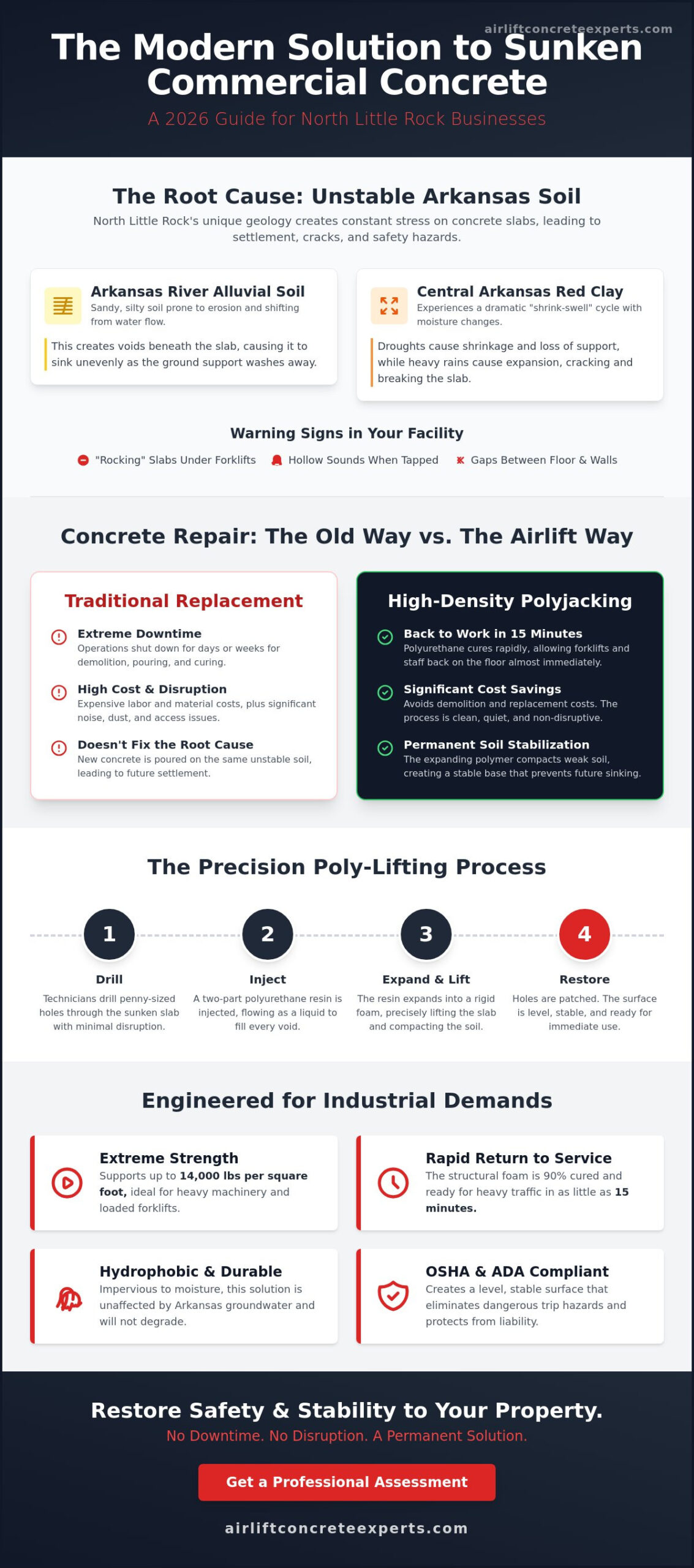
For many facility managers in Central Arkansas, the knee-jerk reaction to a sunken slab is to tear it out and start over. However, the financial reality of replacement often outweighs the benefits. Commercial concrete raising North Little Rock provides a much higher return on investment by bypassing the expensive demolition and hauling phases. Most businesses find that raising their concrete costs between 30% and 70% less than a full replacement. When you opt for replacement, you’re also falling into the “weight trap.” New concrete weighs roughly 150 pounds per cubic foot. Adding that massive load onto the same alluvial soil that already failed is a recipe for a repeat performance. By contrast, high-density foam adds negligible weight while reinforcing the existing sub-base, making commercial concrete raising North Little Rock the most durable financial choice.
There’s also a significant environmental factor to consider. Choosing to lift rather than replace keeps tons of debris out of our North Little Rock landfills. It’s a sustainable choice that aligns with modern corporate responsibility goals. While any major project must adhere to OSHA’s Concrete and Masonry Construction Standards, raising your existing slabs allows you to meet safety requirements without the massive carbon footprint of a new pour. You’re essentially recycling your existing asset while fixing the underlying soil issue.
The most significant hidden cost of concrete replacement is business interruption. A new commercial slab typically requires 7 to 28 days to reach full structural strength. During that time, your warehouse or loading dock is a dead zone. With polyurethane injection, the material cures in about 15 minutes. This speed allows for an immediate return to service for both foot traffic and heavy forklifts. We can often partition the work area, ensuring that 90% of your facility stays fully operational while we level the remaining sections. You don’t have to stop production to fix your floors.
Investing in polyurethane concrete leveling is a permanent fix because the foam doesn’t degrade. It has an indefinite lifespan once it’s in the soil, and it won’t wash away during the heavy rain cycles common in North Little Rock. Beyond the slab itself, you’ll see a drop in equipment maintenance costs. Level floors mean less wear and tear on forklift tires, axles, and pallet jack bearings. Keeping your surfaces OSHA-compliant and smooth protects your machinery just as much as it protects your employees.
Maintaining a safe workplace isn’t just a best practice; it’s a legal requirement under OSHA 1910.22. This regulation mandates that all walking and working surfaces must be kept in a safe condition, free from recognized hazards. In an industrial setting, a sunken concrete slab is more than an eyesore. It is a direct violation that can lead to significant fines. For facility managers, commercial concrete raising North Little Rock serves as a critical tool for maintaining compliance and protecting the business from unnecessary liability. When floors are uneven, the risk of forklift tip-overs and load spills increases dramatically. A sudden change in elevation at an expansion joint can cause a forklift’s steering to jerk or a high-reach load to shift, creating a life-threatening situation for your operators.
Beyond the immediate risk of accidents, level floors play a major role in employee ergonomics. Workers who spend eight hours a day walking on sloped or uneven surfaces experience higher rates of fatigue and joint strain. This physical stress often translates into lower productivity and more frequent absences. By restoring a level surface, you create a more comfortable environment that supports the long-term well-being of your team. If you’re concerned about your facility’s safety standards, you should schedule a professional assessment to identify potential hazards before they escalate.
The threshold for a trip hazard is smaller than most people realize. According to 2010 ADA standards, any vertical change in level greater than 1/4 inch requires a transition or repair. These small “lips” at the edge of a slab are the leading cause of trip-and-fall accidents in North Little Rock commercial spaces. Polyurethane concrete raising restores the smooth, seamless transition required for high-traffic areas, effectively reducing your exposure to costly personal injury lawsuits. This proactive maintenance often results in a noticeable reduction in workers’ compensation claims, as the primary source of falls is eliminated from the premises.
One of the greatest benefits of modern polyjacking is that it requires very little preparation from the facility manager. You don’t need to empty your warehouse. Most heavy racking, machinery, and office furniture can remain exactly where they are during the injection process. To ensure a smooth repair, we recommend clearing high-traffic lanes for our technicians and marking any known private underground utilities. Before the project begins, a local expert will walk the site with you to confirm the lift plan. This pre-repair walkthrough ensures every transition meets your specific operational needs and safety goals.
Choosing the right contractor for commercial concrete raising North Little Rock means finding a partner who understands the specific challenges of our region. Airlift Concrete Experts is a family-owned, Arkansas-based company that treats every local business like a neighbor. We aren’t a national franchise using one-size-fits-all methods. Instead, we bring a deep understanding of the North Little Rock river-valley climate and how it interacts with the heavy industrial loads of our local facilities. Our team knows that Central Arkansas weather can be unpredictable, and we’ve refined our processes to ensure your slab remains stable through every season.
We use specialized, industrial-grade equipment designed for high-precision concrete lifting in active commercial zones. This technology allows us to work in tight spaces, such as narrow warehouse aisles or busy retail storefronts, without bringing in heavy machinery that could damage your property. One of our primary signatures is our “no-mess” commitment. We understand that maintaining a clean environment is essential for retail or food-grade warehouse standards. Because we use small injection ports and a self-contained delivery system, there’s no dust, no slurry, and no need for extensive cleanup once the job is done.
Our roots run deep in the community, with years of experience serving businesses across North Little Rock, Sherwood, and Jacksonville. We believe in transparent, straightforward communication, which is why we explain exactly what we’re doing at every stage of the project. This clarity reflects our value for your time and your bottom line. We prioritize the use of eco-friendly, high-density polyurethane materials that are inert and safe for the surrounding environment. These polymers provide a durable solution that doesn’t compromise the local ecosystem while delivering the strength your facility requires.
Every large-scale industrial facility has its own set of structural challenges. That’s why we begin every partnership with a professional site evaluation. During this initial walkthrough, we’ll use laser levels to map out the settlement and identify the specific soil voids that need attention. We then provide a customized proposal that outlines the precise lift plan and the expected results. This low-pressure process ensures you have all the technical details needed to make an informed decision for your property. You can schedule your free commercial concrete assessment today to start the process of restoring your facility’s safety and value.
Restoring the safety and structural integrity of your property doesn’t have to mean pausing your production or facing the high costs of demolition. By choosing high-density polyurethane injection, you address the underlying soil instability common in the Arkansas River valley while ensuring your floors can support the heaviest industrial loads. This modern approach keeps your facility OSHA-compliant and protects your machinery from the wear and tear caused by uneven joints. Since 2017, we’ve helped businesses across Central Arkansas achieve permanent results with our specialized commercial concrete raising North Little Rock services.
Our team utilizes industrial-grade foam that cures in minutes, allowing your warehouse or retail space to stay fully operational throughout the repair. We’re proud to offer complimentary commercial site assessments to help you identify specific vulnerabilities before they become major liabilities. When you’re ready to stabilize your sub-base and eliminate trip hazards for good, we’re here to help as your local, reliable partner in property maintenance.
Request Your Free Commercial Concrete Leveling Quote today and see the difference that professional, regional expertise makes for your business.
Most commercial projects are completed in a single day. Depending on the total square footage and the severity of the settlement, our team can often finish the injection process in just a few hours. This speed is a significant advantage over traditional methods that require days of site preparation and demolition. We focus on getting your facility back to full capacity as quickly as possible.
Yes, your forklifts can return to the repaired area in as little as 15 minutes. The high-density polyurethane foam reaches nearly its full structural strength almost instantly after injection. This rapid cure time is essential for North Little Rock warehouses that operate on tight schedules. You won’t have to worry about cordoning off sections of your floor for days while waiting for materials to dry.
High-density polyurethane is specifically engineered to support the immense weight of industrial racking and heavy machinery. The material can support loads of up to 14,000 pounds per square foot by filling every underlying void and consolidating the soil. This creates a uniform, stable base that prevents the point-load failures often seen with racking systems on settling slabs. It is a reliable solution for heavy-duty environments.
Choosing commercial concrete raising North Little Rock is typically much more cost-effective than a full tear-out and replacement. By avoiding the expenses of demolition, debris hauling, and the high cost of new concrete, most businesses save between 30% and 70% on the total project. You also avoid the “hidden cost” of lost revenue that occurs when a section of your facility is closed for weeks during a new pour.
No, the polyurethane material is hydrophobic, meaning it does not react with or dissolve in water. Even if your facility faces challenges with groundwater or poor drainage near the river valley, the foam remains structurally sound and stays in place. This durability makes it a superior choice over traditional mudjacking, which uses a soil-based slurry that can eventually erode or wash away in wet conditions.
In the vast majority of cases, you do not need to move your warehouse racks or heavy equipment. The expansion force of the polyurethane is powerful enough to lift the concrete slab even while it is under a significant load. This saves your team hours of labor and ensures that your inventory stays exactly where it needs to be throughout the entire repair process.
Yes, we provide comprehensive commercial services in Sherwood, Jacksonville, and throughout the entire Central Arkansas region. Our deep roots in the community mean we understand the specific environmental challenges and soil types found in these neighboring cities. We are proud to serve as the local authority for businesses across the metro area, providing the same high level of professional care to every neighbor.
Common signs of failure include slabs that “rock” or move when heavy equipment passes over them, as well as widening gaps at expansion joints. You might also notice a hollow sound when tapping the surface, which indicates a void has formed in the sub-base. If you see these symptoms or notice your office-to-warehouse transitions are becoming uneven, it is time to schedule a professional evaluation to prevent further damage.

 Call Now