
What if the solution to your crooked walkway isn’t more concrete, but a better foundation beneath it? If you’re looking to fix uneven concrete path Cabot surfaces, you’ve likely felt the anxiety of a guest tripping or the frustration of an eyesore that lowers your property value. It’s common to assume that a cracked, sunken path requires a full, expensive replacement. However, in Cabot’s shifting red clay, simply pouring new slabs often leads to the same sinking issues just a few years later.
You deserve a permanent fix that doesn’t involve heavy machinery tearing up your yard. As local specialists, we’ve seen how modern polyjacking technology can restore your walkway for up to 70% less than the cost of replacement. This May 2026 guide reveals why polyurethane foam provides a level of durability that traditional mudjacking can’t match in our Arkansas environment. We’ll walk through the specific soil challenges in Lonoke County, the current permit requirements for Cabot homeowners, and how to achieve a perfectly level path without the stress of a total demolition.
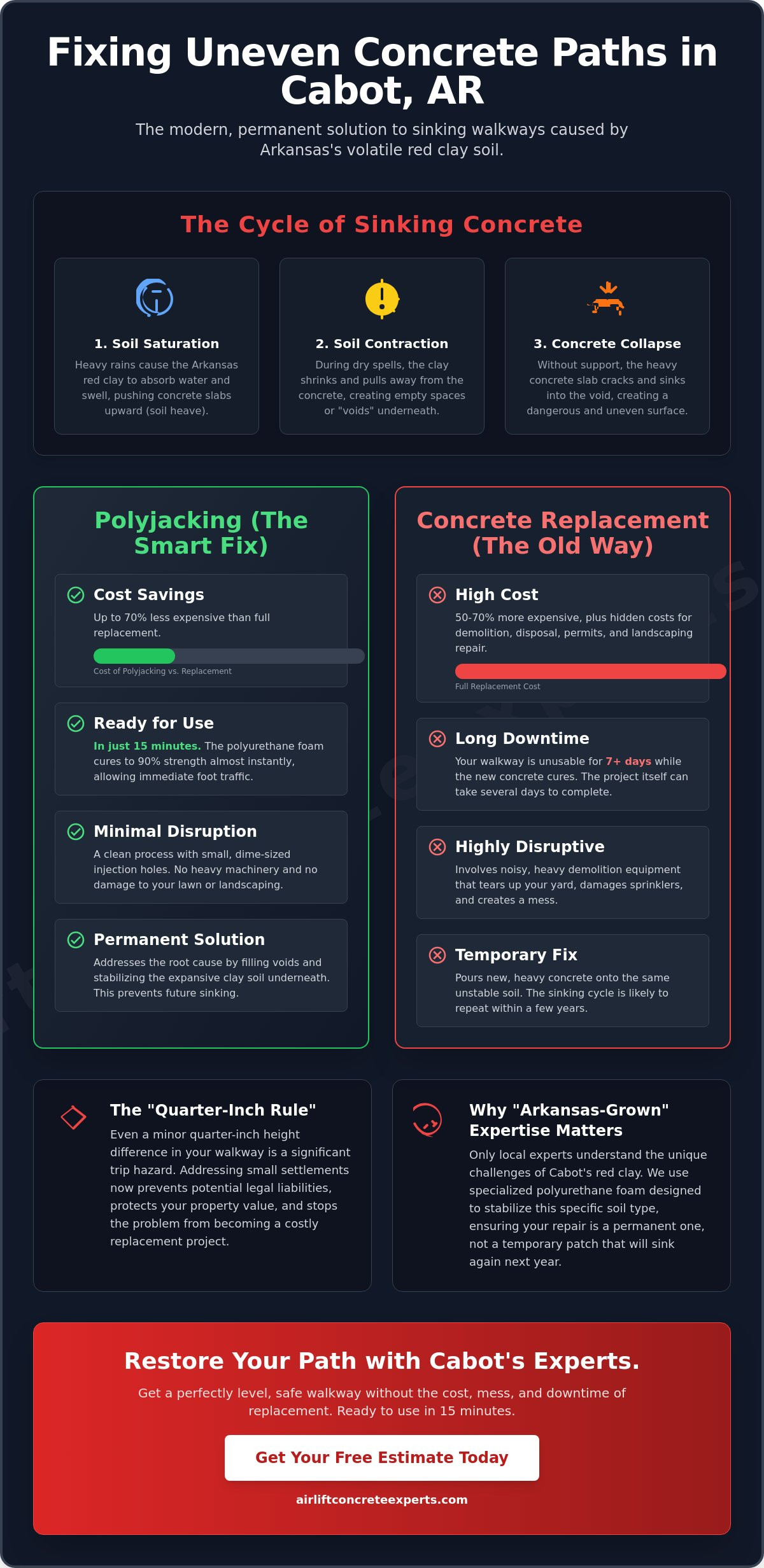
If you live in Lonoke County, you’ve likely noticed that the ground under your feet is rarely still. The primary reason homeowners eventually need to fix uneven concrete path Cabot surfaces is the high concentration of Arkansas red clay. This specific soil type is notorious for its expansive properties. It doesn’t just sit there; it reacts to every rainstorm and dry spell we experience. In 2026, Central Arkansas has seen a 12% increase in volatile precipitation cycles, which has put unprecedented stress on residential walkways. When the soil moves, your concrete has no choice but to follow.
The problem usually begins deep underground. As the clay absorbs water, it swells with immense pressure, often lifting heavy concrete slabs. When the weather turns dry, the clay shrinks and pulls away, leaving empty spaces known as voids. Without the soil there to support the weight, gravity eventually pulls the concrete down into the hole. Homeowners often research various Concrete Leveling Methods to understand how to bridge these gaps and restore a safe walking surface. Understanding this cycle is the first step toward a permanent solution.
Local clay acts much like a sponge. During a wet Arkansas spring, the soil becomes saturated and expands, a process we call soil heave. Soil heave is the upward movement of the ground caused by moisture expansion, and it can exert enough force to crack even the thickest reinforced path. During the hot, humid summers Cabot is known for, that moisture evaporates. The clay then contracts and creates a structural “void” beneath your walkway. Because concrete is rigid and cannot bend, it snaps under its own weight once that support disappears. This is why a path that looked perfect in April can suddenly become a tripping hazard by September.
It’s vital to distinguish between a cosmetic issue and a structural failure. If you notice “stepped” cracks, where one side of the fracture sits higher than the other, you’re looking at active soil settlement. This isn’t just a bad finish from the original contractor; it’s a sign that the foundation has shifted. You should also check for localized sinking near downspouts or flower beds. Improper drainage often washes away the sub-base, accelerating the settlement process. In older Cabot neighborhoods, mature tree roots can also play a role by drinking up the moisture the clay needs to stay stable, leading to localized “shrinkage zones” that cause the path to tilt toward the tree.
When homeowners look to fix uneven concrete path Cabot areas, the first instinct is often to tear everything out and start over. This approach assumes that new concrete is “better,” but it ignores the underlying causes of uneven concrete we discussed in the previous section. If you pour a heavy new slab on the same unstable Arkansas clay, that new path will likely sink again within a few seasons. Beyond the structural risks, a full replacement is often an unnecessary expense that can cost between 50% and 70% more than professional leveling.
The difference in project timelines is just as dramatic. New concrete requires a minimum of seven days to cure before it can handle regular foot traffic, and even longer for heavy loads. In contrast, polyjacking allows you to use your walkway almost immediately. The high-density foam reaches 90% of its compressive strength within 15 minutes of injection. This efficiency means your daily routine remains uninterrupted while we restore your home’s safety and curb appeal. For a detailed look at how this works across our region, you can explore our polyjacking near me guide.
A quote for new concrete rarely tells the whole story. To replace a path, contractors must bring in heavy demolition equipment that often leaves ruts in your lawn or damages nearby landscaping. You also face the challenge of color matching; new concrete is bright white and will likely clash with your existing driveway or porch for years. Additionally, Cabot’s building department requires permits for structural work. For a project valued at $1,500, you’ll pay a base fee of $21.00 plus additional valuation charges. When you add in disposal fees for the old concrete and the $100 to $200 per cubic yard delivery fee common in Cabot as of May 2026, the “simple” replacement quickly becomes a major financial burden.
Polyjacking offers a surgical, no-mess alternative to traditional construction. We drill holes about the size of a penny through the sunken slab to inject the polyurethane material. This foam is hydrophobic, meaning it won’t wash away or degrade when exposed to groundwater. It actually waterproofs the underside of your concrete, sealing the soil and preventing the erosion that leads to future voids. If you’re tired of looking at that trip hazard, you can request a free inspection to see if your path is a candidate for this permanent, cost-effective solution. We focus on stabilizing your property’s foundation so you don’t have to worry about the same problem next year.
Watching a heavy concrete slab rise back into place is often a surprise for homeowners. When we arrive to fix uneven concrete path Cabot installations, we follow a methodical four-step protocol designed for accuracy and longevity. Unlike older methods that rely on heavy machinery and messy cement slurries, our process is surgical. This modern approach is frequently compared to polyjacking vs. traditional concrete repair because it eliminates the weight and bulk of traditional mudjacking materials, which can actually cause more sinking over time in Arkansas’s soft soils.
Our specialized equipment is housed in a single truck, meaning we don’t need to drive heavy tractors across your lawn to fix uneven concrete path Cabot issues. The injection hoses can reach several hundred feet, allowing us to work from the street or your driveway. This setup is particularly safe for nearby landscaping and flower beds that would otherwise be destroyed by demolition crews. The magic lies in the chemical reaction of the foam; it expands with enough force to lift thousands of pounds of concrete while remaining lightweight enough to avoid further soil compression.
The entire process is remarkably fast. Most Cabot paths are leveled and stabilized in under two hours. Because we aren’t pouring new concrete or using loud jackhammers, the noise levels are minimal, and you don’t even need to be home for us to complete the work. We take pride in our final cleanup, ensuring that no debris is left behind. Once we finish sealing the injection ports, the only evidence of our visit will be a perfectly level, safe walkway that stays that way for years to come. If you’re ready to see this technology in action, contact us for a free inspection today.
Many homeowners view a sunken slab as a minor cosmetic nuisance. However, delaying the decision to fix uneven concrete path Cabot areas can lead to significant financial and legal consequences. In the world of property management and insurance, we often refer to the “Quarter-Inch Rule.” Any vertical change of 1/4 inch or more is classified as a trip hazard by ADA standards and most local building codes. If a delivery driver or a neighbor trips on your property, that small bump transitions from a backyard eyesore into a major legal liability.
Neglect also triggers a “domino effect” on your home’s structural health. When a path sinks, it often creates a low point where water pools against your home’s foundation. This concentrated moisture accelerates soil settlement in a localized area, potentially leading to foundation cracks or basement leaks. By addressing the walkway today, you’re also protecting the most expensive part of your property from water damage. It’s much simpler to stabilize a path now than to repair a foundation wall later.
Arkansas insurance adjusters look closely at walkway maintenance when evaluating homeowners’ claims. A documented repair shows that you’re proactive about safety, which can prevent premium hikes or denied coverage. Beyond the legalities, there is an emotional weight to having a dangerous entrance. You shouldn’t have to worry every time a family member walks to the mailbox or a guest arrives for dinner. Taking action now provides a sense of security that far outweighs the cost of the repair. It’s about being a good neighbor and ensuring your home is a safe environment for everyone who visits.
Curb appeal is the first thing a buyer sees. If you’re planning to sell your home in the next few years, an uneven path is a major red flag during an appraisal. It suggests to potential buyers that the home may have larger soil or foundation issues. According to our expert concrete lifting guide, professional leveling offers a high return on investment by instantly restoring the visual integrity of your entrance.
In Cabot’s competitive real estate market, small details matter. A level, clean walkway signals that a home has been well-maintained. When you compare the minimal cost of polyjacking to the potential loss in home value or a legal settlement, the choice is clear. If you’re concerned about a specific area of your property, schedule a professional inspection to identify potential hazards before they become expensive problems. We’ll help you determine exactly what’s needed to secure your property’s value and safety.
Choosing the right partner to fix uneven concrete path Cabot issues is about more than just finding a contractor with a truck. It requires a team that understands the unique geological personality of Lonoke County. At Airlift Concrete Experts, we don’t view your walkway as just a slab of stone; we see it as a vital part of your home’s safety and structural health. Because we’re an “Arkansas-grown” company, we’ve spent years studying how our local weather patterns and soil types interact with residential foundations. We’re committed to providing permanent solutions that address the root cause of settlement, ensuring you don’t have to deal with the same tripping hazard again next year.
Founded in 2017, Airlift Concrete Experts has built a 5-star reputation by focusing on a specific niche. While many construction companies in Central Arkansas offer concrete services as a side business, we specialize exclusively in repair and leveling. We don’t sell new concrete construction or DIY kits because we know that these options often fail to solve the underlying soil problems. Our technicians use specialized, professional-grade equipment designed specifically for the precision of polyjacking. This focus allows us to provide a level of expertise that national franchises simply can’t match when it comes to the specific challenges of Cabot’s red clay.
Our commitment to the community means we treat every neighbor’s home with the same care we’d give our own. We prioritize transparency and straightforward communication, avoiding flashy marketing gimmicks in favor of honest, technical assessments. When we finish a job, our goal is to leave your property better than we found it, with a level path and a stabilized foundation that adds long-term value to your investment.
If you’re tired of worrying about guests tripping or your home’s curb appeal suffering, the solution is just a phone call away. We make the process of restoring your walkway simple and stress-free. When you schedule an evaluation, one of our expert technicians will visit your property to perform a comprehensive diagnostic. We don’t just look at the surface; we investigate what’s happening underground to ensure a lasting repair. During your inspection, we typically evaluate several key factors:
After the inspection, we’ll provide a clear, no-pressure explanation of our findings and a detailed plan to fix uneven concrete path Cabot hazards on your property. You’ll have all the information you need to make a confident decision about your home’s maintenance. Ready to level up? Schedule your free concrete path inspection with Airlift today and let us restore your peace of mind.
You don’t have to live with the daily stress of a trip hazard or the looming cost of a total tear-out. By choosing to fix uneven concrete path Cabot issues with modern polyjacking, you are addressing the root cause of soil settlement rather than just patching a symptom. This specialized technology stabilizes your home’s foundation and protects your property value without the messy demolition or the week-long curing times required by new construction.
Since our founding in 2017, Airlift Concrete Experts has remained a dedicated, family-owned partner for Central Arkansas homeowners. We combine 5-star local service with high-density polyurethane technology to ensure your walkway repairs stand up to the unique demands of our local clay. Restoring your path is a simple, two-hour process that provides immediate safety and long-term peace of mind.
Get Your Free Concrete Path Inspection in Cabot
Taking this proactive step today ensures your home remains a safe and welcoming environment for your family and neighbors for many years to come.
The cost to fix uneven concrete path Cabot homeowners typically see ranges from $8 to $25 per square foot for polyjacking services as of May 2026. Most professional projects have a minimum charge between $300 and $700 to cover equipment setup and materials. For a standard 100 square foot sidewalk, you can expect an average investment between $800 and $2,500 depending on the volume of the underlying void.
Yes, you can typically walk on your path just 15 minutes after the final injection is completed. The high-density polyurethane foam reaches 90% of its full compressive strength almost instantly. This is a significant advantage over new concrete pours which require at least seven days of curing before they can safely support regular foot traffic or heavy loads.
No, the polyjacking process is environmentally inert and won’t harm your landscaping or flower beds. Because the material is injected through penny-sized holes, we don’t need to use heavy excavators that leave ruts in your lawn. The foam remains contained beneath the concrete slab and doesn’t leach chemicals into the surrounding Arkansas soil, making it safe for your home’s ecosystem.
A professional polyjacking repair is designed to be a permanent solution that lasts as long as the concrete itself. Unlike mudjacking material which can weigh 100 pounds per cubic foot and cause further settlement, polyurethane foam is lightweight and won’t compress the underlying clay. Its hydrophobic nature ensures it never washes away, even during the heavy rain cycles common in Central Arkansas.
Polyjacking is generally superior for residential paths because it requires much smaller injection holes and adds less weight to the soil. Mudjacking uses a heavy slurry and requires holes nearly two inches in diameter which can be unsightly on a narrow walkway. Polyjacking’s ability to fill tiny microscopic voids ensures a more stable foundation in Cabot’s shifting red clay conditions.
Ignoring a sinking slab often leads to a “domino effect” of property damage and increased legal risk. According to the Quarter-Inch Rule, any vertical rise over 1/4 inch is a documented trip hazard that can lead to insurance liability. Additionally, sunken paths often direct water toward your home’s foundation, which can cause structural issues that are far more expensive than a simple walkway leveling project.
Yes, the City of Cabot requires permits for structural work and significant alterations to residential properties. You should contact the Planning and Zoning department at 501-843-4819 to confirm requirements for your specific project. For work valued between $501 and $2,000, the current permit fee is $21.00 for the first $500 plus $2.75 for each additional $100 of valuation.
Polyjacking is most effective for slabs that are still mostly intact; if your path is shattered into many small fragments, replacement is usually necessary. While we can lift individual large pieces, a “spiderweb” of cracks often indicates that the concrete has lost its structural integrity. During a free inspection, our technicians can determine if your path is a candidate for leveling or if the damage is too extensive.

 Call Now