

Why spend $3,500 on a full replacement when a surgical repair could save you up to 70%? It’s a common dilemma for Little Rock homeowners watching their front steps pull away from the porch. When you’re calculating the cost to raise concrete steps Little Rock, the math usually favors modern polyjacking over the mess of a new pour. You’re likely worried about delivery drivers tripping or your home’s curb appeal dropping as those gaps widen. You want a safe entryway, but you also want a solution that actually holds up against Arkansas’s expansive clay soil without destroying your landscaping.
We understand that a sinking entryway feels like a structural nightmare. This 2026 guide breaks down real-world pricing for polyurethane foam injection and compares it to traditional mudjacking and replacement. You’ll discover why polyjacking costs between $900 and $3,000 for most local projects and how this lightweight foam provides a permanent, stable lift for your heavy concrete steps. We’ll also explain how addressing the soil settlement directly saves you thousands while restoring your peace of mind.
Your front steps aren’t just a point of entry; they’re heavy structural elements that rely entirely on the ground beneath them. In Central Arkansas, that ground is often composed of highly expansive red clay. Concrete leveling is the specialized process of injecting material beneath a sunken slab to restore its original height and stability. When we talk about the cost to raise concrete steps Little Rock homeowners often face, we’re really talking about fixing the soil’s inability to support the weight of the concrete.
Arkansas red clay acts like a sponge. It swells significantly during our wet spring months and shrinks just as dramatically during dry summer heatwaves. This constant movement creates voids or air pockets under your steps. Over time, the heavy concrete simply follows gravity into those empty spaces. Settlement is the natural downward movement of soil under heavy concrete loads. It’s different from structural failure, where the concrete itself is crumbling or weak. Most sinking steps in Little Rock are structurally sound but are suffering from soil failure.
Heavy rain cycles also play a major role. Little Rock averages about 50 inches of rain annually, which can lead to “washout.” This occurs when rushing water carries away the loose dirt and fines from under the slab. Without that support, the steps tilt or sink, often pulling away from the house foundation.
Humidity and poor water management are the silent enemies of your concrete. If your gutters aren’t clear, water pours directly onto the base of your steps. This saturation accelerates the softening of the clay. During the winter, Little Rock’s “freeze-thaw” cycles cause trapped moisture to expand and contract. This process pushes the concrete up and then drops it as the ice melts, worsening any existing voids. Sunken steps are frequently a symptom of these larger drainage issues that need to be addressed to ensure a permanent repair.
Safety is the most urgent reason to consider the cost to raise concrete steps Little Rock neighbors might trip on. Even a 1/2 inch shift creates a significant trip hazard for family members and delivery drivers. Little Rock municipal codes often hold homeowners liable for injuries occurring on uneven walkways or steps. Addressing these gaps early prevents accidents and protects your financial interests. A level entryway isn’t just about curb appeal; it’s about maintaining a secure environment for everyone who visits your home.
Most homeowners in Central Arkansas find that the cost to raise concrete steps Little Rock typically falls between $800 and $1,200 for standard residential entryways. This range covers the essential labor, specialized equipment, and the high-density polyurethane material needed to stabilize a typical two or three-step stoop. While larger projects or complex commercial entryways can scale higher, these smaller residential repairs are highly efficient. Our crews generally complete the work in a single day, often leaving the area ready for foot traffic in less than 30 minutes after the injection is finished.
The total weight of your concrete and the number of steps directly influence the amount of material we use. A heavy, poured-in-place set of stairs exerts much more pressure on the soil than a simple pre-cast step. If the soil has washed away significantly due to our local rain cycles, we must account for “void filling.” This involves pumping extra foam to fill hollow pockets before the lifting pressure can be applied. Ensuring the space is completely filled prevents the steps from sinking again once the weight is restored. Because the foam cures almost instantly, you don’t have to worry about a multi-day construction zone on your front porch.
Several variables can shift your final estimate. Accessibility is a major factor; front yard steps are usually easier to reach than those tucked behind a narrow fence in Hillcrest or The Heights. We also look at the degree of lift. Moving concrete four inches requires more material and precision than a one-inch adjustment. Finally, we assess soil stabilization needs. If the underlying clay is extremely loose, we may need to reinforce the base to ensure the polyjacking provides a permanent solution.
While our process is transparent, local regulations vary across the metro. Permit requirements in North Little Rock or Sherwood might differ from those in Little Rock proper, which can occasionally impact the project timeline. You should also consider cleanup and site preparation. Polyjacking is inherently mess-free because it doesn’t involve heavy machinery or wet concrete, so you won’t face the high disposal fees associated with traditional demolition. A professional inspection is the only way to get a fixed-price quote tailored to your specific property. If you’re ready to see exactly what your project requires, you can schedule a free inspection with our local team.
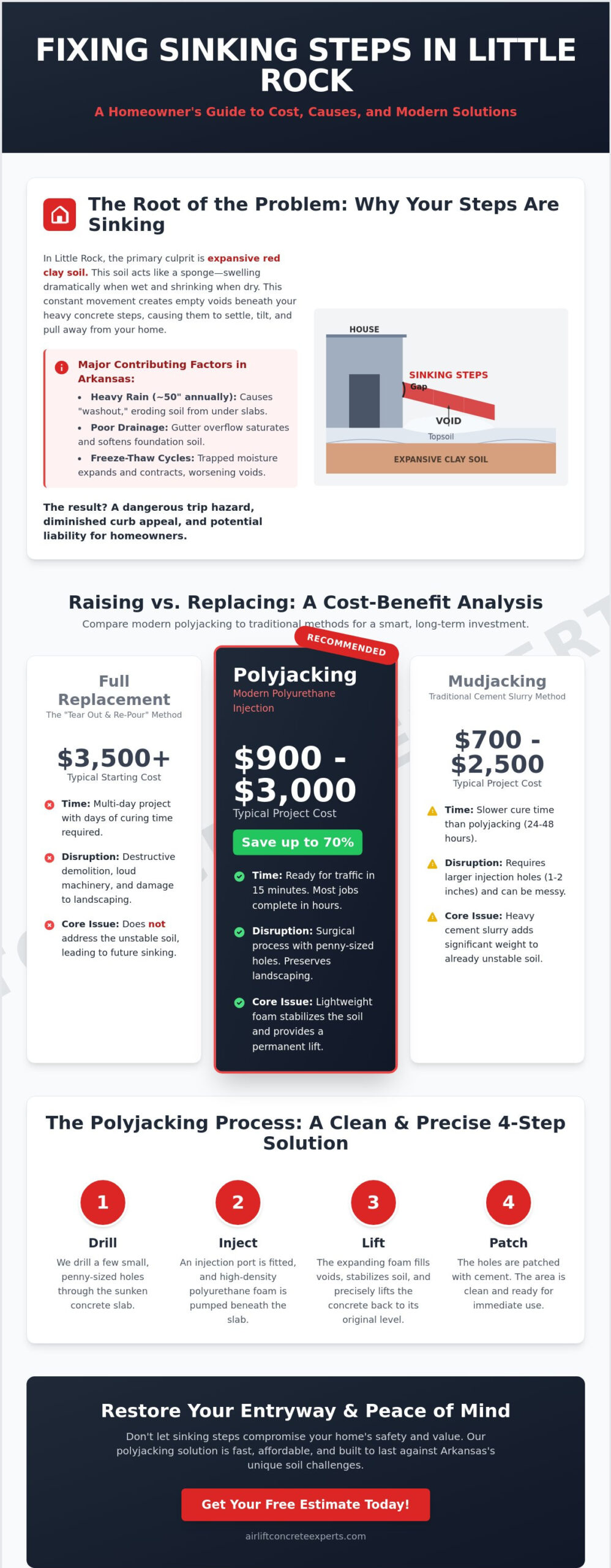
Choosing between a new pour and a specialized repair often comes down to the “all-in” price tag. When you look at the total cost to raise concrete steps Little Rock, you’re usually comparing a surgical $900 to $3,000 repair against a $3,500 average for full replacement. Replacement isn’t just about the new concrete; it includes the labor for demolition, the cost of hauling away heavy debris, and the high price of a new pour. Many homeowners don’t realize that a new set of steps can weigh several thousand pounds. If you place that massive weight on the same unstable Arkansas clay that caused the first set to sink, you’re simply restarting the clock on future settlement. Raising the existing steps addresses the void without adding significant new weight to the soil.
Time is another critical factor in your decision. A new concrete pour requires several days of curing before it’s strong enough for heavy traffic. In contrast, polyjacking is ready for use in about 15 minutes. We also consider your yard and landscaping. Replacement typically requires heavy machinery and trucks that can easily rut or tear up a manicured lawn. Our lifting process uses small, portable equipment that leaves your landscaping exactly as we found it, saving you the additional expense of sod or garden repairs.
There are times when the concrete is too far gone for a lift. If your steps show “spiderweb” cracking or the material is literally crumbling into chunks, the structural integrity is lost. We generally recommend replacement if the repair cost exceeds 70% of the price of new concrete. You may also need professional foundation repair if the steps are structurally tied to your home’s footer and are pulling the house foundation down with them. In these cases, simply lifting the steps won’t solve the underlying structural issue.
Homeowners often ask if foam can really hold up heavy steps over the long term. The high-density polymers we use are specifically engineered to be impervious to the moisture and washout cycles common in Central Arkansas. Unlike traditional mudjacking slurry, which is basically heavy dirt and cement that can eventually wash away, polyurethane concrete leveling provides a permanent, lightweight solution. It won’t degrade in the soil, ensuring your entryway stays level for the long haul while resisting the “shrink-swell” patterns of local clay.
Understanding the mechanical side of the repair helps demystify the cost to raise concrete steps Little Rock homeowners see in their estimates. We don’t use heavy bulldozers or messy cement mixers. Instead, the process is surgical and controlled. Our team follows a proven five step method to restore your entryway without the chaos of a construction site. This streamlined approach ensures that your home remains accessible throughout the day while we address the underlying soil issues.
Steps require a higher level of accuracy than a flat driveway or sidewalk. We must manage the immense weight of solid concrete while ensuring the “pitch” of the stairs allows water to run away from your foundation. Polyjacking allows for incremental, controlled movement that traditional mudjacking simply cannot match. Because the foam expands in seconds, we can make micro-adjustments until the alignment is perfect. This prevents over-lifting and ensures that the structural integrity of your stairs is fully supported by a dense, stable base.
Many homeowners worry about chemicals leaching into their gardens. The high-density polyurethane we use is non-toxic and environmentally inert once it cures. It won’t degrade over time or release harmful substances into the Arkansas groundwater. Choosing expert concrete lifting is actually a “green” alternative to traditional methods. It prevents thousands of pounds of old concrete from ending up in local landfills and avoids the high carbon footprint of manufacturing new cement. If you want a repair that respects your property and the local environment, request your free inspection today to get started.
Airlift Concrete Experts is deeply rooted in Central Arkansas. We’ve spent years studying how the region’s unique climate and expansive red clay affect residential structures. When calculating the cost to raise concrete steps Little Rock residents need to know they’re paying for a solution that lasts, not just a temporary patch. Our team brings a level of local authority that national franchises simply can’t match. We treat every home like it belongs to a neighbor because, in our community, it usually does. This local perspective allows us to anticipate soil behavior before we even begin the injection process.
We rely on specialized, industrial-grade polyjacking technology to achieve permanent results. This isn’t a DIY kit or a generic cement slurry that might wash away in the next heavy rain. Our high-density foam is engineered for the specific load-bearing requirements of heavy, poured concrete steps. We take a no-nonsense approach to every project we undertake. If your steps are structurally sound, we’ll stabilize them. We don’t sell new concrete construction, so we have no incentive to push for an expensive and unnecessary replacement. You receive transparent pricing with no hidden fees or surprise demolition costs during the project.
We proudly serve a wide range of communities across Central Arkansas, including Little Rock, North Little Rock, Benton, Bryant, and Conway. Being a locally owned and family-operated business gives us a personal stake in the safety of our area’s homes. We understand that a sinking entryway is a high-stress issue for any homeowner. Our goal is to transform that anxiety into a sense of security by providing a stable, level, and permanent repair. We’re committed to restoring the safety and curb appeal of your home’s entryway with minimal disruption to your daily routine.
Every successful repair begins with a thorough, professional evaluation. Our free inspection goes beyond the surface to identify the root cause of your sunken steps. We examine drainage patterns, soil voids, and structural alignment to ensure our polyjacking solution is the right fit for your specific property. We stand behind our work with the “Airlift Guarantee” on concrete leveling and soil stabilization. This guarantee reflects our confidence in the durability of our methods and our commitment to your peace of mind.
You can get your free concrete raising quote today and take the first step toward a safer home. We provide a clear, fixed-price estimate so you can make an informed decision about the cost to raise concrete steps Little Rock homeowners can afford. Our experts are ready to show you how modern technology can save your steps and your budget simultaneously.
A sinking entryway doesn’t have to be a structural nightmare or a budget-breaking construction project. You now understand how polyjacking addresses the root cause of the problem by stabilizing the Arkansas red clay that supports your home. By choosing a surgical repair over a full replacement, you can save up to 70% while avoiding the mess of heavy machinery in your yard. Remember that the cost to raise concrete steps Little Rock homeowners pay is an investment in long-term safety and curb appeal.
Airlift Concrete Experts has been serving our Arkansas neighbors since 2017. We use specialized polyjacking technology to provide a permanent lift that traditional mudjacking simply can’t match. We’re here to help you navigate these repairs with transparency and technical expertise. If you’re ready to fix those trip hazards for good, we offer free on-site inspections to give you a clear, no-pressure plan. You don’t have to live with unsightly gaps or unstable stairs. Get a Free Concrete Raising Estimate in Little Rock today and let’s make your home’s foundation solid again. We look forward to helping you secure your property for years to come.
The typical residential cost to raise concrete steps Little Rock homeowners pay is between $800 and $1,200 for standard entryways. Polyjacking projects generally range from $900 to $3,000 depending on the total weight of the steps and the volume of the voids beneath them. This represents a significant savings compared to the $3,500 average for a full concrete replacement. We provide a fixed price quote after a free inspection to ensure you have an accurate total before work begins.
Polyjacking is superior for heavy steps because the high-density foam adds almost no weight to the already unstable Arkansas soil. Traditional mudjacking uses a heavy slurry of dirt and cement that can actually cause further settlement over time. The foam expands to fill every tiny void, providing a stable, waterproof base that resists the shrink-swell cycles of local red clay. It offers a cleaner, faster, and more durable result for Central Arkansas properties.
Most residential step raising projects in Central Arkansas are completed in 2 to 4 hours. Because we use specialized, portable equipment, we don’t need a massive setup or cleanup time. You won’t have to deal with a construction crew for several days. Our team arrives, performs the precision injection, patches the small access holes, and clears the site in a single morning or afternoon session.
The high-density polyurethane foam will not sink or wash away because it is impervious to moisture. Unlike natural soil or mudjacking slurry, this material does not shrink during Arkansas heatwaves or swell during heavy spring rains. It creates a permanent, stable foundation that effectively bridges the gaps in the underlying clay. This prevents the steps from following the natural downward movement of the soil.
We can successfully lift steps with minor cracks, but we cannot repair concrete that is crumbling or structurally compromised. If the steps have “spiderweb” cracking or the surface is spalling into chunks, replacement is usually the better investment. During our free inspection, we’ll assess whether the concrete is strong enough to withstand the lifting pressure and provide an honest recommendation for your specific situation.
Permits are typically not required for minor residential concrete leveling in Little Rock proper. However, specific municipal codes in North Little Rock or Sherwood can vary. We understand the local logistics and will let you know if your specific project requires any city documentation. Most residential step repairs fall under home maintenance and do not trigger the same permitting process as new construction pours.
You can walk on your steps approximately 15 minutes after the injection is complete. The high-density foam reaches 90% of its full strength in less than half an hour. This is a massive advantage over new concrete pours, which require a 24 to 48 hour wait period before they can handle traffic. You won’t have to block off your front door or change your daily routine at all.
Concrete raising is considered a permanent solution because the polyurethane material does not degrade in the soil. It remains stable for decades and is not affected by the “washout” that causes original steps to sink. By filling the voids and stabilizing the base, we eliminate the air pockets that allow gravity to pull your heavy concrete down. It is a long-term fix that addresses the root cause of the settlement.

 Call Now