

Last Tuesday, a family in Conway discovered their back patio had dropped nearly three inches, leaving a dangerous gap where the slab met the sliding glass door. It’s a frustrating reality for many in our region, as roughly 60 percent of local foundation and concrete issues stem from the high volume of expansive red clay in our soil. You probably feel that these uneven surfaces are more than just ugly; they are tripping hazards that threaten your family’s safety and risk directing water toward your home’s foundation.
The good news is that you don’t need a sledgehammer or a massive budget for a full replacement. This guide will teach you how to raise a concrete patio using modern, long-lasting methods like polyjacking. We promise to show you how to lift and level your sunken Arkansas patio while avoiding the dusty mess of a total tear-out. We will walk through the specific challenges of Central Arkansas soil and explain the step by step process our experts use to provide a permanent, stable fix for your outdoor living space.
A sunken concrete patio is more than just an eyesore for Arkansas homeowners; it’s a sign that the ground beneath your feet is shifting. When you choose to raise concrete patio slabs, you are opting for a process that pumps specialized material under the concrete to fill empty spaces and restore a level surface. This method, often referred to as concrete leveling, addresses the root cause of the problem without the mess or expense of a full replacement.
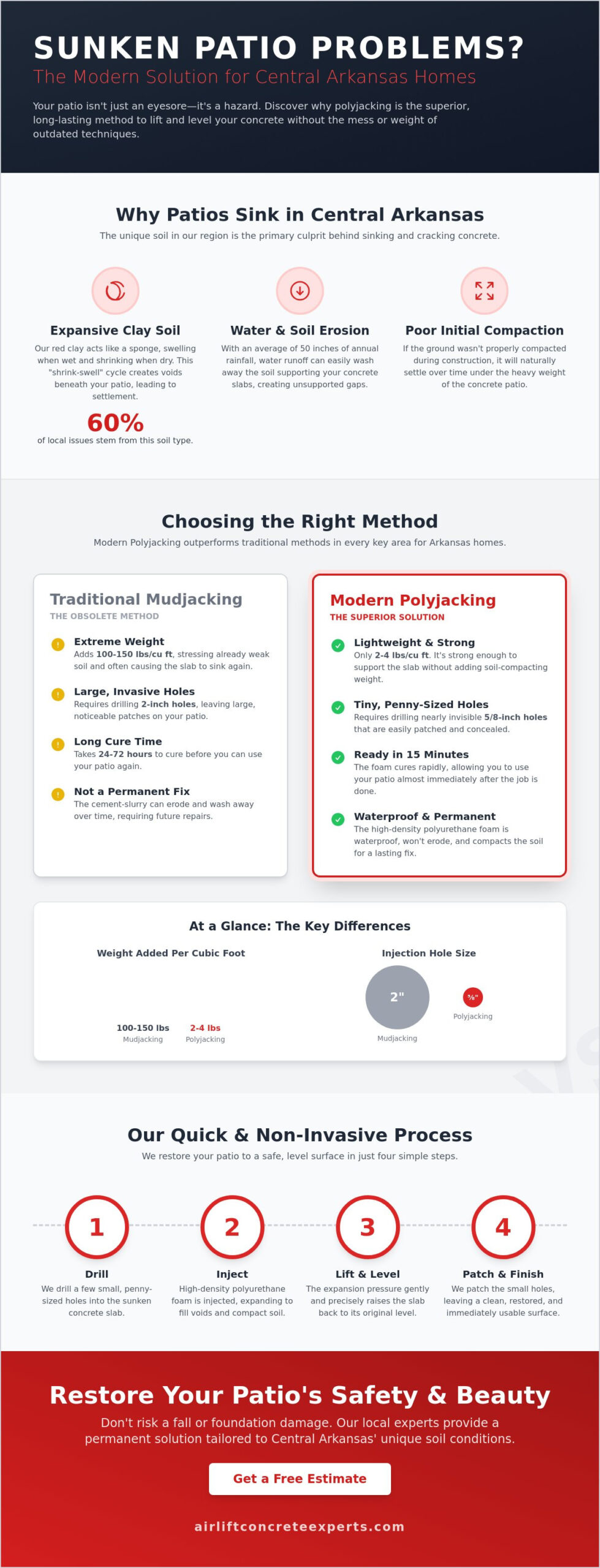
In Central Arkansas, patios typically sink due to three main factors: soil erosion, poor initial compaction, and the unique nature of our local earth. Our region receives an average of 50 inches of rainfall annually, which creates significant runoff. This water often finds its way under concrete slabs, washing away the supporting soil and leaving the heavy concrete suspended over nothing. Eventually, gravity takes over and the slab drops. Ignoring these changes can lead to foundation damage or serious tripping hazards for your family and guests.
The red clay common in our area is highly reactive. It acts like a sponge, expanding significantly during wet seasons and shrinking during the intense heat of Hot Springs summers. This constant movement creates “voids,” which are empty pockets that offer no support to the patio above. Soil subsidence is the primary culprit for patio failure in Malvern, where the ground settles unevenly over time as moisture levels fluctuate. When the soil loses its volume, the weight of the concrete causes it to dip into these newly formed gaps.
Identifying the problem early can save you from more expensive repairs later. Homeowners should stay vigilant and look for specific symptoms of sub-surface movement. If you notice any of the following, it’s likely time to raise concrete patio sections to restore safety and stability:
These signs indicate that the soil has moved or washed out, leaving your patio’s structural integrity at risk. Addressing these issues promptly prevents the damage from spreading to your home’s main foundation, ensuring your outdoor space remains a safe place for relaxation.
When you decide to raise concrete patio slabs around your home, you’ll encounter two primary techniques. For decades, mudjacking was the go-to solution for local homeowners. However, modern engineering has introduced polyjacking, a method that addresses the specific weaknesses of traditional repairs. A side-by-side Mudjacking vs. Polyjacking analysis shows that while both aim to level your concrete, the materials and long-term results differ significantly.
The most critical factor for Arkansas homeowners is weight. Mudjacking uses a heavy mixture of topsoil, cement, and water. This slurry adds roughly 100 to 150 pounds of weight per cubic foot under your slab. In contrast, high-density polyurethane foam weighs only 2 to 4 pounds per cubic foot. In the soft, expansive clay common in our region, adding thousands of pounds of extra weight often triggers secondary settling. By choosing a lighter material, you reduce the stress on already unstable soil.
Polyjacking is the preferred choice for homeowners looking for polyjacking near me in Malvern and surrounding areas. The process is remarkably non-invasive. Technicians drill tiny 5/8-inch holes, about the size of a penny, into the concrete. A specialized foam is injected, which triggers a chemical reaction. This foam expands to 20 or 30 times its liquid volume, filling every hidden void and compacting the underlying soil. Because the foam is waterproof, it won’t wash away during a heavy Arkansas thunderstorm. Your patio is ready for furniture and foot traffic in 15 minutes; mudjacking often requires 24 to 72 hours of cure time.
Traditional mudjacking is becoming an obsolete choice for high-end Cabot patio repairs because of its inherent mess and lack of durability. The process requires large 2-inch injection holes that are difficult to patch discreetly. Because the slurry is water-based, it remains susceptible to erosion and shrinkage. If water gets under your patio again, the very material meant to fix the problem can wash out or lose its shape. This creates a cycle of repeated sinking that costs more in the long run.
Choosing a lightweight, permanent solution ensures your outdoor living space stays level for the long haul. Modern polyjacking provides a waterproof barrier that stabilizes the ground permanently. If you’re concerned about your patio’s stability, request a free inspection from a local specialist to see which method fits your specific soil conditions.
Homeowners in Conway and Bryant often face a difficult choice when a patio begins to sink. The temptation to grab a retail foam kit from a big-box store is strong, but the physics of soil settlement rarely favor a “do-it-yourself” approach. To successfully raise concrete patio slabs, you need more than just foam; you need a calculated lift that accounts for the weight of the concrete and the resistance of the underlying Arkansas clay.
Retail DIY kits usually provide low-grade, single-component foam. This material lacks the compressive strength and lifting power required to move a slab that weighs several thousand pounds. Professional polyjacking uses high-density, two-part polymers that react instantly. Our industrial equipment ensures precision lifting, which prevents the existing concrete from cracking under uneven pressure. Without this control, a simple repair can quickly turn into a total loss.
The “hidden cost” of DIY is the most significant factor. If a homeowner miscalculates the injection point or the expansion rate, the slab can become permanently stuck in an uneven position. In these cases, the only solution is a total replacement. Industry data suggests that a full demolition and repour of a standard patio can cost between $3,000 and $7,000. Investing in a professional lift from the start avoids this financial risk.
Controlling foam expansion without specialized industrial pumps is nearly impossible for an amateur. DIY canisters often result in “runaway” expansion where the foam continues to grow long after you stop the flow. This over-lifting can cause permanent structural damage to your home’s adjoining foundation or basement walls. Furthermore, these kits offer no warranty. If the soil settles again in six months, your initial investment is gone. A professional repair provides a stable, long-term solution that a home-brew fix simply cannot match.
Airlift Concrete Experts takes a no-nonsense approach to evaluating Central Arkansas patio slabs. We don’t guess; we use our local knowledge of the region’s expansive soils to determine exactly how much lift is required. This local accountability means we stand behind our work with a professional warranty. For homeowners who want to understand the science behind our process, we offer a detailed guide on polyurethane concrete leveling. We treat every project like it’s in our own backyard because we live and work in the same communities you do. Choosing a local expert ensures your raise concrete patio project is handled with the right tools and the right experience for our specific environment.
Understanding the technical side of how we raise concrete patio slabs helps demystify the repair and provides peace of mind. Our method relies on five distinct stages designed to stabilize your home’s exterior without the mess of traditional demolition. We begin with a comprehensive site inspection to determine if the settlement stems from poor compaction or the high clay content typical of Central Arkansas soil. By identifying the specific failure point, we ensure the lift is permanent rather than a temporary patch. This diagnostic phase is vital because it dictates the density of the foam and the volume required to fill the subterranean gaps.
Before any equipment starts, we protect your property. When working in residential areas like Sherwood and Jacksonville, we use specialized barriers to safeguard your landscaping and turf from foot traffic. Our technicians then drill a series of 5/8-inch holes, roughly the size of a penny, into the sunken sections of the slab. We don’t guess where these holes go. We follow a calculated grid pattern that allows for maximum coverage of the voids beneath the concrete. This approach is entirely non-invasive. You won’t see heavy machinery tearing up your grass or turning your backyard into a muddy construction zone.
The core of the repair is the injection of high-density polyurethane foam. This process, known as polyjacking, involves a controlled chemical reaction where the liquid foam expands into a rigid structural material. As the foam fills every gap in the soil, it exerts upward pressure to gently raise concrete patio sections back to their original height. We monitor the movement in real-time with laser levels to ensure the surface is perfectly even. Because the foam cures in about 15 minutes, the results are immediate. This material is waterproof and won’t wash away during the heavy spring rains common in our region.
Once the patio is level, we clean the area and seal the injection holes with color-matched grout. This creates a seamless finish that blends into your existing concrete. Many homeowners choose to combine this service with our sidewalk and driveway leveling for a total property refresh. We finish by clearing all debris, leaving your outdoor space ready for use the same afternoon. Our goal is to leave your home looking better than we found it, with a foundation that stands the test of time.
Since 2017, Airlift Concrete Experts has operated as a family-owned business dedicated to serving our neighbors across Central Arkansas. We’ve intentionally chosen a specialized path. We don’t pour new concrete. Instead, we’ve spent years mastering the technical art of repairing and restoring it. This singular focus ensures that when you need to raise concrete patio slabs, you’re working with a team that treats your home’s structural integrity as their top priority. From the quiet streets of Little Rock to the growing neighborhoods in Benton, we provide a stable, reliable partnership for every homeowner.
Our “Arkansas-grown” identity is more than just a label. It’s a commitment to the community. We’ve built our reputation on the fact that we’re local specialists who understand the specific environmental stressors of our region. We aren’t a national chain following a generic manual. We’re your neighbors, and we’ve been stabilizing foundations and patios in this climate for over seven years.
Central Arkansas soil presents unique challenges that require a localized approach. The notorious “red clay” found in areas like Cabot and Conway is highly expansive. It swells when wet and shrinks during our hot, dry summers. This constant movement is the primary reason why patios sink and crack. Our local experience allows us to identify these patterns quickly. We prevent the common mistakes made by national franchises that often fail to account for the specific density and moisture retention of Arkansas clay. Our specialized knowledge extends to every part of your property, including pool deck repair for local homes that need to be safe and level for the summer season.
Taking the first step toward a safe, level outdoor space doesn’t have to be a source of stress. We believe in empowering homeowners with facts. Our expert evaluations are designed to be low-pressure and educational. When we visit your home, we perform a thorough assessment of your patio’s current state and the soil conditions beneath it. We provide a transparent, detailed quote so you can make an informed decision without any hidden surprises. If you’re ready to raise concrete patio sections that have become a trip hazard or an eyesore, we’re here to help you restore your home’s value.
Don’t let a sinking patio compromise your safety or your home’s curb appeal. Our methodical approach ensures a permanent fix that stands up to the Arkansas elements. Schedule your free concrete patio inspection with Airlift today and experience the peace of mind that comes with professional, local expertise.
Leaving a sunken patio to worsen only leads to more expensive structural issues down the road. Central Arkansas soil is notoriously unpredictable, but you don’t have to tackle these challenges alone. Since 2017, Airlift Concrete Experts has served homeowners in Malvern and the surrounding regions with specialized polyjacking technology. This modern method provides a permanent solution that outperforms traditional mudjacking by addressing the root cause of soil settlement without the weight of heavy slurry.
Choosing to raise concrete patio slabs with professional help ensures your family’s safety and restores your property’s curb appeal. Our team brings deep local knowledge to every job, providing the technical precision needed for lasting results. We believe in transparency and honest service, which is why we offer a no-pressure environment for every customer. You deserve a stable foundation and a backyard you can enjoy without worrying about trip hazards or pooling water. Let’s get your outdoor living space back to its original condition together.
Restore your patio’s safety and value; get a free inspection from Airlift Concrete Experts now!
It is typically 50% to 70% less expensive to raise a concrete patio than to tear it out and pour a new one. Replacement requires demolition, hauling fees, and the cost of new concrete. Polyjacking avoids these labor-intensive steps by using the existing slab. This method saves you money while providing a permanent solution for your sunken outdoor space.
Polyurethane concrete raising is designed to last for the lifetime of the structure because the foam doesn’t degrade in the soil. Unlike traditional mudjacking which uses organic materials, our specialized foam is waterproof and remains stable through Arkansas’s 50 inch average annual rainfall. It provides a permanent base that resists the freeze-thaw cycles common in Little Rock and surrounding areas.
You can raise a patio with cracks as long as the concrete remains structurally sound and hasn’t crumbled into small fragments. Our team uses polyjacking to lift the individual sections back into alignment. Once we raise a concrete patio to its original height, we seal the cracks to prevent water from reaching the subgrade. This process restores the 100% surface utility of your outdoor living area.
The polyurethane foam we use is environmentally inert and won’t leach chemicals into your lawn or flower beds. Since the installation requires only small, 5/8 inch holes, it leaves 95% less of a footprint than heavy excavation equipment. Your grass and landscaping remain undisturbed throughout the entire repair process. This makes it a safe choice for homeowners who value their curb appeal.
You can use your patio just 15 to 30 minutes after the injection process is complete. Polyurethane foam reaches 90% of its full compressive strength within minutes of being applied. This is a major advantage over new concrete pours, which require a 7 day curing period before they can support heavy furniture. You’ll have your backyard back the same afternoon.
We back our work with a multi-year warranty to ensure your peace of mind and long-term satisfaction. If a slab shifts more than 1/4 inch during the warranty period, we return to the site to perform the necessary adjustments. This commitment to quality is why 98% of our customers recommend our services to their neighbors in Central Arkansas. We stand by the durability of our polyjacking process.
Most standard homeowners insurance policies don’t cover concrete raising because they view soil settlement as a maintenance issue rather than a sudden peril. However, you should check your specific policy for earth movement endorsements. Investing in a repair now prevents the 100% liability risk associated with trip and fall accidents on uneven surfaces. Proactive maintenance protects your property value over time.
Polyjacking is an excellent solution for correcting negative drainage that directs water toward your home’s foundation. We can precisely raise a concrete patio to create a 2% slope away from the structure. This redirection of water prevents basement leaks and protects your foundation’s structural integrity. It’s a critical repair that addresses the root cause of potential water damage.

 Call Now