
If you think replacing a sunken warehouse floor is your only path to safety, you’re likely preparing to overspend by as much as 70%. You already understand that a single uneven joint in a Little Rock loading dock is more than a nuisance; it’s a liability risk that can halt your 24-hour production cycle. At Airlift Concrete Experts, we provide specialized commercial concrete lifting using high-density polyurethane to stabilize your facility without the weeks of downtime required for a traditional pour.
This 2026 guide explains how our Arkansas-grown team uses precision polyjacking to ensure your Central Arkansas facility floors meet strict ADA standards while protecting your bottom line. You’ll discover the technical advantages of soil stabilization and see why waiting for a 48-hour concrete cure is no longer necessary for industrial strength. We’ll also detail how our free inspection process identifies the root cause of settlement before it becomes a total structural failure.
Uneven pavement is more than a minor nuisance for Central Arkansas business owners; it’s a significant operational risk. Commercial concrete lifting provides a non-invasive, high-tech solution to restore the structural integrity of slabs without the massive overhead of a full replacement. In the 2026 business environment, local companies must prioritize infrastructure to avoid escalating repair costs. Choosing to ignore a settling slab often leads to a 20% increase in long-term maintenance expenses as the underlying soil continues to erode.
Central Arkansas presents unique challenges for foundation stability. The region’s soil moisture cycles create a constant “push and pull” effect on heavy masonry. Various concrete leveling methods exist to combat this, but modern polyjacking has become the gold standard for its speed and durability. When the soil fails, the concrete loses its support system, creating dangerous voids that can no longer sustain commercial vehicle weights or heavy foot traffic.
Staying ahead of these issues is essential for maintaining OSHA safety standards and ensuring ADA compliance. A simple trip hazard can lead to thousands of dollars in legal fees and insurance premium hikes. By addressing the root cause of the settlement now, you protect your bottom line and your reputation as a reliable local establishment.
Retail centers from Hot Springs to Little Rock face constant scrutiny regarding pedestrian safety. A settlement of just 1/2 inch can result in a trip-and-fall incident that exposes property owners to significant legal liability. In the industrial zones of Malvern, uneven warehouse floors are even more problematic. These shifts cause 35% more mechanical wear on forklift drivetrains and increase the risk of spilled cargo. Addressing these hazards through commercial concrete lifting ensures your facility remains safe for both employees and the public.
A hairline crack is rarely just a surface issue; it’s often a symptom of deep-seated soil failure. Voids beneath a slab can lead to catastrophic failure when subjected to heavy commercial loads, such as delivery trucks or machinery. Structural settlement is a result of Arkansas red clay contraction. Identifying these issues early prevents the need for total demolition. Our team focuses on stabilizing the ground first, ensuring that the repair lasts for years rather than months.
Commercial concrete lifting has evolved significantly from the days of heavy cement slurries. Traditional mudjacking adds up to 100 pounds of weight per cubic foot to already failing soil, which often causes further sinking. In contrast, high-density polyurethane foam weighs only 2 to 4 pounds per cubic foot while providing superior lift. This chemical reaction begins the moment two liquid components meet under the slab. The foam expands 20 to 30 times its original volume; it seeks out every void and creates a dense, structural foundation that supports thousands of pounds per square foot.
By 2026, data from local infrastructure assessments indicates that polyjacking materials maintain 90% of their compressive strength for over 50 years. This longevity is vital in Central Arkansas, where humidity levels often exceed 70%. Unlike organic fillers, this foam is hydrophobic. It doesn’t wash away or degrade when exposed to groundwater. This stability is essential for preventing Commercial Concrete Failure under heavy industrial loads and high-traffic conditions.
Benton and Bryant businesses deal with some of the most expansive red clay in the state. This soil type expands by as much as 10% during wet seasons, putting immense pressure on foundations. Polyjacking solves this by compacting the existing soil. As the foam expands, it pushes against the clay; this increases the soil’s load-bearing capacity by up to 25% without adding the dangerous weight of concrete slurry. The material is also environmentally inert. It won’t leach chemicals into the local water table during heavy spring rains.
The efficiency of commercial concrete lifting lies in its precision. We drill penny-sized holes (5/8 inch) rather than the 2-inch ports required for mudjacking. Our technicians use laser levels to monitor the lift, achieving accuracy within 1/32 of an inch. This level of control ensures that warehouse floors and loading docks return to their exact original specifications. Because the foam reaches 90% of its full load-bearing capacity in under 15 minutes, your facility can resume operations almost immediately. If you’re noticing uneven surfaces or trip hazards, you can request a specialized site inspection to see how this technology applies to your facility. This modern approach to commercial concrete lifting provides a permanent fix that traditional methods simply can’t match.
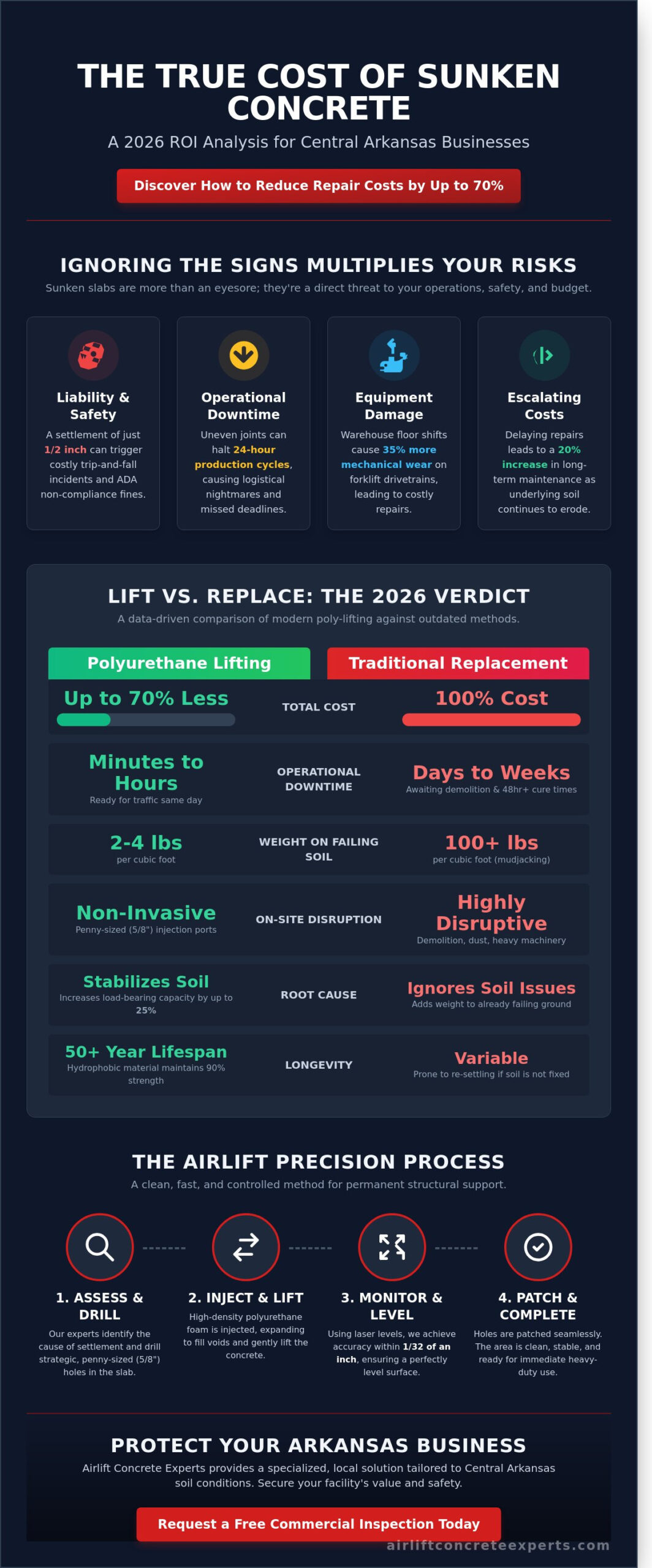
For Central Arkansas business owners, the decision to repair a sinking loading dock or a cracked warehouse floor often comes down to the bottom line. Traditional replacement involves heavy machinery, noise, and weeks of curing. In contrast, commercial concrete lifting provides a direct cost savings of 50% to 70% compared to a full tear-out and pour. You aren’t just saving on materials. You’re eliminating the expenses of demolition permits, hauling fees for old debris, and the high price of new ready-mix delivery. These indirect costs often bloat a simple repair into a massive capital expenditure that many businesses would rather avoid.
The environmental ROI is equally compelling. Instead of sending tons of concrete to a local landfill, our process preserves the existing slab. This reduces the carbon footprint associated with new cement production by approximately 85% per project. It’s a cleaner, smarter way to maintain your facility’s infrastructure without the mess of a construction site. By choosing commercial concrete lifting, you’re making a sustainable choice that aligns with modern corporate responsibility standards while keeping your budget intact.
Time is money in a commercial setting. New concrete requires a curing period of 7 to 28 days before it can handle heavy equipment or vehicle traffic. High-density polyurethane foam reaches 90% of its full load-bearing capacity in just 15 minutes. In May 2024, Airlift Concrete Experts repaired a 5,000-square-foot warehouse floor in Little Rock during a single lunch break. The facility didn’t lose a single hour of production. We offer night and weekend scheduling to ensure your 24/7 industrial operations never skip a beat. Our crews work around your production schedule to ensure your facility stays profitable throughout the repair process.
Replacing concrete without addressing the underlying soil is a temporary fix. If the soil is loose or washed out, the new slab will sink just like the old one did. Polyjacking solves the root cause. The polyurethane expands to fill voids and compacts the surrounding Arkansas clay. This creates a stable base that won’t wash away or shrink over time. We stand behind our work with a comprehensive Airlift Concrete Experts warranty. This guarantee provides the peace of mind that your facility remains safe and level for the long haul. It protects your investment from the region’s volatile soil conditions and prevents the need for future costly interventions.
Concrete failure often starts quietly beneath the surface before manifesting as a budget-draining emergency. You might first notice 1/4-inch stair-step cracks along a cinderblock wall or water pooling in a low spot after a heavy Central Arkansas thunderstorm. These symptoms indicate soil settlement is actively occurring. If a slab visibly rocks or “pumps” when a vehicle passes over it, the base material has already washed away, leaving the concrete unsupported.
Forklift operators are your most valuable early warning system. When a 5,000-pound lift “bottoms out” or vibrates aggressively over a joint, it isn’t just a minor annoyance for the driver. It’s a clear signal of a sub-surface void. Addressing these issues early via commercial concrete lifting prevents the slab from snapping under the pressure of daily operations. You can also perform a simple “hollow sound” test by tapping a heavy steel rod or chain across the floor. A dull thud indicates solid ground, while a high-pitched, hollow ring means there’s air where dirt should be.
Prioritizing repairs requires a risk-based approach. A 2-inch trip hazard in a high-traffic pedestrian corridor requires immediate intervention to mitigate liability. Conversely, a hairline crack in a remote storage corner can be monitored for 90 days. However, any void detected near structural load-bearing columns is a priority one repair that necessitates commercial concrete lifting to restore structural integrity and prevent a total floor collapse. The same settlement forces that threaten your commercial slabs also affect occupied spaces, which is why many facility managers also explore interior floor leveling in Little Rock and Malvern to address sloping surfaces inside their buildings before they become a structural liability.
Little Rock’s Port Industrial District sees heavy loading dock traffic where 80,000-pound rigs constantly stress the pavement. In Conway and North Little Rock, retail drive-thrus handle over 450 cars daily, often leading to edge failures and sinking curbs. Malvern manufacturing facilities frequently report interior settling around heavy mechanical equipment, where constant vibration accelerates soil compaction. Data from our 2024 inspections shows that 68% of industrial failures in these zones could have been prevented with early void filling.
Relying solely on employee reports can be risky, as many workers become “blind” to gradual changes in their environment. Facility managers should conduct a dedicated quarterly walk-through to document new cracks or shifting joints. While visual checks are helpful, they don’t tell the whole story. A professional inspection using Ground Penetrating Radar (GPR) can map out hidden cavities with 98% accuracy. For smaller commercial zones like retail storefronts, we often integrate sidewalk and driveway leveling into the maintenance plan to ensure every square foot of your property remains safe and accessible.
Don’t wait for a structural failure to disrupt your operations. Schedule a free commercial concrete inspection with our Arkansas-grown team today.
Selecting a partner for commercial concrete lifting requires more than just finding a contractor with a pump. It requires a team that understands the specific geological makeup of Central Arkansas. Our region’s expansive clay soils fluctuate significantly with the 50 inches of annual rainfall we typically receive. This constant movement creates the underground voids and settlement that threaten your facility’s safety. At Airlift Concrete Experts, we utilize specialized, high-volume foam injection equipment specifically engineered for large-scale industrial applications. This isn’t standard residential-grade gear. Our systems deliver precise amounts of high-density polyurethane to stabilize heavy loads, ensuring your warehouse floors or loading docks remain level for the long haul.
Our “Neighbor-First” philosophy drives every interaction we have with our clients. We believe in professional service backed by a local handshake. You won’t deal with a distant corporate office. Instead, you’ll work with local specialists who live in the same communities they serve. This local accountability ensures that we never cut corners. We provide a permanent solution that restores your property’s value and protects your workers from trip hazards. The same expansive red clay that challenges your commercial facility is also why many of our residential neighbors need to raise a concrete patio using the same proven polyjacking methods we apply at the industrial scale.
We’ve spent years building a reputation for excellence by serving business owners in Malvern, Hot Springs, and Little Rock. Our “Arkansas-grown” identity means we don’t answer to a national franchise; we answer to you. In 2026, we upgraded our entire fleet with the latest digital monitoring sensors. These advanced tools allow our technicians to track slab movement down to 0.01 inches during the injection process. This level of precision is why over 94% of our commercial clients recommend our services to other facility managers. We treat every local storefront or distribution center like it belongs to a member of our own family.
The path to a safer facility is straightforward and transparent. We’ve streamlined our inspection process to minimize the time commitment for busy managers. When you reach out, an Airlift expert arrives on-site to perform a comprehensive 25-point evaluation of your concrete surfaces. We identify the root cause of the soil settlement rather than just patching the surface symptoms. This thoroughness is a hallmark of professional commercial concrete lifting.
Most of our commercial projects are completed in a single day, which means your business stays operational throughout the process. There’s no need for the costly downtime associated with traditional concrete replacement. We work around your schedule to ensure your operations continue without interruption.
Maintaining a safe, level facility is a non-negotiable priority for business owners across Central Arkansas. The 2026 economic landscape rewards operational efficiency, and choosing commercial concrete lifting via polyjacking provides a superior return on investment compared to full slab replacement. This modern method eliminates the need for extended downtime or messy demolition, keeping your doors open while we work. Our team brings over 7 years of Arkansas-grown expertise to every job site, utilizing high-density polyurethane specifically engineered to support heavy commercial loads.
Airlift Concrete Experts understands the unique soil conditions in Little Rock, Hot Springs, and Malvern. We focus on permanent stabilization rather than temporary fixes, ensuring your property remains safe for employees and customers alike. Whether you’re dealing with commercial concrete issues or need pool deck repair in Malvern and Central Arkansas, our polyjacking technology provides the same reliable, long-lasting solution. It’s time to address those trip hazards and drainage issues with a solution that’s built to last. We’re ready to help you protect your investment with the specialized care your business deserves.
Get Your Free Commercial Concrete Inspection and Estimate
We look forward to partnering with you to keep your Arkansas business foundation strong and steady for years to come.
Commercial concrete lifting costs typically range from $3 to $25 per square foot, which is about 50% less than the price of full slab replacement. Your final investment depends on the volume of polyurethane foam required and the depth of the voids beneath your facility floor. For a precise quote, we offer free inspections to measure the exact settlement in your Little Rock warehouse or storefront.
High density polyurethane foam is designed to last for the remaining lifespan of your industrial floor, often exceeding 25 years. This material is chemically inert and waterproof, so it won’t wash away during Central Arkansas flash floods or degrade under 10,000 pound loads. It maintains its structural integrity even in the humid, variable climate of the Arkansas River Valley without shrinking over time.
We can lift concrete slabs even while heavy machinery remains in place. Our specialized foam provides a compressive strength of up to 100 pounds per square inch, which easily supports industrial equipment weighing over 15,000 pounds. This process allows your facility to remain functional while we stabilize the foundation and eliminate trip hazards around your production line without requiring expensive equipment relocation.
Polyjacking is superior for Arkansas businesses because it uses lightweight material that doesn’t add extra weight to our region’s unstable clay soils. While mudjacking adds 100 pounds per cubic foot, our polyurethane foam adds only 4 pounds. This 96% weight reduction prevents the secondary settlement often seen after traditional mudjacking repairs in Little Rock industrial zones where soil capacity is limited.
Most businesses don’t need to close during the commercial concrete lifting process. We work in small sections and use 5/8 inch injection holes that minimize dust and noise. Because the foam cures in 15 minutes, your employees can continue working in adjacent areas without 24 hour wait times or significant operational delays that would otherwise hurt your company’s bottom line.
Concrete sinks in Central Arkansas facilities primarily due to the high concentration of expansive Yazoo clay and seasonal moisture changes. When the 50 inch average annual rainfall in Little Rock saturates the ground, the soil expands; during summer droughts, it shrinks. This cycle creates 2 inch voids that leave your slabs unsupported and prone to cracking under heavy warehouse traffic. Homeowners dealing with the same soil conditions can learn more about how to raise a concrete patio affected by Central Arkansas soil movement using the same polyjacking principles.
Our commercial concrete lifting repairs come with a standard 2 year warranty on both materials and workmanship. This guarantee ensures that if your slab settles more than 1/4 inch during the coverage period, we’ll return to adjust it at no cost to you. We stand behind our polyjacking process as a permanent solution for stabilizing the commercial infrastructure of the Central Arkansas business community.
You can drive forklifts or heavy trucks on the lifted slab just 15 to 30 minutes after we complete the injection. The polyurethane foam reaches 90% of its full compressive strength almost immediately. This rapid cure time means a repair at 8:00 AM allows for full warehouse operations to resume before your 9:00 AM shipping deadline, ensuring zero lost production hours. Property owners in the region can also explore our expert concrete lifting services for Malvern and Little Rock to see how the same fast-curing technology applies to residential driveways, patios, and other surfaces around the home.

 Call Now