

Your garage floor isn’t just settling; it’s reacting to the very ground Little Rock was built on. When you notice a gap under the door or a new trip hazard where the slab meets the driveway, it’s natural to feel a sense of dread about the potential mess of a total demolition. Understanding the signs of a sinking garage floor Little Rock homeowners often encounter is the first step toward protecting your home’s value. The expansive clay in our local Stuttgart soil series is notorious for shifting as it gets wet and dries out. However, a cracked or uneven floor doesn’t have to mean your garage is a lost cause or a construction zone for weeks.
We believe a stable home provides essential peace of mind, and we’re here to show you that a level floor is closer than you think. In this guide, you’ll learn how to identify structural red flags and why modern polyurethane leveling is the superior choice for our unique Arkansas environment. We’ll analyze the root causes of slab failure and explain a repair process that restores stability without the need for a sledgehammer. You’ll gain the technical clarity needed to transform that sinking feeling into a plan for long-term durability and safety.
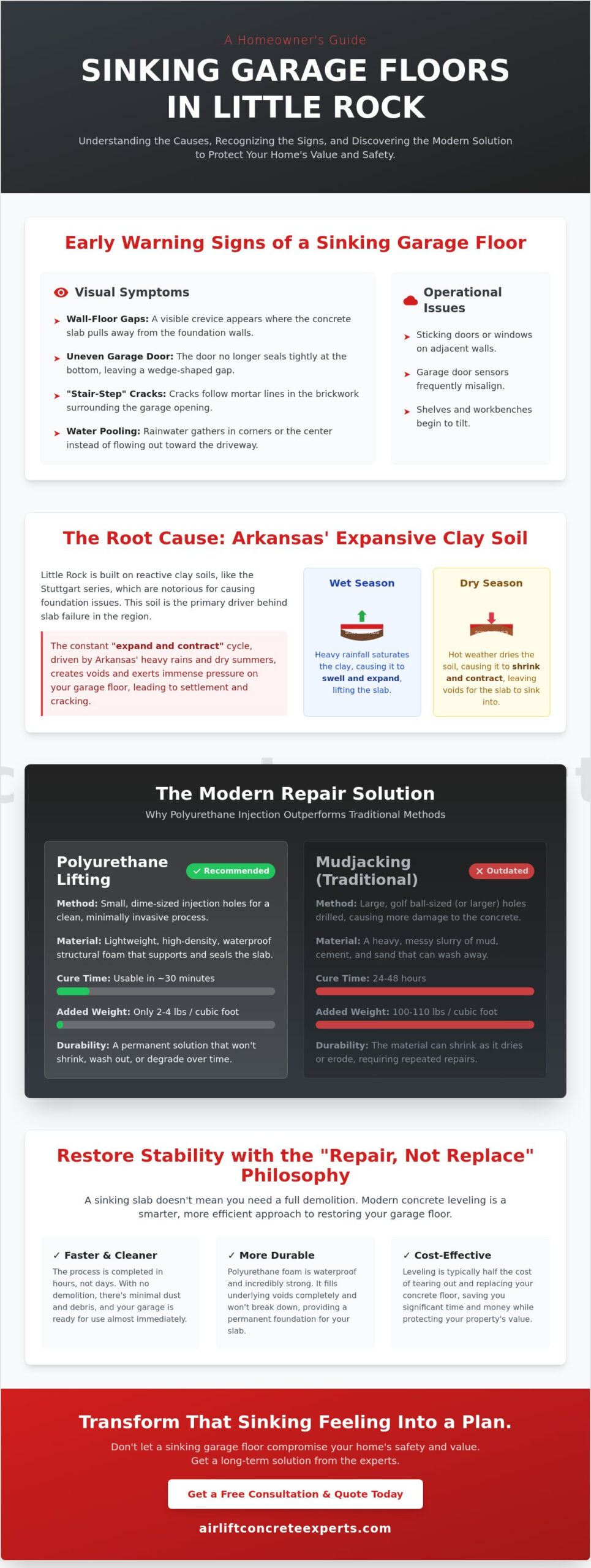
When you pull your car into the garage after a long day, you might not notice the subtle changes happening beneath your tires. However, recognizing the early signs of a sinking garage floor Little Rock homeowners face can prevent minor settlement from turning into a major structural headache. One of the most common indicators is the appearance of a wall-floor gap. This occurs when the concrete slab pulls away from the footer or the foundation walls, leaving a visible crevice that didn’t exist when the home was built. It’s a clear signal that the soil beneath the slab is no longer providing adequate support.
You should also pay close attention to your garage door’s alignment. If you notice that the door no longer seals tightly at the bottom corners, or if there’s a wedge-shaped gap when it’s closed, the floor has likely shifted. In our region, many homes feature brick exteriors. If you see “stair-step” cracks following the mortar lines in the brickwork surrounding the garage opening, the sinking slab is likely exerting downward pressure on the adjacent walls. Finally, keep an eye out after a heavy Central Arkansas rainstorm. If water pools in the center or corners of your garage instead of flowing toward the driveway, the natural pitch of your floor has been compromised by settlement.
It’s vital to distinguish between cosmetic issues and structural failure. Hairline cracks are common as concrete ages and shrinks, but wide, jagged fissures with vertical displacement are a different story. If one side of a crack is higher than the other, you’re looking at a sinking slab. You can also test for voids by walking across the floor; a “hollow” sound indicates that the sub-base has washed away or compacted. While surface wear is a nuisance, cracks that extend from the floor up into the drywall of the garage walls suggest a more serious progression. These structural voids often require professional concrete leveling to stabilize the area and prevent further damage.
Sometimes the most telling signs of a sinking garage floor Little Rock residents encounter are functional rather than purely visual. Garage door sensors are precision instruments. If they suddenly fail to align despite the tracks being clean, it’s often because the floor beneath the rails has dropped. You might also find that doors or windows on the wall adjacent to the garage have started to stick or become difficult to latch. Even your storage setup can provide clues. If your previously level workbenches or heavy storage shelves are now visibly tilting toward one side, the slab is no longer providing a flat, stable plane for your equipment.
Understanding why your concrete is shifting starts with the ground beneath your feet. Little Rock isn’t just sitting on static earth; it’s built on highly reactive clay that behaves differently than the sandy soils found in other parts of the country. This soil is a primary focus in studies regarding Geologic Hazards Associated with…Swelling Clays across the state. When Central Arkansas experiences its signature heavy rainfall, this clay absorbs moisture and expands with incredible force. As the weather turns dry, the soil shrinks and pulls away from the concrete. This constant “expand and contract” cycle is the primary driver behind the signs of a sinking garage floor Little Rock homeowners often discover after a particularly wet spring or a hot, dry summer.
Geography also plays a significant role in how quickly these issues develop. In newer developments across West Little Rock or Bryant, the land is often graded and filled quickly to meet construction timelines. If the sub-base soil isn’t compacted perfectly, the weight of a standard garage slab can cause it to settle much faster than older, more established neighborhoods. Little Rock’s high humidity doesn’t help either. It keeps the soil around the perimeter of a slab-on-grade foundation consistently damp, which can lead to uneven settlement as the center of the slab remains relatively dry while the edges fluctuate.
Water is heavy, and when it saturates the ground, it creates what engineers call hydrostatic pressure. This pressure doesn’t just sit there; it pushes against your garage floor from below. If your home has poor gutter drainage or downspouts that dump water right at the corner of the garage, that localized pressure can actually tilt the slab. Arkansas clay acts like a sponge during spring rains. As it soaks up water, it exerts upward pressure that can crack the concrete, only to leave the slab unsupported once the water eventually drains away.
While some slabs sink because the soil is pushing them, others fail because the soil is simply gone. Through a process known as “piping,” moving water carves tiny tunnels under your garage, slowly carrying away the supporting material. This is particularly common during the intense heatwaves we see in Sherwood and Jacksonville, where the soil dries out so significantly that it leaves massive gaps. Common Arkansas oaks also contribute to this problem. Their expansive root systems can dehydrate the soil deep under your garage, causing the earth to shrink and leave your heavy concrete slab hanging over an empty void. If you suspect your floor is losing its foundation, a quick evaluation by Airlift Concrete Experts can determine if a void is forming before the concrete actually cracks.
Not every crack in your concrete requires an immediate emergency response, but distinguishing between a cosmetic flaw and a structural hazard is vital. When evaluating the signs of a sinking garage floor Little Rock homeowners should first determine if the movement is isolated to the “floating” slab or if it involves the foundation walls. If the floor is pulling away from the walls while the walls remain plumb, the issue is likely localized to the slab sub-base. However, if you see the walls themselves tilting or shifting along with the floor, the structural integrity of the entire garage may be at risk. This distinction dictates whether you need simple slab stabilization or more extensive intervention.
Safety remains the most immediate concern for families in North Little Rock and surrounding areas. A sunken slab often creates vertical lips at the entrance or near the interior door, which become significant trip and fall hazards. Beyond human safety, an uneven floor places constant stress on your garage’s wooden framing. As the floor drops, the studs and sill plates are forced to span gaps they weren’t designed to bridge, potentially leading to warped walls. Even your vehicle isn’t immune; parking on a severely slanted surface daily can lead to uneven tire wear and unnecessary strain on your car’s suspension components.
You should treat cracks larger than 1/4 inch as high-priority repairs. These wide fissures often indicate that the voids beneath the concrete have reached a critical size, increasing the risk of a sudden slab collapse under the weight of a vehicle. These openings also act as highways for pests and moisture. In our humid climate, a gap in the floor allows dampness to seep into the wall cavities, which eventually triggers wood rot in the framing. If you can fit a pencil into a crack or see visible “steps” in the concrete, the time for observation has passed.
Procrastination can be expensive when it comes to concrete. Little Rock home inspectors are trained to spot signs of a sinking garage floor Little Rock buyers might miss, and they frequently flag settlement as a “red alert” during the closing process. Unaddressed sinking can decrease your home’s resale value by significantly more than the cost of the repair itself. Investing in professional foundation repair or slab leveling now protects your biggest investment and prevents the need for a total floor replacement later. Proactive leveling is a surgical, cost-effective solution that restores both safety and property value before the damage spreads to the rest of the structure.
Once you’ve identified the signs of a sinking garage floor Little Rock properties often show, it’s time to look at solutions that address the root cause. For years, mudjacking was the go-to method, but it often fails in Central Arkansas because of the sheer weight of the material used. Mudjacking involves pumping a heavy mixture of water, dirt, and cement under the concrete. In our reactive clay soils, adding this massive weight often leads to secondary settlement as the soil compresses further. High-density polyurethane injection is the modern alternative. It’s incredibly lightweight, yet it possesses the compressive strength to support the heaviest garage slabs and vehicles indefinitely.
The science behind polyurethane is what makes it permanent. Addressing the signs of a sinking garage floor Little Rock homeowners see early on ensures that the repair remains a simple, non-invasive process. Unlike mudjacking slurry, which can wash away during a heavy rainstorm, polyurethane is completely waterproof. It won’t erode, and it won’t react with the soil over time. The cure time is also a significant benefit for busy families. While traditional concrete repairs might keep you out of your garage for several days, polyurethane foam cures in minutes. In most cases, you can park your car back in the garage within an hour of the crew finishing the job. The process is far less invasive, requiring only penny-sized holes rather than the large drill marks left by older methods.
Our approach to leveling is methodical and precise. We begin by strategically drilling small injection ports across the sunken area of the slab. These holes are roughly the size of a penny, which minimizes the visual impact on your floor. Next, we inject the liquid polymer. As it expands into a rigid foam, we monitor the lift with precision levels to ensure a perfectly flat finish that aligns with your garage door and interior entryways. Finally, we seal the ports with a color-matched cement, leaving behind a repair that’s nearly invisible to the naked eye.
Choosing poly-lifting means choosing minimal disruption to your daily life. You don’t have to worry about a massive demolition project or the dust and noise of a total replacement. Modern geotechnical foams are also eco-friendly; they don’t leach chemicals into the surrounding Arkansas soil. Beyond just lifting the slab, polyurethane concrete leveling creates a lasting moisture barrier. This prevents future erosion under the slab by sealing off the sub-base from water intrusion. If you’ve noticed your garage floor shifting, reach out to Airlift Concrete Experts to see how this advanced technology can restore your home’s stability.
When your garage floor begins to fail, you need a partner who understands the local geography as well as you know your own neighborhood. Airlift Concrete Experts is deeply rooted in Central Arkansas, providing specialized solutions to homeowners in Little Rock, Conway, and Benton. We’ve built our reputation on a straightforward commitment: we repair, not replace. Total demolition is messy, expensive, and often unnecessary when the structural integrity of the slab can be restored through precision leveling. By choosing repair, you save significant costs while avoiding the weeks of downtime associated with pouring new concrete.
Our process begins with a free, no-pressure structural assessment. One of our specialists will visit your property to measure the degree of settlement and identify the specific signs of a sinking garage floor Little Rock weather has caused over time. We don’t use high-pressure sales tactics. Instead, we provide a clear, technical explanation of why your floor is shifting and how our equipment can stabilize it. Because we use specialized geotechnical tools designed for the heavy clay and silty alluvium of our region, we can perform repairs that national competitors often overlook. This neighborly approach ensures you feel confident in the stability of your home.
As a family-owned business in Arkansas, we treat every project like we’re working on a neighbor’s home. This local perspective is invaluable when dealing with the complex soil profiles found in Central Arkansas. Whether we are handling a residential driveway or large-scale commercial concrete lifting, our team knows exactly how to adjust our methods for the specific conditions of your street. We don’t use a one-size-fits-all approach. We customize the density of our polyurethane foam based on whether you’re dealing with the packed fill of a newer West Little Rock development or the established, shifting clay of an older neighborhood. This level of precision is what makes our repairs last.
Restoring the safety and value of your home is a simple phone call away. Scheduling an assessment in Little Rock or North Little Rock allows our experts to catch settlement before it leads to a full slab collapse or secondary wall damage. We stand behind our work with a robust warranty and provide long-term support to ensure your garage remains stable for years to come. This provides the peace of mind that your investment is protected by local professionals who will be here whenever you need us. Don’t let uneven concrete create a hazard for your family or a red flag for future buyers. If you’re ready to fix those signs of a sinking garage floor, contact Airlift Concrete Experts today to secure your property’s foundation.
Addressing the signs of a sinking garage floor Little Rock homeowners encounter is about more than just aesthetics; it’s about preserving the structural integrity of your property. By recognizing gaps, door misalignments, and the unique challenges of Arkansas clay early, you can avoid the high costs of a total floor replacement. Modern polyurethane leveling offers a faster, cleaner, and more durable way to stabilize your garage without the heavy mess or weight of traditional methods.
As a local, family-owned authority since 2017, we’ve successfully lifted over 10,000 slabs across Arkansas. Our specialized high-density polyurethane technology is specifically engineered to handle our region’s reactive soil conditions. We’re here to transform your property concerns into a sense of security through transparent communication and technical expertise. You don’t have to live with uneven concrete or trip hazards any longer. Take the first step toward a level, safe garage by clicking below.
Get Your Free Little Rock Concrete Leveling Estimate
Restoring your floor is a straightforward process that brings immediate peace of mind to your household. We look forward to helping you protect your home for the long term.
A sinking garage floor can indicate foundation trouble, but it often stems from a localized failure in the sub-base soil rather than the structural footings of the home. If the sinking is confined to the “floating” slab, it’s generally a simpler repair. However, if you see cracks extending into the garage walls or brickwork, the foundation might be involved. A professional assessment is the only way to confirm which system is failing.
The cost of leveling varies depending on the square footage of the affected area and the volume of polyurethane foam required to fill the voids. Factors such as the degree of settlement and the accessibility of the slab also influence the total. While we don’t provide flat rates, repairing a slab is typically much more affordable than the thousands of dollars required for a full demolition and replacement.
You shouldn’t attempt to lift a structural slab with a DIY kit, as these products are designed only for cosmetic surface repairs. Professional-grade polyurethane injection requires specialized high-pressure equipment and precise monitoring to ensure the slab is lifted evenly without cracking. Attempting a DIY lift can result in an unlevel surface or even cause the concrete to shatter, leading to much more expensive professional repairs later.
Polyurethane concrete leveling is considered a permanent solution because the high-density foam doesn’t degrade or wash away over time. Unlike traditional mudjacking slurry, which can break down when exposed to moisture, polyurethane is waterproof and maintains its compressive strength indefinitely. Once the foam cures and stabilizes the sub-base, it provides a solid foundation that resists the “expand and contract” cycle typical of Arkansas clay.
It’s unlikely your floor will sink again once the underlying voids are filled and the soil is stabilized with geotechnical foam. The polyurethane binds with the soil to create a stable, moisture-resistant base. However, if broader environmental issues like poor gutter drainage or large tree roots aren’t addressed, new voids could potentially form in different areas. We focus on addressing the root cause to ensure long-term stability.
Most standard home insurance policies in Arkansas don’t cover sinking garage floors caused by soil settlement or erosion. Insurance typically covers sudden, accidental damage rather than gradual movement related to the local climate or soil conditions. You should review your specific policy or speak with your agent to see if you have additional coverage for earth movement or foundation issues, though these are often separate riders.
You can typically drive your vehicle back onto the floor within 15 to 30 minutes of the repair being completed. One of the primary benefits of polyurethane is its rapid cure time. While traditional concrete replacement requires days or weeks of waiting, our specialized foam reaches the majority of its full strength nearly instantly. This minimal downtime is a major reason why this method is preferred for residential garages.
Ignoring the signs of a sinking garage floor Little Rock homes display only leads to more expensive structural damage over time. Small gaps can quickly turn into major trip hazards, and unlevel slabs put unnecessary strain on your garage door opener and wooden framing. Eventually, the slab may crack so severely that it becomes unrepairable, forcing a total replacement that could’ve been avoided with proactive stabilization.

 Call Now