
When a Little Rock homeowner discovers a 1/4-inch stair-step crack in their brickwork after a typical Arkansas dry spell, the first instinct is often a sinking feeling in the pit of their stomach. It’s the moment you realize your home’s stability is at the mercy of the ground beneath it. Searching for foundation repair near me isn’t just about finding a contractor; it’s about finding a way to protect your largest financial investment from the relentless movement of our local soil.
You’ve likely heard that Arkansas expansive clay can exert up to 14,000 pounds of pressure per square foot during seasonal moisture changes, and you’re right to be concerned about how that affects your equity. We understand that conflicting advice from different companies can make a stressful situation feel overwhelming. This guide provides a clear roadmap to understanding the three primary causes of structural failure in Central Arkansas and how to identify them before they become catastrophic. You’ll learn why modern methods like polyjacking offer a more durable solution than traditional repairs, ensuring you have the knowledge to restore your home’s safety and your own peace of mind.
Central Arkansas homeowners often spot cracks in their drywall or notice doors that won’t quite latch. These aren’t just cosmetic quirks of an aging house; they’re direct results of our unique local geology. In cities like Malvern and Little Rock, foundations face constant stress from hydrostatic pressure. This physical force occurs when water saturates the ground and pushes against your foundation walls with thousands of pounds of pressure. If you’re searching for foundation repair near me, you’re likely seeing the consequences of this pressure firsthand.
The local weather cycles in 2026 have made soil settlement a “when,” not an “if” for many residents. Data from regional geological surveys shows a 15% increase in soil movement following the erratic precipitation patterns of the last 18 months. It’s vital to distinguish between normal settling and structural failure. Most homes experience minor settling within the first 3 years of construction. However, structural failure involves active, ongoing shifting. Central Arkansas is built on a high concentration of expansive clay soils, which act as the primary catalyst for these structural emergencies.
Central Arkansas red clay behaves like a massive, underground sponge. During heavy spring rains, the clay absorbs moisture and swells significantly, exerting upward pressure on concrete slabs. When the summer droughts hit, this same soil loses moisture and shrinks. This creates “voids” or empty pockets directly beneath your home. Without the soil there to support the weight, the foundation sinks into these gaps. This cycle of swelling and shrinking eventually fatigues the concrete, leading to the deep cracks that require professional intervention.
Your specific zip code in the Natural State changes your risk profile. Homeowners in Hot Springs and Bryant often deal with dense clay pockets that retain water far longer than the sandier soils found toward the Delta. In North Little Rock, the hilly terrain adds another layer of complexity. Steep grades cause water to runoff rapidly, often pooling at the base of foundations rather than draining away. This localized saturation accelerates the “sponge effect” significantly. Vegetation also plays a role. A single large oak tree in a Bryant backyard can pull 100 gallons of water from the soil every day. This localized dehydration causes the soil to shrink unevenly, which is why you might notice one corner of your home sinking faster than the rest. Finding foundation repair near me means finding a team that understands these hyper-local environmental factors.
Identifying foundation issues early can save you thousands of dollars in long-term restoration costs. In Central Arkansas, our soil is notorious for its high clay content, which reacts aggressively to weather changes. If you are currently searching for foundation repair near me, you have likely noticed your home shifting as the seasons transition from wet springs to bone-dry summers. These movements aren’t just cosmetic; they are structural signals that your home’s footprint is no longer stable.
The best place to start your inspection is outside. Walk the perimeter of your home and examine the brickwork or siding closely. In communities like Conway and Benton, brick veneers often display “stair-step” cracks. These follow the mortar lines in a zigzag pattern and usually indicate that one corner of the house is settling faster than the rest. Academic studies on expansive soils in Washington County, Arkansas highlight how these clays exert tremendous pressure on residential structures, a phenomenon we see daily across the entire state.
Your home’s interior often provides the most obvious clues. Doors that stick in the summer but swing freely in the winter are a classic sign of foundation movement. This happens because the soil moisture levels fluctuate, causing the frame to go out of square. You might also notice “nail pops,” which are small, circular bumps in the drywall where the fastener has been pushed out by structural tension. Diagonal cracks extending from the upper corners of door frames or windows are also common red flags. If you feel like you’re walking slightly uphill in your living room, searching for foundation leveling near me is the first step toward stabilizing your floor joists and slab.
For homeowners with pier and beam foundations, sagging floors are a specific concern. This often results from moisture rot in the crawl space or piers that have sunk into the soft Arkansas earth. If a tennis ball rolls across your hardwood floor without help, your support system needs professional attention. Catching these symptoms early allows for less invasive solutions like polyjacking or pier installation. You can schedule a free inspection with our team to get an honest assessment of your home’s current health before these small cracks turn into major structural failures.
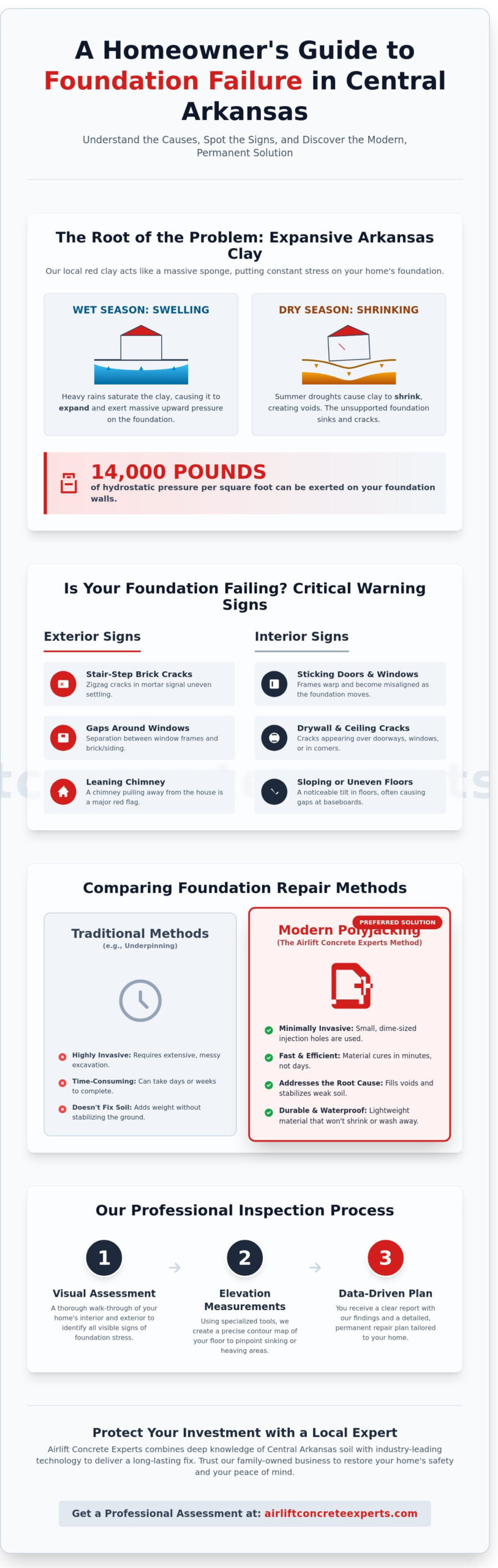
By 2026, the technology behind structural stabilization has shifted toward efficiency and precision. Older methods like mudjacking, which uses a heavy slurry of sand and cement, are becoming obsolete because they add thousands of pounds of unnecessary weight to already failing soil. If you’re searching for foundation repair near me, it’s vital to choose a solution that addresses the root cause rather than just masking the symptoms. A cheap patch might save a few hundred dollars today, but it often leads to a massive structural failure within 3 to 5 years. We focus on permanent fixes that stabilize your home for the long haul, protecting your biggest investment from the volatile Arkansas climate.
High-density polyurethane expansion is a game-changer for Arkansas properties. This chemical process involves injecting a two-part liquid that reacts and expands to 20 times its original volume. It fills every void beneath your concrete and exerts enough pressure to lift heavy slabs back to their original position. It’s waterproof and weighs only 2 to 4 pounds per cubic foot, meaning it won’t cause further settlement. This makes polyurethane concrete leveling the superior choice for Malvern and Central Arkansas driveways, sidewalks, and pool decks. It’s a non-invasive alternative that cures in 15 minutes, allowing you to use your surfaces immediately.
When soil settlement affects the actual footprint of your home, we have to reach deeper than the surface. Steel piers are designed to bypass unstable topsoil and transfer the weight of your house to load-bearing strata or bedrock. Our team uses two primary types based on your specific needs:
Professional contractors determine the right fit by measuring torque and soil resistance during the installation. This ensures your foundation repair near me provides a stable, level home regardless of how the local clay shifts. We provide a free inspection to identify exactly which method your specific site requires, taking the guesswork out of your home’s safety.
Searching for foundation repair near me often starts with a sense of urgency. You’ve noticed a door that won’t latch or a crack in the drywall, and you need answers. At Airlift Concrete Experts, we’ve conducted thousands of assessments since 2017. We treat an inspection like a medical diagnostic. It’s a methodical process designed to uncover the “why” behind the movement, not just the “where.” We begin with a 360-degree exterior walkthrough to identify patterns of soil shrinkage or poor drainage. This step is vital because 80% of structural issues in Arkansas stem from how water interacts with our reactive clay soils.
Inside your home, the process becomes even more precise. We don’t rely on “eye-balling” a slanted floor. Our specialists use digital altimeters and Zip Levels to map out the exact elevation of your foundation. If the northwest corner of your living room has settled 1.25 inches compared to the center of the home, our tools will find it. This data allows us to create a topographic map of your floor’s health. We also check for “plumb” walls using laser levels to ensure your home’s vertical alignment is within the 1/8th-of-an-inch tolerance required for long-term safety.
A thorough visual assessment includes entering the crawl space to check for moisture, wood rot, or pier settlement. We look for specific indicators like “stair-step” cracks in exterior brickwork, which often signal localized soil failure. A no-nonsense professional avoids high-pressure sales tactics. Instead, we present the raw data from our leveling tools. We identify if the root cause is poor site drainage, the natural expansion of Arkansas clay, or original construction errors. You’ll receive a clear explanation of whether your home needs immediate intervention or simple preventative maintenance.
After the walkthrough, you’ll receive a detailed repair proposal. This document acts as a blueprint for your home’s recovery. It outlines the placement of every pier or the specific areas where polyjacking will be used to lift concrete slabs. Local experience in Malvern and Jacksonville is a major advantage here. Our teams understand that the heavy clay in Malvern behaves differently than the varied soil pockets in Jacksonville. This regional knowledge ensures your repair plan is tailored to the specific environment. Every proposal includes a transparent cost estimate and a lifetime transferable warranty, giving you 100% confidence in the durability of the work.
Selecting a partner for structural work is a significant decision. Since 2017, Airlift Concrete Experts has operated as a family-owned and operated business right here in Arkansas. This “Arkansas-grown” identity isn’t just a label; it’s a technical advantage. We understand the unique challenges posed by the state’s diverse geography, from the dense clay in the Delta to the rocky terrain of the Ozarks. Local codes and soil conditions aren’t things we study in a manual; they’re factors we’ve navigated daily for years.
When you search for foundation repair near me, you deserve a team that prioritizes accountability over corporate quotas. Because we’re local, our reputation is built on the word-of-mouth of your neighbors. We don’t just work in these communities; we live in them. This personal connection drives us to provide a level of service that national franchises simply can’t match. We treat every home as if it belonged to our own family, ensuring that the repairs we make are built to last for decades.
Our business model focuses exclusively on repair rather than new construction. This specialization is vital. New construction involves following a blueprint, but repair requires a diagnostic mindset. We’ve spent years identifying why foundations fail in Central Arkansas, allowing us to develop targeted strategies that address the root cause of soil settlement. We don’t just patch a crack; we stabilize the ground beneath it.
We utilize industrial-grade polyjacking near me technology to lift and stabilize sinking concrete surfaces. This method is far superior to traditional mudjacking because it’s lightweight, waterproof, and cures in under 15 minutes. Our equipment is designed for precision, which allows us to maintain clean, non-disruptive job sites. Whether you’re located in Little Rock, Cabot, or Conway, our crews arrive ready to solve the problem without destroying your landscaping or leaving a mess behind.
We know that a cracked wall or a sloping floor creates high levels of stress for any homeowner. Our goal is to transform that anxiety into security by providing clear, honest communication. Every project begins with a comprehensive, free structural evaluation. We’ll walk you through the data, explain the physics behind the settlement, and offer a fixed-price solution. You won’t deal with high-pressure sales tactics, just expert advice from your neighbors.
Schedule your free inspection with Airlift Concrete Experts today and take the first step toward a stable, safe home for your family. We’re ready to show you why we’re the most trusted name for foundation repair near me in the Natural State.
Understanding the unique pressure expansive red clay places on your home is the first step toward long-term safety. Homeowners in Malvern and Little Rock can save thousands in equity by addressing settlement signs before they escalate into structural failure. Our specialized polyjacking technology offers a precise, non-invasive way to stabilize your home that traditional methods simply can’t match. By choosing a local authority, you ensure your repair is tailored to the specific soil conditions found right here in Central Arkansas.
Finding foundation repair near me is about more than just a quick fix; it’s about finding a team you can trust. Airlift Concrete Experts has been family-owned and operated since 2017, and we’ve built our reputation on providing permanent results for our neighbors. We’re committed to transparency and technical excellence in every project we undertake. You don’t have to navigate structural concerns alone when expert help is just a phone call away.
Get Your Free Foundation Inspection & Estimate Now
We look forward to helping you secure your foundation and restore your peace of mind.
Foundation repair costs in Arkansas typically range from $3,500 to $15,000 for most residential projects. Minor crack injections might cost around $600; however, extensive piering systems for a settling home can exceed $25,000 depending on the soil depth. These prices reflect the specialized equipment and high-grade materials required to stabilize the expansive clay soils found in our region. We provide a free inspection to give you an exact quote for your specific property.
A crack isn’t always a structural emergency, but any opening wider than 1/8 inch requires a professional evaluation. Hairline shrinkage cracks often occur as concrete cures; however, horizontal or stair-step cracks in brickwork indicate active soil movement. If you notice these gaps growing or if doors begin to stick, the structural integrity of your home is likely at risk. Catching these signs early prevents a $500 repair from turning into a $10,000 project.
Most foundation repair projects in Central Arkansas take between 2 and 5 days to complete from start to finish. Simple polyjacking for a sunken slab often wraps up in a single afternoon, while installing a full system of steel piers requires more time for excavation and lifting. Our crews work efficiently to restore your home’s stability with minimal disruption to your daily routine. We’ll provide a specific timeline during your initial consultation so you know exactly what to expect.
Professional foundation repair actually protects your home’s resale value by providing a transferable warranty to the next owner. Homes with unaddressed structural issues often see a 10% to 20% reduction in market price or fail to pass a standard home inspection entirely. When you search for foundation repair near me and choose a certified specialist, you’re securing your investment. A stabilized foundation with documented repairs offers peace of mind to buyers and ensures a smoother closing process.
You cannot safely fix a settling foundation with a DIY kit because these products only mask cosmetic symptoms without addressing the underlying soil failure. Retail epoxy kits might seal a surface crack, but they lack the hydraulic power needed to lift a 50-ton structure or reach the stable load-bearing strata. Attempting a DIY fix often leads to further damage, potentially doubling your eventual repair costs. Trusting a local expert ensures the job’s done correctly using industrial-grade steel and high-density polymers.
Most standard homeowners insurance policies in Malvern don’t cover foundation repair caused by natural soil compaction or hydrostatic pressure. Coverage typically only applies if the damage resulted from a sudden covered peril, such as a major plumbing leak or a fire. We recommend reviewing your specific policy’s earth movement exclusions with your agent. Regardless of coverage, addressing the issue now prevents the 15% annual increase in repair costs associated with progressive structural failure.
The best time for foundation repair in Central Arkansas is during the late summer or early fall when the soil is driest. During these months, the clay soil has already contracted, allowing our team to accurately assess the maximum level of settlement. You shouldn’t wait if you see active movement, as Arkansas’s heavy spring rains can quickly wash away loose soil and accelerate sinking. We perform repairs year-round to ensure your home remains safe regardless of the season.
You need polyjacking for sinking concrete slabs like driveways or garage floors, while full foundation piers are required for stabilizing the perimeter walls of your home. Polyjacking uses high-density foam to lift light concrete, whereas steel piers reach deep into the earth to support the weight of the entire building. If your search for foundation repair near me led you here, our team can perform a site-specific soil analysis. This data helps us determine which specialized method will provide a permanent solution.

 Call Now