
Last Tuesday, a homeowner in Little Rock watched a simple afternoon project turn into a stressful cleanup when their retail-grade foam failed to lift a sinking walkway. It’s a common frustration in 2026, as many people look for quick ways to eliminate trip hazards and ease anxiety over foundation shifts. You deserve a home that feels stable and safe, and we agree that a cracked, uneven driveway is a problem that shouldn’t wait. Choosing between a concrete lifting foam kit and a professional solution is the first step toward reclaiming your property’s value.
In this guide, you’ll discover if a DIY approach can truly withstand the shifting nature of Arkansas red clay or if professional polyjacking is required for a permanent fix. We’ll compare the structural durability of these methods and provide a clear path to achieving a level surface that lasts. You will learn how to identify the specific soil challenges in our region and how specialized equipment ensures your concrete remains secure for years to come.
A concrete lifting foam kit is a portable, two-part polyurethane expansion system designed for minor residential repairs. These retail packages typically contain canisters of “Component A” and “Component B,” which, when mixed, create a chemical reaction that expands into a rigid foam. Most kits sold to homeowners include basic mixing nozzles and plastic injection tubes. While they might look similar to the cans of gap-filling spray foam found in hardware stores, there is a fundamental difference in their chemistry. Standard spray foam is meant for insulation, while structural lifting foam is engineered to support significant weight and resist the compressive forces of a concrete slab.
Concrete leveling through chemical expansion has been a standard in the industrial sector for decades. Recently, this technology has trickled down to the consumer market, sparking a trend across Central Arkansas. In suburbs like Benton and Bryant, homeowners are increasingly attempting to manage sinking walkways and porch steps themselves. This shift is driven by the desire for immediate results and the growing accessibility of specialized chemicals that were once reserved for professional contractors.
The primary draw for these kits is their immediate availability on major retail platforms. You can order a kit on a Tuesday and have it sitting on your driveway in Malvern by Thursday. For many residents, the “weekend warrior” mindset is a point of pride. Tackling a sinking sidewalk on a Saturday morning feels like a productive way to maintain home value. The perceived cost savings are also a major factor. When homeowners compare the price of a boxed kit to the initial quote of a professional service, the DIY route often looks like a bargain. It provides a sense of control over the home maintenance schedule without waiting for a service window.
The reality of soil stabilization is more complex than a simple chemical reaction. Retail kits often lack the expansion power necessary to move heavy residential slabs. A standard driveway section can weigh upwards of 3,500 pounds, and consumer-grade concrete lifting foam kit options rarely provide the force required to lift that mass evenly. Without the high-output pumps and specialized injection pressure control used by experts, the risk of “over-lifting” is high. This happens when the foam expands too rapidly in one area, causing the concrete to crack or tilt in an unintended direction.
Precision is another major hurdle for the DIY approach. Professional polyjacking relies on calculated injection points to ensure the foam fills every void. Amateur applications often create large air pockets or “donuts” of foam that don’t provide total coverage. Over time, the weight of a vehicle or even heavy rain can cause the slab to settle again into these empty spaces. While a kit might offer a temporary fix, it frequently fails to provide the long-term structural integrity that Malvern soil conditions require.
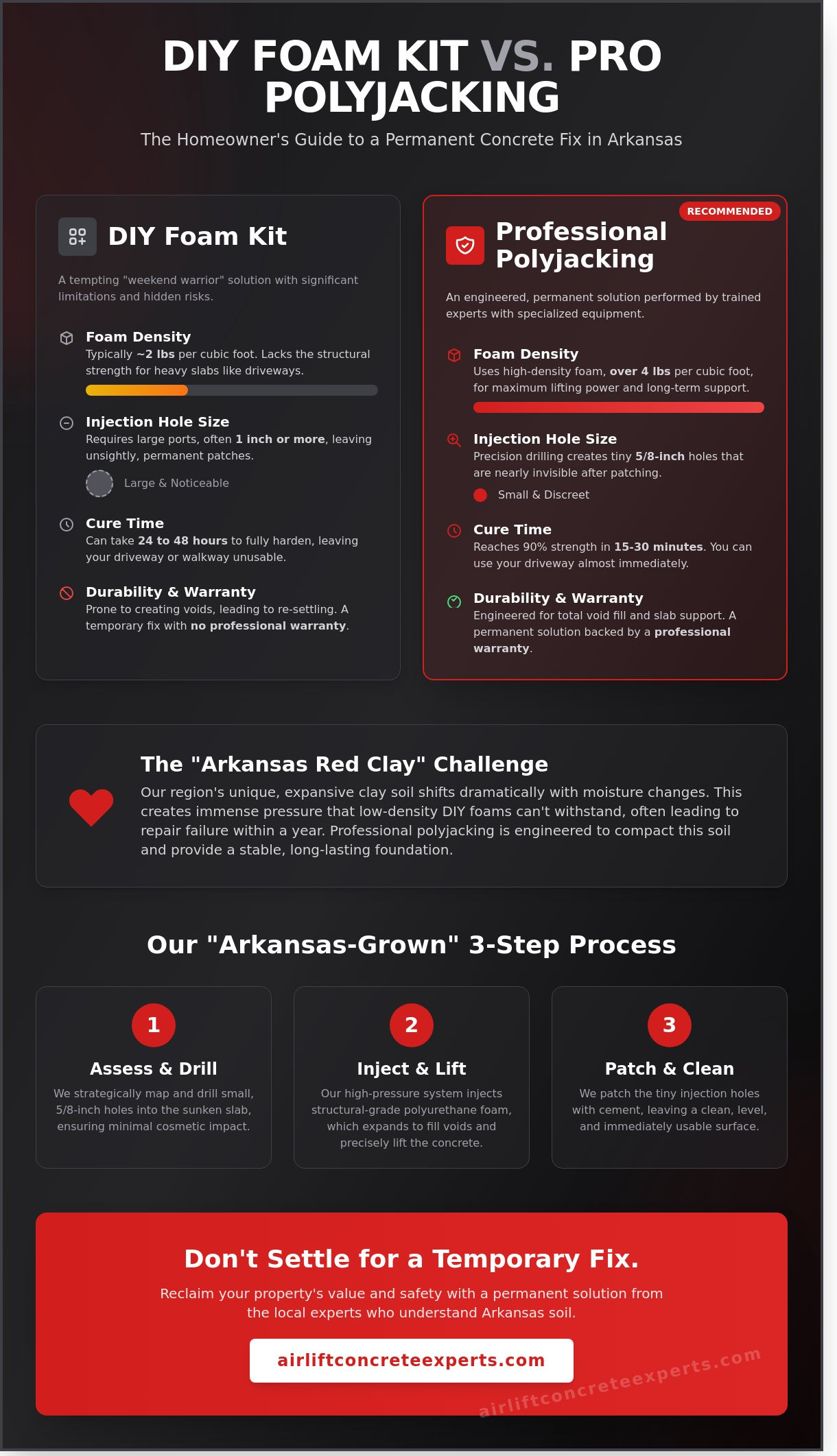
A retail concrete lifting foam kit might seem like a practical Saturday afternoon project, but the technical gap between store-bought canisters and professional polyjacking is substantial. Most retail kits provide a foam with a density of roughly 2lb per cubic foot. While this is sufficient for filling small air pockets, it often lacks the structural power to support heavy traffic over time. Professionals use high-density foam that exceeds 4lb per cubic foot, providing the necessary strength to lift and sustain multi-ton driveway slabs without future compression.
The visual impact of the repair is another area where DIY methods fall short. Professional polyjacking utilizes precision drilling, creating holes only 5/8-inch in diameter. These small entry points are easily patched and blended with the existing concrete. In contrast, many DIY kits require ports that are 1 inch or larger. These larger holes leave behind unsightly scars on your property that are difficult to hide and often serve as a permanent reminder of the repair.
Cure times also vary significantly between the two approaches. Professional-grade polyurethane reaches 90% of its full load-bearing capacity within 15 to 30 minutes of injection. Many consumer-grade foams require 24 to 48 hours to fully harden. This delay means you can’t use your driveway or walkway immediately, which adds an extra layer of inconvenience to the repair process.
Homeowners in Hot Springs and Conway face unique challenges with high groundwater and clay-rich soil. We use closed-cell polyurethane because it is hydrophobic, meaning it repels water rather than absorbing it. This is a critical distinction; open-cell foams found in some consumer products can act like a sponge, leading to further soil instability. When analyzing the mechanical properties of a structural polyurethane foam, we prioritize its compressive strength. Compressive strength is the specific measurement of how much weight a material can support before it deforms, ensuring your concrete remains level under the weight of parked vehicles.
The success of a lift depends heavily on the equipment used to mix the chemicals. Handheld canisters often struggle with consistent mixing ratios, which leads to “soft spots” where the foam fails to expand correctly. Professional teams utilize high-pressure proportioning machines that maintain exact temperature controls. This precision is vital because the chemical reaction that creates the foam is temperature-sensitive. This level of control is how polyurethane foam injection concrete lifting ensures a uniform lift across the entire slab. If you’re concerned about the stability of your walkways, requesting a free expert evaluation can provide clarity on the best repair path for your home.
Choosing a concrete lifting foam kit from a local home improvement store often feels like a savvy financial move. You see a sunken walkway or a trip hazard on your Malvern patio and assume a weekend of work will save you thousands. However, the initial price tag of a DIY kit doesn’t tell the whole story. While a professional service includes labor costs, it also provides a structural warranty. If a DIY patch fails after one heavy Arkansas rainstorm, you’re back at square one with less money in your pocket. A professional repair is a permanent fix, not a temporary bandage.
Time is your most valuable resource. A professional crew typically completes a residential project in two to three hours. For a homeowner, a DIY project often consumes a full weekend between watching tutorials, buying supplies, and cleaning up the inevitable mess. Safety is another critical factor. You’re dealing with pressurized chemicals that expand with immense force. Industry experts at the American Chemistry Council note that Polyurethane and Polyisocyanurate Foams are highly effective for their moisture resistance and durability, but they require precise handling. Without specialized training, you risk chemical exposure or damaging your property if the foam expands in an unexpected direction.
The “affordable” concrete lifting foam kit usually requires extra equipment you don’t have in your garage. You’ll need high-quality masonry drill bits and a heavy-duty hammer drill capable of boring through four inches of cured concrete. These tools can add $200 or more to your total. You also have to account for personal protective equipment and specialized solvents for cleanup. The biggest financial risk is a “stuck” slab. If the foam reacts too quickly or you hit a pocket of loose soil, you can crack the concrete slab entirely. Replacing a single slab of a driveway can cost upwards of $1,500, which is far more than a professional polyjacking service.
In Central Arkansas, our clay-heavy soil is notoriously fickle. We don’t just pump foam into a hole. We perform a comprehensive soil assessment before the first drill bit touches the ground. This ensures the material we use addresses the underlying void rather than just masking the symptom. We provide a surgical-grade finish with minimal site disruption. Our injection holes are no larger than a penny, making them nearly invisible once patched. This process is much cleaner than traditional concrete leveling and mudjacking, and it allows you to use your driveway or sidewalk immediately after we leave. We treat your home like it’s our own, ensuring the structural integrity of your property remains intact for years to come.
Arkansas soil isn’t just dirt; it’s a dynamic environment that reacts aggressively to the weather. The “Arkansas Red Clay” found throughout Malvern and Hot Springs is notorious for its expansive properties. During a wet season, this clay absorbs water and expands. During a dry July, it shrinks and pulls away from the structure. This constant movement creates massive underground gaps. A standard concrete lifting foam kit bought at a big-box store often lacks the compressive strength to fight these forces. These kits typically provide a low-density foam that may support the weight of the concrete initially, but it often crushes under the 1,500 pounds of pressure that shifting clay can exert during a single seasonal cycle.
The moisture levels in Central Arkansas add another layer of difficulty. With Little Rock averaging 50 inches of rainfall annually, the soil stays saturated for long periods. This saturation leads to “washouts” where the subgrade disappears entirely. If the foam used isn’t specifically designed for high-moisture environments, it can lose its bond with the concrete or the soil, leading to a total failure of the repair within 12 months.
The unique topography of Hot Springs creates specific drainage challenges. Sloped lots often direct runoff toward foundation edges, which accelerates the erosion of the subgrade. In nearby Conway, soil density varies wildly across even a single residential lot, leading to uneven slab settlement. Professional-grade slab jacking foam is engineered specifically for these high-moisture environments. Unlike retail products, this high-density polyurethane is hydrophobic. This means it won’t lose its shape, degrade, or wash away when the water table rises after a heavy Arkansas storm.
A DIY concrete lifting foam kit usually results in a “surface lift.” This fills the void directly under the slab but leaves deeper problems untouched. This phenomenon is known as bridging. The foam spans the gap without stabilizing the actual soil below. Professional polyjacking uses deep-injection techniques to reach 24 to 36 inches below the surface. This process compacts the loose soil and creates a stable base that resists future settlement. Signs of deep-seated failure include:
If your concrete is sinking, don’t settle for a temporary fix that might fail by next season. Contact our local team for a free inspection to ensure your repair provides the permanent stability your home deserves.
While a retail concrete lifting foam kit offers a temporary patch, professional polyjacking provides a structural solution that stands the test of time. A standard concrete lifting foam kit from a big-box store rarely accounts for the complex soil dynamics found in our region. We’ve built our reputation on an Arkansas-grown philosophy. This means we treat every property in Malvern like it belongs to a neighbor. We don’t believe in band-aid fixes that fail after a single season of heavy rain or soil shifts. Our focus remains on permanent safety and restoring the curb appeal that adds real value to your investment.
Our professional process follows three distinct steps to ensure your slabs stay level. First, we inspect the site to identify the root cause of the settlement, such as poor drainage or organic material in the soil. Second, we inject specialized, high-density polyurethane foam through small, penny-sized holes. This material expands with enough force to lift thousands of pounds while compacting the loose soil beneath. Finally, we protect your concrete by sealing the injection points and ensuring the slab is fully supported across its entire surface area.
Our team brings local expertise to every job site in Malvern, Cabot, and North Little Rock. We understand the specific clay-rich soil conditions that plague Central Arkansas homeowners. You’ll receive a no-nonsense, honest assessment of your concrete’s health. If your driveway or patio doesn’t need a full lift, we’ll tell you. For those ready to explore the technical advantages of our method, read our polyurethane concrete leveling pillar for a deep dive into the science of soil stabilization.
We’ve designed our consultation process to be entirely low-pressure. Our goal is to evaluate your sunken slabs and provide a customized repair plan that fits your property’s specific needs. You won’t deal with high-stress sales tactics. Instead, you’ll get a clear explanation of how we can restore your home’s safety. Don’t let a tripping hazard decrease your property value or cause an injury. It’s time to secure your foundation with the experts who know Arkansas soil best. Book your free inspection with Airlift Concrete Experts today to get started on a permanent fix.
Choosing between a retail concrete lifting foam kit and professional polyjacking is the difference between a temporary patch and a lifelong structural solution. DIY kits often lack the specialized expansion force required to stabilize the heavy clay soils found throughout Arkansas. Without industrial-grade equipment, these small-scale applications frequently fail when the next rainy season arrives. Professional polyjacking addresses the root cause of settlement by densifying the soil beneath your slab, ensuring it stays level for years to come.
Airlift Concrete Experts has been family-owned and operated since 2017, bringing local knowledge to every job site from Little Rock to Conway. Our team utilizes specialized high-density polyurethane equipment designed specifically for the rigorous demands of residential and commercial leveling. We don’t just fill a gap; we restore the structural integrity of your property using methods backed by years of field experience. You can trust our Arkansas-grown expertise to handle your home with the care it deserves.
Don’t let a sinking slab compromise your safety or property value. Get Your Free Concrete Lifting Inspection in Arkansas to see how our specialized tools provide the stability your foundation needs. We’re ready to help you protect your investment with a solution that’s built to last.
A concrete lifting foam kit is rarely worth the investment for a standard 4-inch thick driveway designed to support 4,000-pound vehicles. While these retail kits might lift a light sidewalk section, they often lack the 100 PSI expansion force required to move heavy driveway slabs. Most homeowners find that the limited volume in a DIY kit covers less than 5 square feet, making it an expensive and temporary fix compared to professional polyjacking.
Most consumer-grade DIY kits provide a compressive strength of approximately 50 to 80 pounds per square inch. In contrast, professional-grade polyjacking foam is engineered to support loads exceeding 10,000 pounds per square foot once fully cured. If you’re parking a 6,000-pound SUV on the slab, a retail foam kit will likely compress and fail within 12 months. Professional materials ensure the soil settlement issues are addressed with structural-grade density.
If a DIY foam injection fails, the cured material creates an uneven barrier that prevents future professional repairs without total slab demolition. Removing hardened polyurethane from under a 3,000-pound slab requires heavy machinery and often doubles the initial repair cost. If the injection port clogs or the foam reacts poorly to Arkansas soil moisture, you’re left with a rocking slab that presents a 2-inch tripping hazard and a much larger disposal bill.
You typically don’t need a building permit for minor driveway or sidewalk leveling in Malvern or Little Rock city limits. However, any work involving structural foundation stabilization requires a permit under Section R105 of the Arkansas State Building Code. Our team handles the 48-hour utility locates through Arkansas 811 to ensure we don’t hit underground lines. Always verify with the Little Rock Planning and Development office for specific zoning requirements on your property.
You cannot use standard hardware store spray foam to lift concrete because it lacks the closed-cell structure and density required for load-bearing applications. Standard insulation foam has a compressive strength of less than 15 PSI, which will flatten instantly under the weight of a 500-pound concrete section. Using the wrong material leads to immediate structural failure. Professional polyjacking uses specialized two-part polymers that expand with enough force to lift 6,000-pound slabs accurately and permanently.
Professional polyjacking is a permanent solution designed to last 20 to 50 years because the material is hydrophobic and won’t wash away. A retail concrete lifting foam kit often uses lower-density materials that degrade when exposed to the high humidity levels found in Central Arkansas. Most DIY applications show signs of re-settlement within 18 months. Our professional process addresses the underlying soil settlement, providing a stable foundation that outlasts the concrete itself.
A retail concrete lifting foam kit is only designed for surface-level aesthetics and won’t fix structural foundation cracks. Foundation issues in Malvern often stem from the 30 percent clay content in our local soil, which requires deep-driven piers or high-pressure polyjacking to stabilize. If you see cracks wider than 0.25 inches in your home’s perimeter, a surface kit is a cosmetic bandage. You need a professional inspection to ensure your home’s structural integrity isn’t compromised.
The ideal temperature for applying concrete lifting foam in Arkansas is between 60 and 80 degrees Fahrenheit. When temperatures drop below 40 degrees, the chemical reaction slows down by 50 percent, often resulting in poor expansion and weak foam density. During our humid 95-degree July days, the foam can set too quickly, making it difficult to achieve a level finish. We use heated hose systems to maintain a consistent 110-degree material temperature, ensuring a perfect lift regardless of the weather.

 Call Now