
The most common way to fix a sunken sidewalk might actually be the reason it fails again in less than 24 months. In the heavy clay soils of Malvern and Central Arkansas, the traditional weight used in concrete leveling mudjacking often adds too much pressure to an already unstable base. You’ve likely spent months worrying about trip hazards on your walkway or watching water pool near your home’s foundation after a heavy 3-inch rainfall. It’s natural to fear that a total concrete replacement is the only way to restore your property’s safety and curb appeal.
We understand that you want a repair that’s both permanent and professional without the mess of a construction site. This guide promises to show you how modern polyjacking techniques save your driveway and your budget by addressing the root cause of soil settlement. We will break down the 2026 standards for durability and downtime. You’ll learn how to secure a level, safe surface that lasts for 10 years or more, providing the long-term stability and peace of mind your home needs.
If you live in Malvern or Little Rock, you’ve likely heard neighbors or contractors talk about “mudjacking” when a driveway starts to sink. Technically, mudjacking refers to a 20th-century repair method where a heavy slurry of sand, soil, and portland cement gets pumped through large holes to lift a slab. Over time, the term has become a generic catch-all phrase for concrete leveling mudjacking throughout the state, regardless of the materials actually being used in the repair. Whether you’re dealing with a trip hazard on your sidewalk or a dip in your garage floor, understanding the nuances of concrete leveling mudjacking helps you make an informed decision for your 2026 home improvement projects.
In Central Arkansas, we deal with specific geological challenges that make these repairs a necessity for home maintenance. Homeowners frequently encounter issues with several common targets:
The Hot Springs region is famous for its diverse landscape, but the high concentration of “expansive clay” presents a unique challenge for homeowners. During heavy Arkansas rain cycles, hydrostatic pressure builds up as the red clay absorbs water and expands against your concrete. When the weather turns dry, that same soil shrinks significantly, leaving empty pockets or “voids” beneath your heavy slabs. Soil settlement acts as the primary cause of sunken slabs in Central Arkansas. Because traditional mudjacking adds thousands of pounds of weight to these already unstable soils, many Malvern residents now look for lighter alternatives that won’t cause the slab to sink again a few years later.
Mudjacking served as the industry standard for most of the 1900s. It provided a functional fix for a fraction of the cost of pouring new concrete. In Malvern, many homeowners still ask for this service by name because it’s what they’ve seen used on local farmhouses and city sidewalks for generations. However, the 2026 repair market has evolved significantly. While the goal remains the same, the shift toward modern, lightweight materials has gained momentum. Local experts now prioritize methods that address the root cause of the problem without adding unnecessary bulk to the fragile Arkansas soil. This evolution ensures that your repair lasts longer than the original slab did.
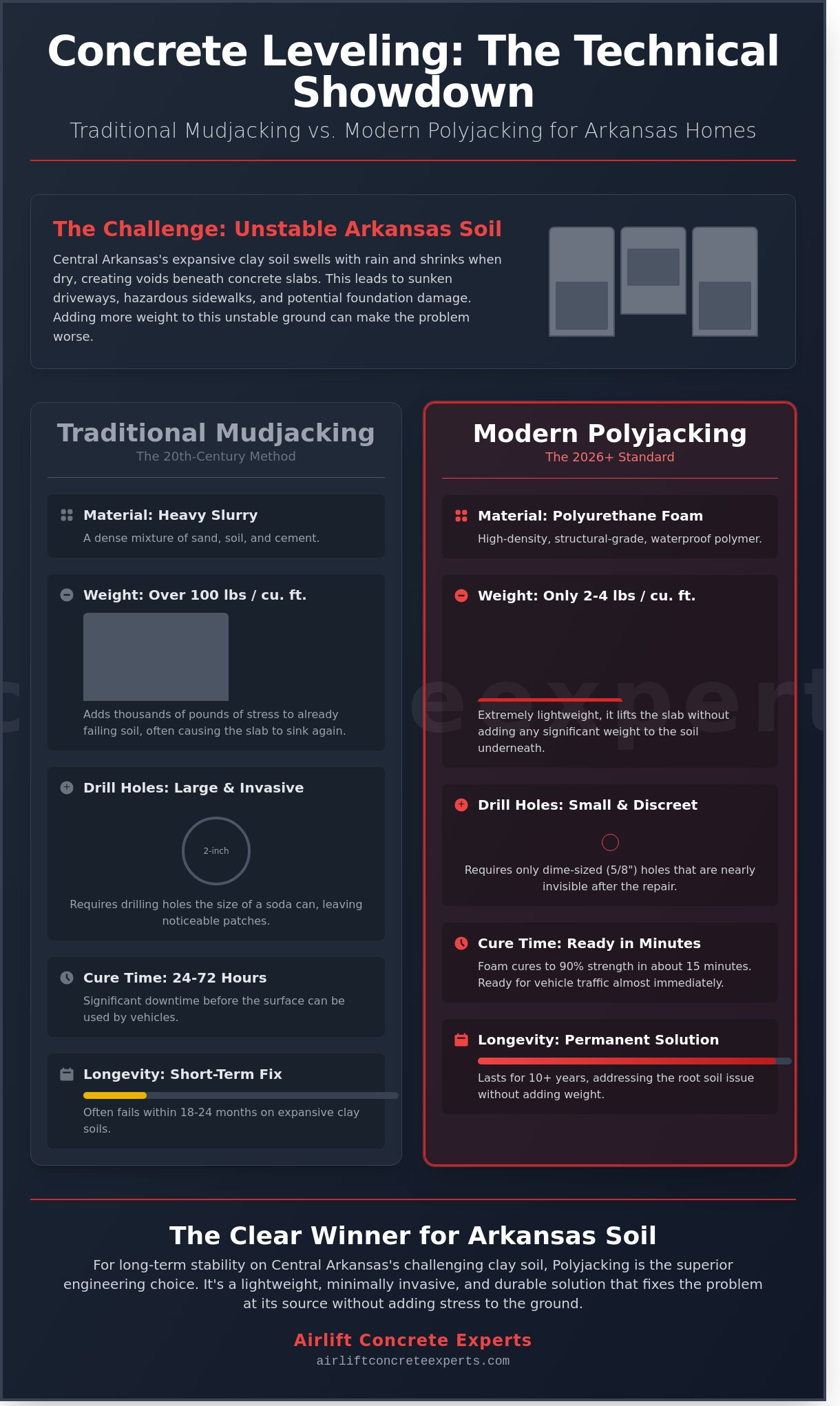
Choosing between traditional methods and modern technology is the first step toward a permanent fix for your home. In Central Arkansas, where the clay-heavy soils of Cabot and Conway frequently shift, the weight of your repair material is a critical factor. Traditional concrete leveling mudjacking involves pumping a heavy mixture of sand, cement, and soil under the slab. This “mud” can weigh over 100 pounds per cubic foot. Adding that much mass to already unstable ground often causes the concrete to sink again within 18 to 24 months because the underlying soil simply can’t support the new load.
Polyjacking uses high-density polyurethane foam that weighs only 2 to 4 pounds per cubic foot. It provides the same lifting power without the risk of further soil collapse. This technical difference is why many Malvern homeowners are moving away from older slurry methods in 2026. The materials you put under your home should solve the problem, not add to the weight that caused the sinking in the first place.
Older contractors still rely on the slurry injection method. This process requires drilling 2-inch holes through your concrete, which are roughly the size of a soda can. It’s a high-pressure, messy operation that often results in slurry “blowouts” at the edges of the slab. Cleanup is labor-intensive and rarely perfect. Because the material is thick and heavy, it doesn’t always fill every pocket of air. This leaves hidden voids that can lead to future cracking. You’ll also need to wait 24 to 72 hours before driving a vehicle onto a mudjacked surface, which is a significant inconvenience for busy families.
Polyjacking represents the modern evolution of the trade. Instead of heavy mud, we use slab jacking foam. This material expands as a liquid, reaching every corner of the void before it hardens into a rigid, lightweight structure. It’s a waterproof solution, which is vital during the rainy seasons we experience across the state. While traditional concrete leveling mudjacking can wash away over time, polyurethane remains stable and won’t degrade in the dirt.
If you’re noticing uneven walkways or a sinking garage floor, you can request a free inspection from our local team to see how these technical differences apply to your specific property.
Homeowners in Malvern often weigh the initial price tag against the actual lifespan of a repair. While traditional concrete leveling mudjacking has served the industry for decades, the technology hasn’t evolved to meet the specific demands of our local environment. Choosing the cheaper upfront option often leads to a second repair bill just a few years down the road.
The primary issue involves cost versus long-term value. Mudjacking uses a heavy slurry of sand, cement, and soil. In Central Arkansas, where humidity levels often exceed 70% and summer temperatures regularly climb above 95 degrees, this heavy material struggles. The soil beneath Malvern homes shifts frequently due to high clay content. Adding 100 pounds of slurry per cubic foot often accelerates settlement by overtaxing the already weak subgrade. Polyjacking uses a lightweight foam that weighs only 2 to 5 pounds per cubic foot, providing a permanent lift without the added bulk.
Aesthetics and environmental safety also set these methods apart. Mudjacking requires 2-inch holes drilled throughout your slab. These look like large, noticeable patches even after they’re filled. Polyjacking uses 5/8-inch holes, which are roughly the size of a penny and blend seamlessly into the concrete texture. Additionally, our polyurethane foam is an inert, non-toxic material. It won’t leach chemicals into your lawn or the local water table, unlike slurry which can wash out and contribute to sediment runoff during heavy Arkansas rainstorms.
The “washout” problem is the most significant factor for Malvern residents. Because mudjacking slurry is comprised of organic materials, it remains susceptible to erosion. When groundwater moves beneath your slab, it can carry the slurry away, leaving you with the same sunken concrete you started with. Airlift Concrete Experts chooses polyjacking for every project because the foam is waterproof. It won’t move, rot, or wash out, regardless of how much rain falls in a season.
You might still see mudjacking used in rare industrial applications where aesthetics don’t matter and the budget is extremely tight. However, for residential properties, it’s rarely the right call. Polyjacking is the undisputed gold standard for pool decks, patios, and interior floors because it’s clean, fast, and permanent. It’s the only solution we trust to stabilize a home’s value. You can find a deep dive into the specialized foam process in our polyurethane concrete leveling pillar.
Determining if your slabs are eligible for concrete leveling mudjacking begins with a simple visual assessment of structural integrity. We generally look for the “point of no return,” which occurs when a slab has shattered into too many small pieces to be lifted as a single unit. If your driveway or patio is broken into a jigsaw puzzle of fragments, replacement is likely your only option. However, if the concrete is mostly intact but has sunken or tilted, it’s an ideal candidate for our specialized polyjacking process.
Little Rock homeowners often face unique challenges due to the region’s expansive clay soils. These soils swell when wet and shrink during our hot Arkansas summers, leaving voids that cause heavy slabs to settle. In Hot Springs Village, the hilly terrain and varied elevations frequently lead to soil erosion under walkways and porches. If you notice a gap between your concrete and the threshold of your home, it’s time to act before the problem migrates to your foundation.
For business owners, the decision is often driven by safety and liability. According to the Americans with Disabilities Act (ADA), any vertical displacement of 0.25 inches or more in a walkway is considered a trip hazard. These small lips are easy to ignore until a customer trips, leading to costly legal complications. We help you identify these risks during our initial walkthrough to ensure your property remains compliant and safe for all visitors.
Our commitment to a free inspection ensures you don’t have to guess about the state of your property. We provide a professional assessment to determine if the soil beneath your slab is stable enough for a permanent repair. This honest evaluation prevents you from spending money on a temporary fix when a more robust solution is required.
We frequently resolve driveway settlement in newer Benton and Bryant subdivisions where soil compaction wasn’t sufficient during initial construction. In the North Little Rock and Sherwood business districts, high-traffic sidewalks often develop uneven joints that collect water and ice. Lakeside properties in Hot Springs present another common issue; water runoff from the lake often washes away the supporting base beneath pool decks, creating dangerous voids that we can fill with precision.
Small cracks never stay small in the Arkansas climate. Rainwater enters these openings and further softens the subgrade, which accelerates the sinking process. Proactive repairs are significantly more affordable than reactive ones. Choosing to level your concrete now typically saves you 50% to 70% compared to the total cost of a full tear-out and replacement. Concrete leveling in Malvern is a preventative measure against structural failure. By stabilizing the soil now, you protect the long-term value of your home.
Ready to secure your property’s foundation? Schedule your free inspection with Airlift Concrete Experts today and get a professional evaluation of your concrete slabs.
Arkansas soil doesn’t play fair. Between the heavy rains and the expansive clay found throughout Malvern, concrete slabs often shift or sink within just a few years of construction. We take a no-nonsense approach to these repairs. Our team doesn’t just patch the surface; we address the soil instability beneath the slab. Being a family-owned business based right here in Malvern means we understand the local geography better than national franchises. We use specialized equipment designed to handle the specific density of Arkansas soil, ensuring that your repair is permanent and reliable.
Our commitment to transparency means you get clear answers about your foundation. We’ve seen how the fluctuating water table in Central Arkansas impacts structural integrity. By choosing a local specialist, you’re opting for a team that has successfully leveled hundreds of driveways and foundations across the region. We don’t rely on guesswork. We use data-driven methods to ensure your concrete stays level for the long haul.
Whether you’re managing a 50,000-square-foot commercial warehouse or a residential patio in Malvern, we provide the same level of technical precision. While traditional concrete leveling mudjacking was the standard for decades, we’ve evolved our methods to include high-density polyjacking. This modern process is significantly cleaner and requires smaller injection holes, usually only 5/8 of an inch in diameter. We treat every home like it belongs to our own neighbor because, in many cases, it does. Our goal is to leave your property in better condition than we found it, with zero mess and a level surface that restores your property’s value.
Our process is designed to be as stress-free as possible. It starts with a simple phone call to our Malvern office. One of our experts will visit your property to evaluate the damage and provide a clear, written estimate. We service a wide range of areas across Central Arkansas, including Jacksonville and Cabot, bringing our specialized equipment directly to your doorstep. You won’t face any high-pressure sales tactics here. We provide the facts, explain the science of soil settlement, and let you make the decision that’s best for your home. Schedule your free concrete leveling inspection today!
Choosing between concrete leveling mudjacking and modern polyjacking depends on your specific soil conditions and the long-term goals for your Malvern property. While traditional mudjacking remains a known method, our 2026 comparison highlights that specialized polyurethane injection offers a lighter, more durable fix that won’t wash away. Airlift Concrete Experts has spent over 7 years perfecting these techniques to ensure your driveway or foundation stays level despite the region’s unique clay shifts. You don’t have to guess about the safety of your walkways or patio anymore. Our team provides the technical expertise needed to restore your home’s value without the stress and mess of a full concrete replacement. We prioritize transparency and neighborly service, which is why every project begins with a thorough, no-pressure assessment of your specific structural needs. Take the first step toward a permanent solution today by partnering with a local specialist who understands Arkansas soil.
Get Your Free Concrete Leveling Inspection in Central Arkansas
We’re ready to help you regain peace of mind and protect your home for the future.
No, mudjacking and polyurethane leveling are different methods used for concrete leveling mudjacking projects. Mudjacking involves injecting a heavy slurry of sand, soil, and cement through holes the size of a soda can. Polyjacking uses a high-density, lightweight resin injected through holes smaller than a penny. This foam expands to fill the entire void, while the heavy mudjacking slurry often adds 100 pounds per cubic foot of extra weight to the soil.
Mudjacking typically has a lower initial price point, often costing 25% to 50% less than polyurethane injection according to industry data from HomeAdvisor. However, the long-term value of polyjacking is often higher for Malvern homeowners. Because mudjacking slurry is heavy and prone to erosion, it often fails within 2 to 5 years. Polyjacking is a permanent solution that doesn’t wash away, which saves you the cost of repeating the repair later.
You cannot drive on a surface immediately after mudjacking because the cement-based mixture requires significant time to cure. Most contractors recommend waiting 24 to 72 hours before parking a 4,000-pound vehicle on the slab. If you’re looking for a faster turnaround, polyjacking is the better option. The polyurethane foam cures in about 15 minutes, allowing you to use your driveway or garage floor the same day the work is finished.
If the soil shifts or settles further, the concrete slab will likely sink again because mudjacking doesn’t address the underlying soil stability. The heavy weight of the slurry can actually accelerate settlement by compressing the weak Arkansas clay beneath it. We provide a free inspection to determine if your soil can handle the weight of a repair. If the soil is unstable, we use lightweight foam to prevent further sinking.
Yes, mudjacking requires drilling holes that are approximately 2 inches in diameter, which leaves noticeable circular patches on your concrete. These large patches are difficult to hide and can detract from your home’s curb appeal. Polyjacking is much less invasive because it uses 5/8-inch injection ports. Once we’ve finished the job, these tiny holes are patched and blended, making them nearly invisible to the naked eye after a few weeks of weathering.
Concrete leveling mudjacking is considered a long-term fix, but its permanence depends on the material used for the lift. Traditional mudjacking uses organic materials that can decompose or wash away during heavy Central Arkansas rainstorms. Polyjacking is a permanent solution because the polyurethane material is waterproof and inert. It won’t react with the soil or break down over time, ensuring your patio remains level and safe for decades to come.
Airlift Concrete Experts doesn’t offer traditional mudjacking services in Little Rock or the surrounding areas. We’ve chosen to specialize exclusively in polyjacking because it’s the most reliable and advanced technology for our local soil conditions. Our team focuses on providing high-quality results that stand the test of time. By using modern resins instead of heavy mud, we give our neighbors a cleaner, more durable repair that doesn’t damage their property.
You can level concrete year-round in Arkansas as long as the ground isn’t frozen, but the dry months are often the most convenient. Most projects in Malvern are scheduled between March and November to avoid the heaviest winter rains. While mudjacking is difficult to perform in wet conditions, polyjacking is highly resistant to moisture. This means we can provide a stable, professional repair even during the humid spring months when other methods might fail.

 Call Now