
Tearing out a settled warehouse floor in 2026 isn’t just expensive; it’s an unnecessary $8,000 gamble that could halt your entire production line for weeks. You already know that even a minor shift in our local red clay can turn a level facility into a series of OSHA trip hazards and forklift-damaging joints. When you need industrial concrete lifting Benton facility managers can trust, you shouldn’t have to worry about the $0.12 per square foot commercial permit fees or the logistics of full slab replacement. You need a solution that stabilizes your heavy machinery without the mess or the wait of new construction.
This article explains how high-density polyjacking restores maximum load-bearing capacity with zero operational downtime. You’ll discover how this moisture-resistant polyurethane foam creates a permanent bond beneath your slab, even in Arkansas’s challenging freeze-thaw cycles. We will walk through the technical process of soil stabilization and show you how to maintain a level, safe floor that meets all City of Benton building codes and industrial tolerances.
Industrial concrete lifting is a specialized engineering process that involves injecting high-density polyurethane foam beneath heavy-duty slabs to restore their original elevation and structural integrity. Unlike residential repairs, this requires a deep understanding of the extreme weight loads found in manufacturing and logistics hubs. In our local community, industrial concrete lifting Benton services have become essential as the I-30 corridor continues to expand. This high-traffic artery brings heavy freight and industrial activity that puts immense pressure on foundations that were often built on unstable ground decades ago.
The primary culprit behind slab failure in Saline County is Arkansas red clay. This soil is notorious for its high plasticity; it expands significantly when wet and shrinks during our hot, dry summers. This constant movement creates massive voids beneath concrete floors. When a 20,000-pound forklift travels over a slab with a void underneath, the concrete eventually cracks or sinks. Concrete leveling through polyjacking addresses this root cause by filling the void and compacting the soil. This creates a stable base that resists the seasonal shifts of our regional geography.
Arkansas weather isn’t kind to large-scale warehouse foundations. Rapid temperature swings and heavy rainfall penetrate the perimeter of industrial buildings, saturating the clay and weakening the subgrade. In many of Benton’s newer industrial developments, soil compaction wasn’t always handled with long-term stability in mind. Facility managers often try to “grind down” high spots to fix trip hazards. This is a mistake. Grinding only thins the slab and ignores the structural void beneath it. It’s a temporary cosmetic fix that often leads to a total slab collapse later because the underlying soil remains unstable.
Neglecting sunken floors creates a liability nightmare for local plant managers. OSHA requires walking and working surfaces to be free of recognized hazards, which includes uneven floor joints or holes. An uneven joint as small as 1/4 inch can cause a forklift to tip or spill its load, leading to worker compensation claims or expensive machinery repairs. Modern Benton facilities also rely on automated racking and conveyor systems. These machines require precision leveling to function. If your floor isn’t perfectly flat, your high-tech automation will suffer from constant mechanical failure and operational downtime. Using industrial concrete lifting Benton solutions ensures your facility stays compliant and your equipment stays in peak condition.
In a high-output environment, every minute of halted production translates to lost revenue. Traditional repair methods often require days or even weeks of curing time, but modern industrial concrete lifting Benton facilities utilize polyjacking to eliminate these delays. This process is engineered for speed and precision, allowing heavy machinery and forklift traffic to resume within 15 to 30 minutes of the final injection. Our specialized approach follows a strict 5-step industrial protocol designed to keep your operations moving.
The success of polyjacking lies in the expansive force of the polyurethane foam. As the two-part liquid combines, it creates a powerful reaction that can lift multi-ton slabs with ease. This material is hydrophobic, meaning it repels water and will not wash away during Central Arkansas’s heavy spring rains. Industrial-grade polyurethane foam provides a compressive strength of up to 100 psi, which far exceeds the load-bearing capacity of typical loose or saturated subgrade soils. This ensures that once the floor is lifted, it remains stable under the weight of heavy racking and 10,000-pound forklifts.
We understand that Benton manufacturing plants often run 24/7. To accommodate these schedules, we offer night-shift and weekend appointments to ensure your peak hours remain uninterrupted. Because our equipment is self-contained and the process is dust-free, it is perfectly suitable for clean-room environments and food-grade facilities. If you’re noticing uneven joints, a free inspection from a local specialist can help you identify the problem before it requires a total shutdown. Our goal is to provide a permanent fix that respects your production timeline and your bottom line.
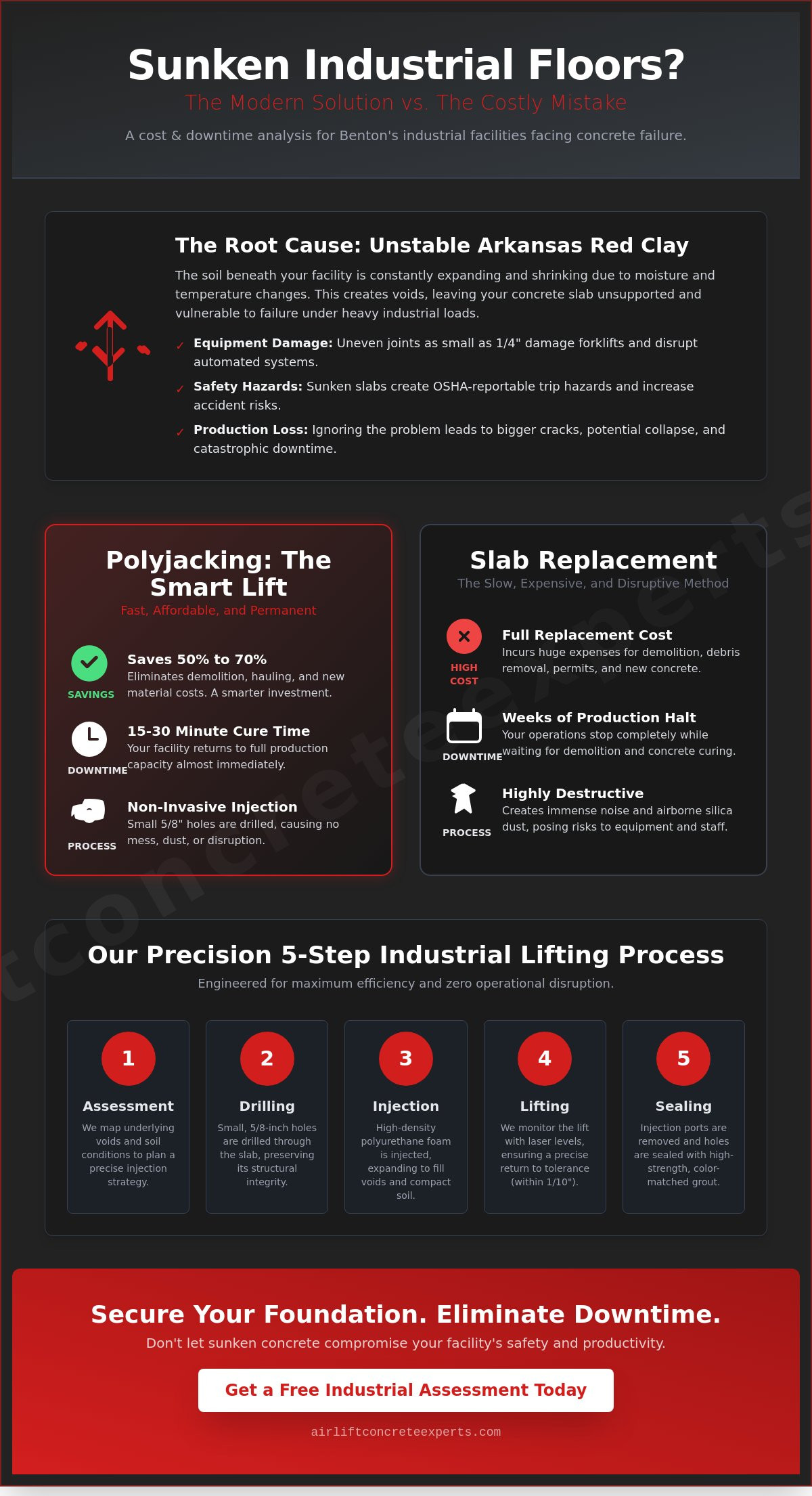
For most facility managers, the decision to repair or replace a slab comes down to the bottom line. Full concrete replacement is a massive undertaking that often costs 50% to 70% more than industrial concrete lifting Benton specialists provide through polyjacking. While the upfront price of new concrete is high, the “hidden costs” of demolition are what truly drain a budget. You have to account for the noise of jackhammers, the pervasive concrete dust that can contaminate inventory, and the specialized disposal fees for hauling away tons of debris. Most importantly, new concrete requires a 28-day cure time to reach full structural strength, which is a luxury many high-volume facilities simply cannot afford.
Choosing polyjacking is also a more sustainable choice for our local environment. By preserving your existing slabs, you keep usable material out of Saline County landfills. Polyurethane is a permanent solution for void filling because it does not wash away or degrade over time. If you address the signs of concrete failure early, you can stabilize your facility for decades without the waste and disruption of a total rebuild.
Downtime is the silent killer of profitability in the I-30 industrial corridor. If a loading dock is out of commission for a 7-day pour and cure cycle, the ripple effect through your supply chain can cost thousands in delayed shipments and labor inefficiencies. You don’t just lose the use of the floor; you lose the productivity of every employee and machine tied to that zone. For a 10,000 sq. ft. warehouse, the immediate return on investment for polyjacking is realized by avoiding the cumulative costs of a 28-day production halt and the associated structural debris removal fees. Most projects we handle allow businesses to stay 100% operational in adjacent zones while we work.
Traditional mudjacking uses a heavy slurry of sand and cement to lift slabs. In Arkansas’s soft red clay, adding this extra weight is counterproductive because it often causes the soil to sink even further under the new load. Polyjacking material is incredibly lightweight, weighing only about 3 to 5 pounds per cubic foot, yet it maintains a high compressive strength. This material is also inert, meaning it resists the oils, chemicals, and industrial solvents common in Benton manufacturing plants. Professional polyurethane repairs often come with multi-year warranties and a life expectancy that matches or exceeds the original concrete slab itself.
Early detection of slab settlement can mean the difference between a simple morning repair and a multi-week operational shutdown. In Benton’s industrial corridor, the most common warning sign is “joint chatter.” This is the rhythmic, metallic thud you hear when a forklift crosses a transition between two slabs. If the wheels are hitting the edge of the concrete rather than rolling smoothly over it, your floor has already shifted. You might also notice visible gaps appearing under the base of your warehouse racking or new cracks spidering out from the corners of your bay doors. These aren’t just cosmetic issues; they’re clear indicators that you need industrial concrete lifting Benton specialists to stabilize the subgrade.
One of the most dangerous conditions is “Rocking Slab” syndrome. This occurs when a void has formed beneath the concrete, but the slab hasn’t fully collapsed yet. Every time a heavy load passes over, the concrete physically deflects into the empty space. This movement acts like a pump, forcing air and moisture out of the joints and further eroding the soil. If left unaddressed, this repeated stress will eventually snap the slab, leading to major structural failure and potential injury to your floor personnel.
You don’t need expensive sensors to perform a preliminary check on your facility’s health. Start with a simple level check using a 4-foot straight edge across your production lines. If you see daylight under the level, your floor is sloping. Another effective method is observing dust patterns. A fine, white powder accumulating near floor joints often indicates that the slabs are rubbing together due to sub-slab void formation. Finally, conduct a “tap test” by striking the concrete with a heavy steel rod. A hollow, echoing sound is a definitive sign that the Arkansas clay has settled away from the concrete, leaving the slab unsupported.
Benton’s heavy rainfall, which often exceeds 50 inches annually, plays a major role in industrial slab failure. When gutters or downspouts fail to direct water away from the building, the runoff saturates the soil near bay doors and loading docks. This leads to “soft spots” in the perimeter soil where the earth becomes too weak to support the weight of the building. For a broader perspective on how these issues affect our region, you can read our guide on Expert Concrete Lifting in Malvern & Little Rock. If you spot perimeter erosion or standing water near your foundation, it is time to schedule a free structural evaluation with a local expert. Catching these drainage issues early prevents the need for more extensive industrial concrete lifting Benton projects in the future.
Airlift Concrete Experts is more than just a repair company; we’re a dedicated partner in the long-term stability of Benton’s industrial infrastructure. Our “Arkansas-grown” identity means we’ve spent years studying the specific behaviors of the soil in Saline County. We don’t just patch surface symptoms. We provide engineered solutions for industrial concrete lifting Benton plant managers rely on to keep their facilities safe and operational. Our team has a proven track record of stabilizing heavy-load environments, from high-traffic loading docks along the I-30 corridor to sprawling manufacturing floors that house multi-ton machinery.
To handle the extreme demands of an industrial site, we utilize specialized, high-volume equipment. Standard residential pumps often lack the pressure and material flow required to lift massive, reinforced slabs effectively. Our systems are designed specifically for high-pressure industrial injections, ensuring that the polyurethane foam reaches every corner of the sub-slab void to create a uniform, load-bearing base. This technical capability is backed by the Airlift Guarantee, which promises total transparency in our process and a commitment to the structural integrity of your facility. We treat your production floor with the same care we would a neighbor’s home, but with the technical rigor an industrial environment demands.
Understanding Central Arkansas geology is critical to a successful repair. The red clay found throughout our region is highly reactive to moisture changes, and a company without local roots might not realize how a wet spring can compromise a poorly compacted subgrade. We’ve developed customized injection plans that account for these local conditions and the specific load requirements of your plant. Our references include Benton-area facility managers who have seen firsthand how our soil stabilization prevents the recurring settlement issues common with less specialized alternatives. We know what it takes to make a repair last in this specific environment.
A professional, no-obligation structural inspection is the first step toward securing your facility and protecting your fleet of forklifts. During your free Benton industrial site assessment, our experts use precision diagnostic tools to map voids and identify the root cause of your slab’s failure. We provide a clear, detailed plan that outlines the exact steps needed to restore your floor to its original tolerances without interrupting your workflow. If you’re ready to stabilize your warehouse or plant, you can find our local service details at Polyjacking Near Me to book your inspection. We offer the honest, expert service that only a local specialist can provide.
Protecting your facility’s structural integrity shouldn’t be a source of stress. By choosing polyjacking, you avoid the 28-day cure times of new concrete and the heavy costs associated with demolition. We’ve shown that stabilizing Central Arkansas’s reactive red clay requires more than just a surface repair; it requires high-density technology that can support multi-ton loads without further sinking.
Since 2017, Airlift Concrete Experts has operated with deep Arkansas roots and a commitment to our neighbors. We provide the specialized industrial concrete lifting Benton managers need to keep their production lines moving and their workers safe. Our team possesses the technical expertise to handle both heavy-duty industrial slabs and residential projects with the same level of precision and transparency.
Don’t wait for a minor trip hazard to become a major liability. Schedule Your Free Industrial Concrete Inspection in Benton today to see how our permanent solutions can restore your floor’s stability. We’re ready to help you secure your foundation for the long term and provide the peace of mind you deserve.
Industrial polyurethane foam can support loads exceeding 10,000 pounds per square foot once fully cured. This high-density material is specifically engineered to handle the concentrated weight of heavy racking systems and loaded forklifts found in Saline County facilities. Because the foam expands to fill every microscopic void, it creates a uniform support structure that prevents future point-load failures under your heaviest machinery.
Industrial concrete lifting Benton projects are designed to occur while your facility remains active. We typically work in sections, meaning you only need to clear the specific area being lifted rather than shutting down the entire warehouse. Since the material reaches 90% of its full strength within 15 minutes, your team can drive heavy machinery over the repaired area almost immediately after we finish our work.
Yes, polyjacking is considered a permanent solution because the polyurethane material is chemically inert and does not biodegrade. Unlike traditional mudjacking slurry, which can wash away during Central Arkansas’s heavy rain cycles, this foam repels water and maintains its volume indefinitely. It effectively stabilizes the underlying soil to prevent the recurring settlement issues common in our local red clay.
You should consider replacement only if the concrete is severely crumbled or has lost its structural integrity through extensive spider-web cracking. If the slab is mostly intact but has simply tilted or sunk, industrial concrete lifting Benton specialists can usually restore it to its original position. A professional inspection can determine if the internal rebar is still providing the necessary tension for a successful lift.
Polyjacking is exceptionally effective for large voids under loading docks because the foam expands up to 20 times its initial liquid volume. This expansive force allows it to reach deep into washouts caused by poor drainage or I-30 traffic vibrations. It fills the entire cavity and compacts the surrounding soil to create a dense, stable foundation that supports heavy freight trailers without further shifting.
Industrial-grade foam typically reaches a full cure in under 30 minutes, regardless of Arkansas’s high humidity levels. Because the chemical reaction is exothermic and the material is hydrophobic, moisture in the air or soil doesn’t interfere with the hardening process. This is a significant advantage over concrete pours, which can take much longer to set when the humidity exceeds 60%.
We proudly serve Benton’s entire business community, ranging from large-scale manufacturing plants to small local retail shops and storefronts. Whether you have a single sunken sidewalk at a main entrance or a 50,000-square-foot warehouse floor, we apply the same professional standards and high-density materials. Our goal is to provide every local business owner with a safe, level surface that protects their investment and their customers.
OSHA 1910.22 requires that all walking and working surfaces be maintained in a clean, safe, and orderly condition. Most safety inspectors identify any vertical displacement of 1/4 inch or more as a significant trip hazard that requires immediate remediation. Maintaining level floors is essential for staying compliant and avoiding the fines associated with preventable workplace injuries in industrial environments.

 Call Now