

Many homeowners don’t realize that their gutter system plays a critical role in protecting their home’s foundation. Gutters do much more than keep rain from pouring off your roof—they are designed to control where water goes after it leaves your home.
When gutters and downspouts work properly, they collect rainwater and direct it safely away from your house. But when gutters clog, overflow, or drain too close to the foundation, water can begin to pool around the base of your home.
Over time, this excess moisture can weaken the soil supporting your foundation, leading to cracks, sinking concrete, and structural movement.
In areas like Alabama that experience heavy rainstorms throughout the year, poor gutter drainage is one of the most common causes of foundation problems.
A properly functioning gutter system is designed to manage rainwater in three simple steps:
When this system works correctly, rainwater flows away from your home and the soil around your foundation remains stable.
However, when gutters fail, water often ends up exactly where it should never be—right next to your foundation.
Poor gutter drainage allows large amounts of water to soak into the soil surrounding your home. Over time, this creates several problems that can damage your foundation and surrounding concrete.
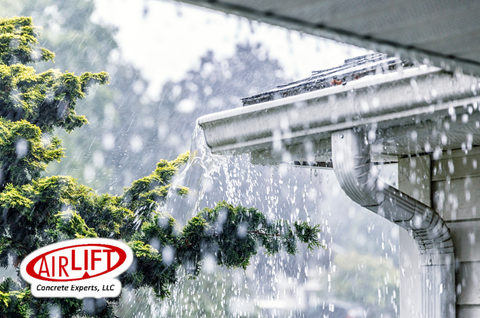
Clogged or overflowing gutters can dump water directly beside your home during heavy rain. This leads to water pooling around the foundation, which keeps the soil constantly saturated.
When soil becomes too wet, it loses the strength needed to support the weight of your home and surrounding concrete slabs.
If downspouts release water only a few inches from your foundation, rainwater can quickly seep into the soil around your home.
Experts typically recommend extending downspouts at least 5–10 feet away from the foundation to prevent water buildup.
Without proper drainage extensions, the same area of soil becomes repeatedly saturated during storms.
When water collects in the soil around your home, it can create hydrostatic pressure against foundation walls.
This pressure can lead to:
The longer water remains around the foundation, the greater the pressure becomes.
Poor gutter drainage can also wash away soil supporting nearby concrete surfaces such as:
When supporting soil erodes, voids form beneath the concrete, causing slabs to sink, crack, or become uneven.
This type of damage is very common when water repeatedly drains in the same area near the home.
Because drainage issues develop gradually, many homeowners don’t realize their gutters are causing damage until symptoms appear.
Common warning signs include:
If you notice several of these issues together, poor gutter drainage may be contributing to foundation movement.
To avoid water-related foundation damage:
The good news is that many drainage problems can be prevented with routine maintenance and proper water management.
Homeowners can protect their foundations by:
These simple steps help keep rainwater from accumulating around the foundation.
If drainage problems have already caused soil erosion beneath concrete slabs, the result is often sunken or uneven concrete surfaces around the home.
At Airlift Concrete Experts, we frequently repair concrete settlement caused by long-term water drainage issues.
Using advanced polyurethane foam injection, our team can lift and stabilize sunken concrete by filling the voids beneath it and restoring proper support.
The process is:
If poor gutter drainage has already caused your concrete to sink or become uneven, professional repair can restore the safety and appearance of your property.
At Airlift Concrete Experts, we specialize in lifting and leveling sunken concrete using high-density polyurethane foam, helping homeowners across Alabama repair damage caused by soil erosion and drainage problems.
Contact our team today to learn how we can stabilize your concrete and protect your property from further damage.
Don’t let bad gutters erode your home’s value.
📞 Contact Airlift Concrete Experts.
Yes. When gutters clog or overflow, rainwater can collect around the base of your home. Over time, this excess moisture weakens supporting soil and can lead to foundation cracks, shifting, or sinking concrete.
Most experts recommend extending downspouts at least 5 to 10 feet away from your home’s foundation. This helps prevent water from pooling near the house and causing soil erosion or foundation problems.
Yes. When water repeatedly drains next to your home, it can wash away the soil that supports nearby concrete slabs such as driveways, sidewalks, and patios. This can create voids beneath the concrete, leading to sinking or uneven surfaces.
Common warning signs include water pooling near the house after rain, cracks in foundation walls, uneven floors, sticking doors or windows, and sinking concrete around the home.

 Call Now